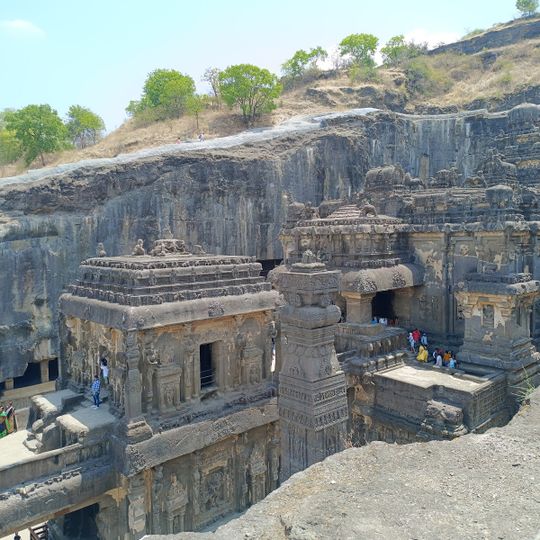
Ellora Caves, Rock-cut cave complex in Sambhajinagar district, India
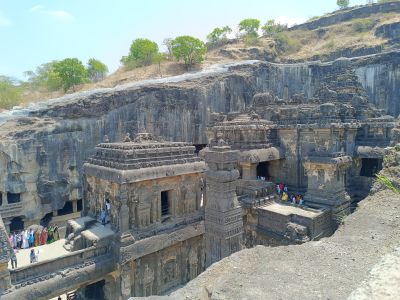
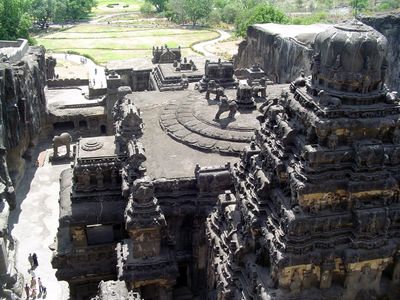
The Ellora Caves are a group of rock-cut temples and monasteries in Aurangabad district, India. In total, 34 structures extend across 2 kilometers (about 1.2 miles), all carved out from the natural basalt formations.
The caves were carved in three phases: a Buddhist period from about 600 to 730 CE, followed by Hindu and Jain work from about 730 to 950 CE. The Rashtrakuta dynasty (r. 753–982) built part of the Hindu and Buddhist caves, and the Yadava dynasty (c. 1187–1317) built several of the Jain caves. Royalty, traders and wealthy locals funded the work.
The name Ellora derives from the ancient Elloorpuram, also called Verul or Elura; the 812 AD Baroda inscription records the Kailasa temple as built at Elapura by Krishnaraja. Each cave carries a suffix such as Guha, Lena or Leni, meaning cave. The site lay on an ancient South Asian trade route, making it a commercial centre of the Deccan as well as a rest stop for pilgrims.
Walking through all the areas takes several hours, so it helps to start early in the day and bring comfortable shoes. Some paths between the caves are uneven or involve stairs, which makes moving around more tiring.
The Kailasa temple was hollowed out from top to bottom, with stonemasons removing roughly 200,000 tons of rock. This method meant that no mistake was allowed during the work, as nothing could be added or corrected.
The community of curious travelers
AroundUs brings together thousands of curated places, local tips, and hidden gems, enriched daily by 92,130 contributors worldwide.