Ujjayanta Palace, Royal palace in Agartala, India.
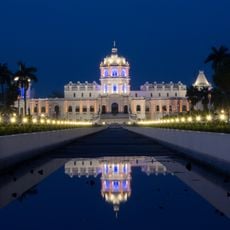
Ujjayanta Palace is a two-storey white Indo-Saracenic palace beside two artificial lakes in central Agartala, designed by Sir Alexander Martin of Martin and Burn Co. Its central block carries a ribbed dome 86 ft high on a colonnaded drum, flanked by smaller domed pavilions, with a pyramidal-roofed tower on the right. Inside are the throne room, durbar hall, library and reception hall.
The first Ujjayanta Palace was built in 1862 by King Ishan Chandra Manikya about 10 km from Agartala and was destroyed by the Assam earthquake of 12 June 1897. Maharaja Radha Kishore Manikya rebuilt it in central Agartala between 1899 and 1901 for 10 lakh rupees, to designs by Sir Alexander Martin of Martin and Burn Co. It remained the Manikya residence until Tripura merged with India in October 1949.
The name Ujjayanta was given by Rabindranath Tagore; in Tripuri the palace is called Nuyungma. Since 2013 it has housed the state museum, whose 22 galleries display the crafts and customs of Tripura's communities and northeast India, including 79 stone sculptures and 774 coins of the Manikya dynasty.
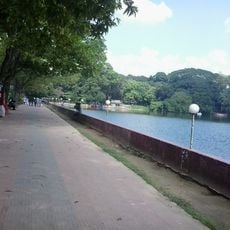
The museum occupies the two-storey palace in central Agartala, with 22 galleries spread across the throne room, durbar hall, library and reception hall. The compound covers about 1 km², with two artificial ponds flanking the garden, so allow time to walk between the wings and the adjacent Hindu temples. The building was seismically retrofitted before opening as a museum in 2013.
The palace's name was suggested by Rabindranath Tagore, who visited Tripura and gave the title Ujjayanta. The Tripuri name is Nuyungma. The museum holds 1,406 objects, including 774 coins of gold, silver and copper from the Manikya dynasty.
The community of curious travelers
AroundUs brings together thousands of curated places, local tips, and hidden gems, enriched daily by 92,672 contributors worldwide.