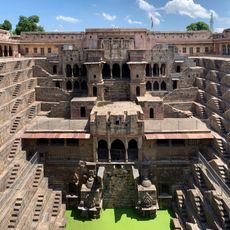
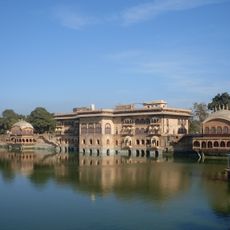
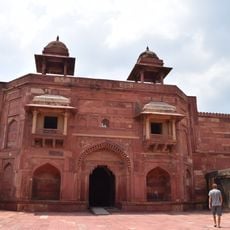
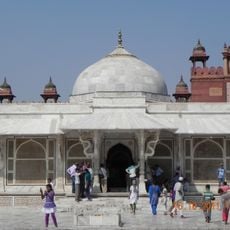
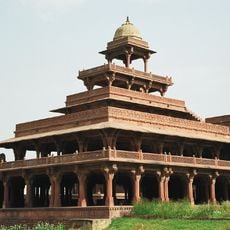
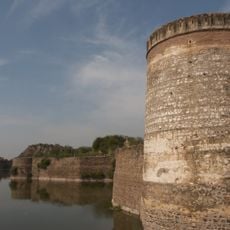
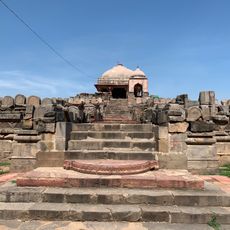
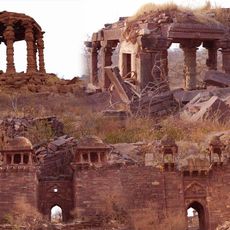
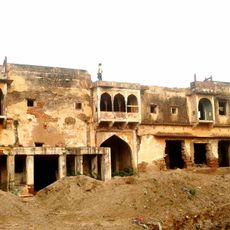
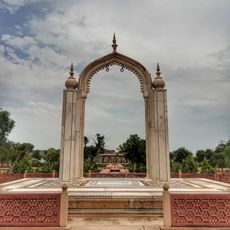
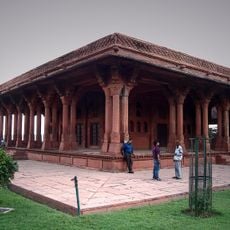
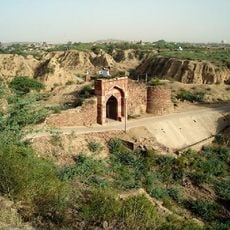
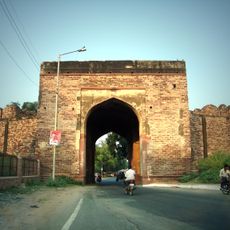
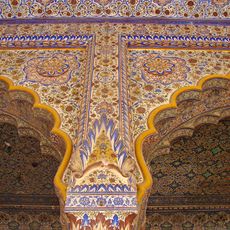
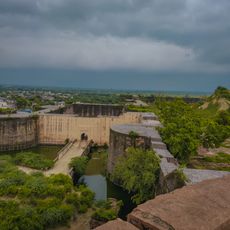
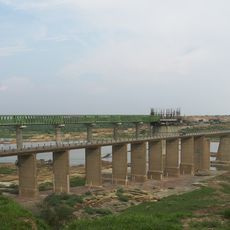
Bijai Garh, Ancient fort in Bayana, Bharatpur district, India.
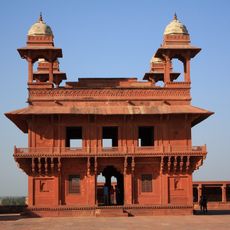
Bijai Garh is a hill fort on Damdama Hill, an extension of the Aravalli Range, built in reddish local stone. Its continuous perimeter wall follows the steep rocky slopes, and the south entrance is reached by a long stairway through a series of gateways. Inside are two small red-sandstone palaces with carved brackets, a ruined Bhagirath pavilion, cisterns, and the Bhimlat pillar on a cliff edge.
Bijai Pal, a Yaduvanshi Jadaun Rajput ruler, built the fort around 1040–1041 CE, as recorded in the 1043 CE Bayana inscription. In 1196 it surrendered to Muhammad of Ghor and became a Delhi Sultanate outpost; Sikandar Lodi took it in 1492, Humayun in 1535. Babur called it one of India's most famous forts, and the Ain-i-Akbari notes its many buildings, underground chambers and tall tower.
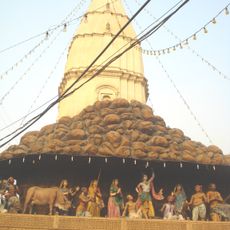
The fort contains both Hindu temples and Islamic structures side by side, showing how different faiths coexisted within the same space over time.
The fort sits on Damdama Hill, about 2 miles southwest of Bayana town and roughly 25 km from Hindaun. The south entrance is reached by a long stairway through a series of gateways, and the ground inside is uneven, with natural boulders and thorny vegetation. Wear sturdy shoes and carry water; the summit is exposed.
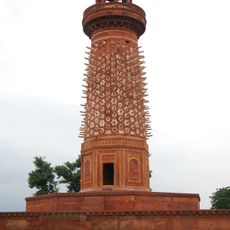
The Bhimlat pillar stands on a cliff edge inside the fort, not moved there from elsewhere. Its Sanskrit inscription in Gupta Brahmi dates to the 4th century CE, when the hill belonged to Vishnuvardhana, a feudatory of Samudragupta. It was likely a sacrificial pillar of long antiquity, later reused as a symbol of sacred geography.
The community of curious travelers
AroundUs brings together thousands of curated places, local tips, and hidden gems, enriched daily by 92,709 contributors worldwide.