British Residency, Hyderabad, British colonial mansion in Hyderabad, India
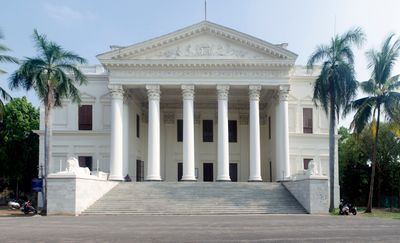
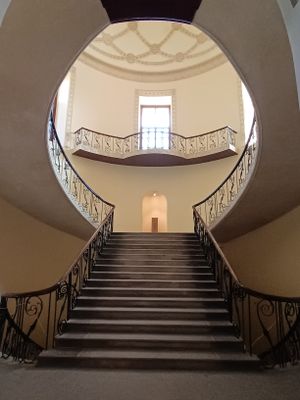
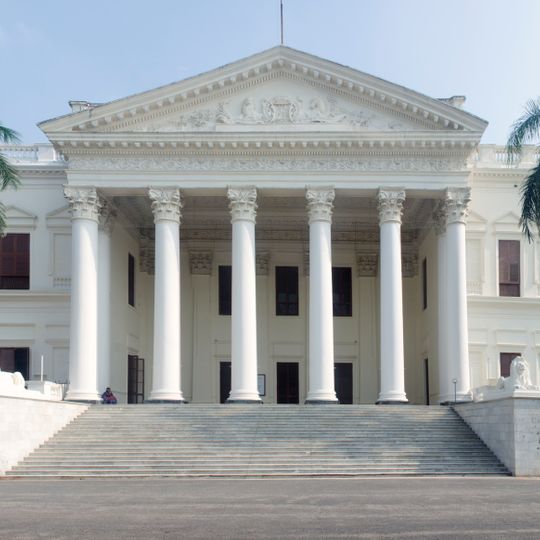
The British Residency in Hyderabad is a Palladian villa designed by Lieutenant Samuel Russell of the Madras Engineers, with construction begun in 1803. Its front is a classical portico of six Corinthian columns carrying a triangular pediment with a relief of a central crest flanked by figures, reached by a broad flight of steps; low balustraded walls run out from the stairs. Inside, a wide stone staircase with dark treads and black wrought-iron balustrades rises to a curved gallery landing lit by a tall window.
Built in 1803 during the British colonial period, it served as the official residence for British representatives in the Nizam State. It played a role in the region's political developments throughout the 1800s.
The building shows how European designs were brought into colonial India and represents British presence in the region. Visitors can observe how Western and local architectural traditions existed side by side here.
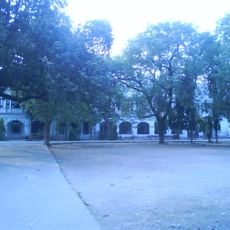
The Residency stands in Koti, beside the Osmania University College for Women campus, which now occupies the mansion. Visits to the building and its museum require prior online booking, so arrange a slot before travelling. The grounds hold the zenana quarters and a restored scale model of the mansion.
A scaled model of the mansion stands in the compound; legend holds that it was made so Kirkpatrick's wife Khair un Nissa, who observed purdah and stayed inside, could see the whole building including its front. The model has been restored.
The community of curious travelers
AroundUs brings together thousands of curated places, local tips, and hidden gems, enriched daily by 94,072 contributors worldwide.