Badshahi Ashurkhana, Religious monument near Charminar, Hyderabad, India
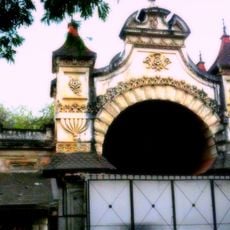
Badshahi Ashurkhana is a Shia Muslim mourning hall near Charminar in Hyderabad, built in 1594 under Muhammad Quli Qutb Shah and finished with coloured tile-mosaic in 1611 under Abdullah Qutb Shah. Its walls carry enamel tiles in hexagonal and floral patterns that kept their colour for four centuries. The complex includes the Niyaz Khana, Naqaar Khana, Sarai Khana, Abdar Khana, Langar Khana, Makan-e-Mujawer, Daftar-e-Mujawer, Alawa Chabutra and a guardroom.
Muhammad Quli Qutb Shah built the ashurkhana in 1594 to commemorate the martyrdom of Imam Hussain; its coloured tile-mosaic decoration was completed under Abdullah Qutb Shah in 1611. After the Mughal conquest of Hyderabad, Aurangzeb used the building as a stable for Mughal cavalry and destroyed part of it. Asaf Jah II restored the monument in 1764–65, adding a new entry gate, outer halls and wooden colonnades.
The ashurkhana is used during Muharram, the Shia mourning period for Imam Hussain, in whose memory it was built. Its hereditary custodian, the Mutawalli Mujawer Mir Nawazish Ali Moosvi, is the eleventh generation of his family to hold the role, sharing care of the monument with the state Department of Archaeology and Museums.
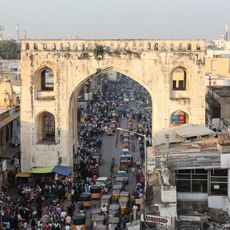
This site is located near Charminar and is easily accessible from various parts of the old city. Visitors should wear modest clothing and allow one to two hours to explore the different sections.
The original Persian enamel tiles from the early 17th century have retained their vibrant colors and detailed patterns over four centuries, making them rare examples of well-maintained ceramic craftsmanship. These tiles were created using techniques that are rarely practiced today.
The community of curious travelers
AroundUs brings together thousands of curated places, local tips, and hidden gems, enriched daily by 92,817 contributors worldwide.