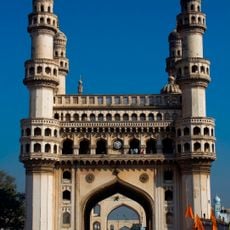
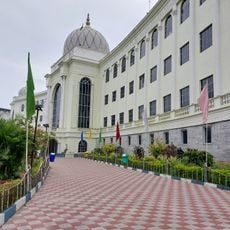
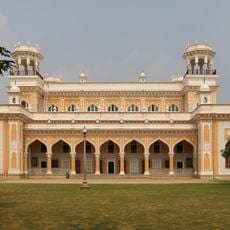
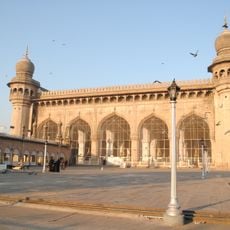
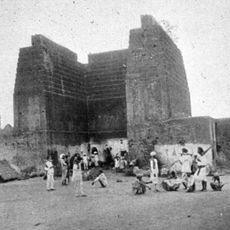
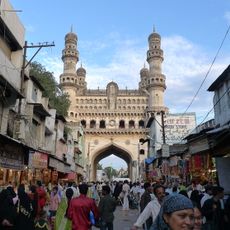
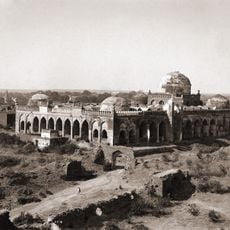
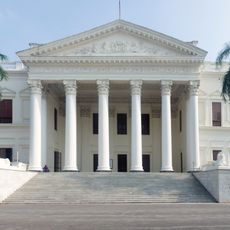
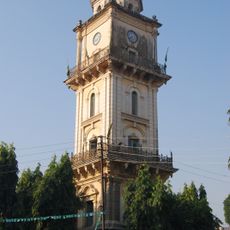
Char Kaman, Four monumental arches in Old City, Hyderabad, India
Char Kaman is a set of four Qutb Shahi arches completed in 1592, each about 60 feet tall, 36 feet wide at the base and six feet thick, standing roughly 375 feet from the centre of the square. The southern arch facing the Charminar is the Charminar Kaman; the northern is Machli Kaman, the eastern Kali Kaman and the western Kaman Sher-i-Batil. In the middle of the open square sits the octagonal Gulzar Houz cistern.
Sultan Muhammad Quli commissioned these four gates in 1592 to mark his newly founded capital of Hyderabad, symbolizing the shift of power from the older fortress of Golconda. The structure became the central reference point for the expanding city.
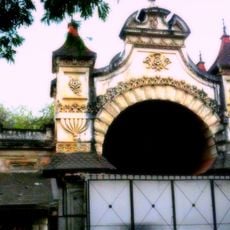
The northern arch is called Machli Kaman, "fish gateway", because a large fish made of bamboo and paper was suspended in its centre at every lunar new year as a symbol of prosperity. The eastern arch, Kali Kaman, was originally the Naqqar Khana, with an elevated chamber atop it for drummers and musicians.
The four arches stand about 375 feet from the centre of the piazza, so the Gulzar Houz cistern marks the middle of the walk between them. The southern arch faces the Charminar directly, making it the usual starting point when approaching from that monument. The western arch, once the entrance to the royal palaces, is the one to look for on the palace side.
The arches are large enough for an elephant carrying a canopy to pass through. Historian Ghulam Yazdani suggested this was deliberate: royal flagbearers mounted on elephants had to dismount or lower their banners at smaller gateways. The Machli Kaman, or "fish gateway", held a bamboo-and-paper fish suspended on every lunar new year.
The community of curious travelers
AroundUs brings together thousands of curated places, local tips, and hidden gems, enriched daily by 94,361 contributors worldwide.