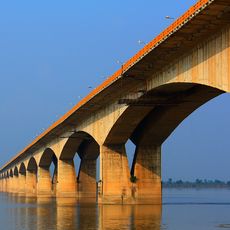
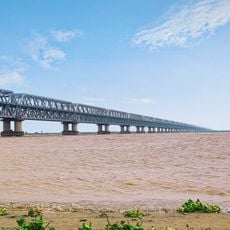
Koilwar Bridge, Railway and road bridge in Bhojpur, India
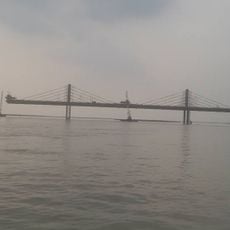
Koilwar Bridge is a combined railway and road crossing over the Sone River in Bhojpur district, Bihar, uniting two transport lanes across a span of 1.44 kilometers (0.89 miles). Trains and vehicles use the structure simultaneously, connecting the cities of Arrah and Patna across the wide riverbed.
Construction began in 1856 and finished in 1862, making the crossing the longest river bridge in India at that time. This position held until the opening of the Upper Sone Bridge in 1900.
The structure carries the name of Professor Abdul Bari, an early 20th-century scholar and reformer who worked for education in Bihar. His memory remains present in the region through this name.
The crossing lies on the railway line between New Delhi, Patna and Howrah and carries passenger and freight trains, while road traffic flows in parallel. Travelers can view it from a train window or drive across.
George Turnbull, Chief Engineer of the East Indian Railway Company, surveyed the site alone on 17 February 1851 and measured the river at 5,350 feet (1,630 m); the finished bridge spanned 5,280 feet (1,610 m). He chose ground near Pures, where old Hindu temples showed the channel had long been confined within fixed banks.
The community of curious travelers
AroundUs brings together thousands of curated places, local tips, and hidden gems, enriched daily by 93,924 contributors worldwide.