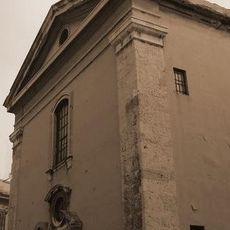
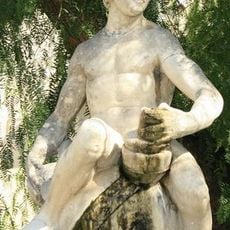
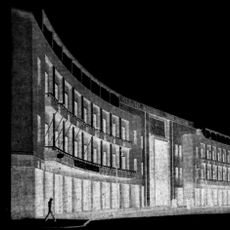
Santa Maria Alemanna, Gothic church in Messina, Italy.
Santa Maria Alemanna is a Gothic church in Messina defined by its three naves separated by pillars with half-columns throughout the interior. The building employs marble and limestone with grey-green veins, which gives the space its distinctive appearance.
In 1220, Frederick II granted the Teutonic Knights permission to construct this building as shelter for Crusaders crossing the Messina Strait. This role as a hospice and infirmary shaped the church's purpose across several centuries.
The name Santa Maria Alemanna comes from the Teutonic Knights, who dedicated the church to the German (Alemannic) community. After the order left around 1485, the Arciconfraternita dei Rossi, one of Messina's oldest confraternities, took over the church and its hospital. Since 2001 the building has hosted exhibitions, events and performances.
The church stands on Via Sant'Elia, set below street level after the 1908 earthquake. The west facade was rebuilt in glass after 1994 restorations, and the building reopened to the public in 2001. It now hosts exhibitions, events and performances, so entry depends on the scheduled programme.
The old hospital of the Teutonic Knights, run by the Arciconfraternita dei Rossi, took in Miguel de Cervantes in 1571 after the Battle of Lepanto; he later wrote Don Quixote (1605). Of that hospital only a small pointed arch and a wall fragment survive near the church's apses.
The community of curious travelers
AroundUs brings together thousands of curated places, local tips, and hidden gems, enriched daily by 93,230 contributors worldwide.