Palazzo Boyl, Neoclassical palace in Castello district, Cagliari, Italy.
Palazzo Boyl is a neoclassical palace in Cagliari's Castello district. Its marble balustrade carries four statues of the seasons, with the family coat of arms carved in the centre: a hand holding a tuft of hair (pilu) for the Pilo, a bull (boi) for the Boyl and the red bars of Aragon. The building incorporates the Torre del Leone, built by Giovanni Capula and often wrongly called Torre dell'Aquila.
Carlo Pilo Boyl, Marquis of Putifigari and artillery general, built the palace in 1840. He descended from Filippo Pilo Boyl, who in the 14th century helped the Aragonese defeat the Pisans and seize the city's fortress. The building later passed to the Rossi family, whose initial "R" is carved in some windows; the Marche counts Tomassini Barbarossa own it today.
The name Boyl comes from the Sardinian word boi, meaning ox, while Pilo comes from pilu, meaning a tuft of hair; both appear on the family coat of arms carved in the centre of the marble balustrade, together with the red bars of Aragon on a gold field. The four statues on the balustrade each represent a season.
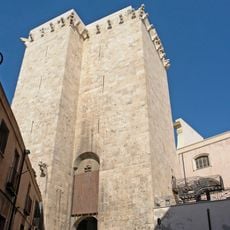
The palace stands in the Castello district, near the Bastione di San Remy. Its position on the hill makes it visible from several points in the old city. The incorporated Torre del Leone, damaged in 1708, 1717 and 1793, is best identified from the outside; the building is privately owned by the Tomassini Barbarossa counts.
The tower the palace absorbed is the Torre del Leone, often wrongly called Torre dell'Aquila. It was built by Giovanni Capula, the architect of Cagliari's other two towers, the Elephant and San Pancrazio. British bombardment in 1708, Spanish cannon fire in 1717 and the French attack of 1793 stripped away its upper part before it was folded into the palace.
The community of curious travelers
AroundUs brings together thousands of curated places, local tips, and hidden gems, enriched daily by 92,904 contributors worldwide.