Palazzo Solimena, Baroque palace in Naples, Italy
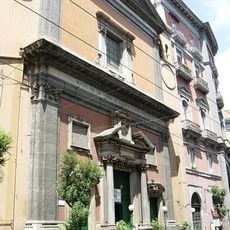
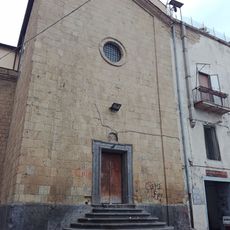
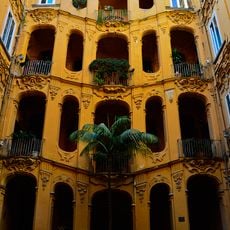
Palazzo Solimena stands on the San Potito hill beside Palazzo Caracciolo di Melissano and Palazzo Zona. Its facade has five bays over four floors including a mezzanine: a portal with a low broken pediment on rusticated pilasters, giant pilasters with floral capitals, and piperno-stone balconies. Inside, a courtyard with sail vaults leads to the former stables, with an octagonal staircase to the upper floors.
The palace existed in the 17th century as a group of palatial houses, bought in 1638 by Andrea De Riso and enlarged illegally. In 1710 the painter Francesco Solimena acquired it and rebuilt it to his own design, with engineer Giacomo Farina; Onofrio Giannone wrongly credited Giovan Battista Nauclerio. In 1717 Orazio Carafa blocked Solimena's planned expansion. Damaged in 1799, it was reworked in 1867 and 1889.
The palace takes its name from the painter Francesco Solimena, who bought it in 1710 and rebuilt it to his own design. The frescoes on the piano nobile date from the first half of the 19th century, not from Solimena's time. The octagonal staircase inside resembles those of Palazzo di Majo and Palazzo Palmarice, both by Ferdinando Sanfelice.
The easiest way to reach the palace is by Naples Metro Line 1, which has several stations throughout the historic district. The building sits in a neighborhood full of narrow streets, so wearing comfortable shoes and allowing time to explore the surrounding area is recommended.
The stables and the entrance portal were commissioned from the pipernieri Nicola Pagano and Tommaso Cortese, who worked the local volcanic stone. The portal has a low arched profile with a broken pediment carried on rusticated pilasters, and the balconies are decorated in piperno.
The community of curious travelers
AroundUs brings together thousands of curated places, local tips, and hidden gems, enriched daily by 94,394 contributors worldwide.