Tomb of Priscilla, Ancient Roman tomb on Via Appia Antica, Rome, Italy
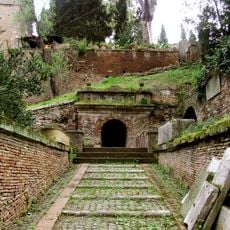
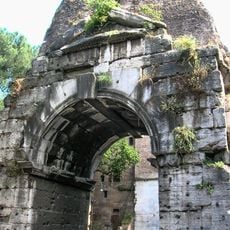
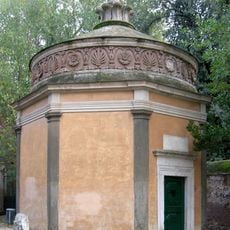
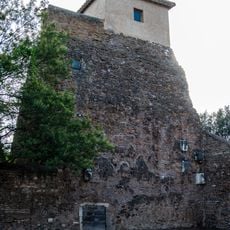
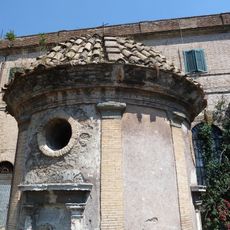
The Tomb of Priscilla is a first-century funerary monument on the Via Appia Antica, opposite the Church of Domine Quo Vadis. It stands on a quadrangular base of travertine blocks; two superimposed cylindrical drums of opus mixtum and opus reticulatum once rose above it, the upper one with 13 statue niches. The barrel-vaulted burial cell, entered by a corridor now reached from the basement of an adjacent house, held three sarcophagus niches.
The monument was built in the 1st century for Priscilla, wife of Titus Flavius Abascanto, a freedman who served under Emperor Domitian. During the Middle Ages it was transformed into a fortress held first by the counts of Tusculum and later by the Caetani family.
The tomb is identified through the fifth book of Statius's Silvae, which describes Priscilla's funeral: she was not cremated but embalmed on Abascanto's orders, wrapped in Tyrian purple and laid in a marble sarcophagus. A marble slab found near the mausoleum in 1773, dedicated to the slave Aphrodisius by the tomb keeper Epaphroditus, is now in Ferrara.
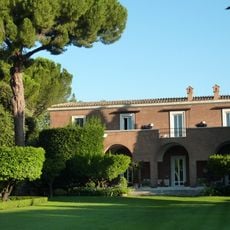
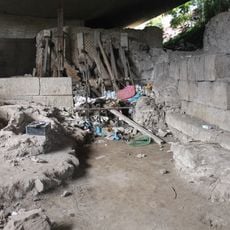
Access to the burial chamber runs through a corridor in the basement of an adjacent house along the ancient Appian Way. The underground passage requires care due to tight spaces and uneven flooring.
The tomb's identification rests on a passage in Statius's Silvae, Book V, which describes Priscilla's funeral and states she was embalmed rather than cremated on Abascanto's orders. A marble slab found near the mausoleum in 1773, dedicated to the slave Aphrodisius by the tomb keeper Epaphroditus, is now in Ferrara's civic lapidarium.
The community of curious travelers
AroundUs brings together thousands of curated places, local tips, and hidden gems, enriched daily by 93,939 contributors worldwide.