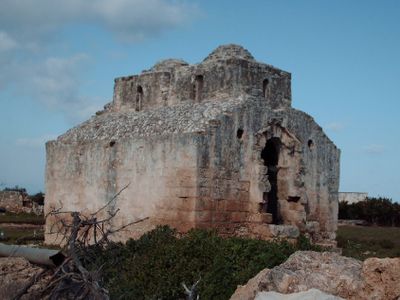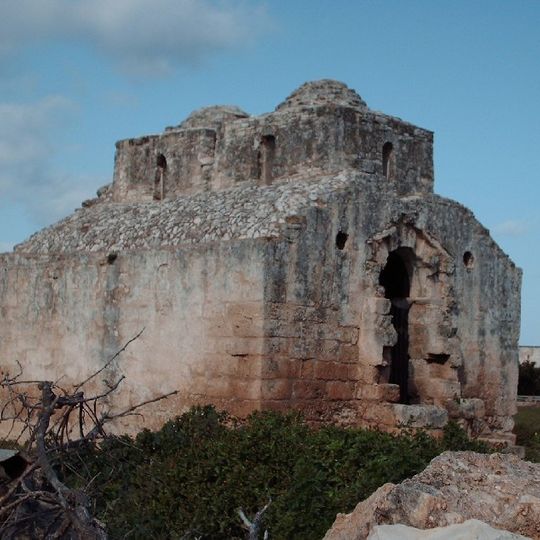
Tempietto di Seppannibale, Lombard-era church in the countryside near Fasano, Italy.
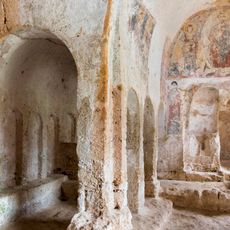
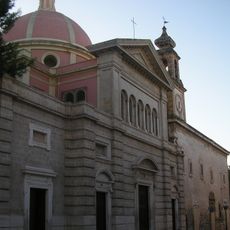
The Tempietto di Seppannibale, originally the church of San Pietro lo Petraro, is a small early medieval church of the late 8th to early 9th century in Fasano, on the road to Monopoli. It has a quadrangular plan only eight metres on a side, with three naves divided by arches on piers and half-piers; the central nave is covered by two domes aligned on corbels and corner niches.
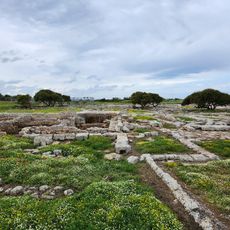
Built between the late 8th and early 9th century, the small church was originally called San Pietro lo Petraro. Count Goffredo of Conversano donated it to Abbot Lorenzo of Monopoli in 1086 and again in 1099. Excavations directed by Gioia Bertelli in the 1990s and again between 2003 and 2006 traced a late-antique settlement of the 4th to 7th century in front of the church, resting on earlier Roman walls.
The interior preserves remains of 8th-century frescoes of the Beneventan school, showing biblical scenes and episodes from John's Apocalypse against backgrounds with red flowers, in line with other Lombard works in Apulia. The name Seppannibale probably comes from the diminutive of Giuseppe Annibale, of the Indelli family, owners of the district in the last two centuries.
The church stands inside the fortified complex of Masseria Seppannibale Grande, on the road from Fasano toward Monopoli near a replacement stretch of the ancient Via Appia Traiana. The complex is privately owned, so entry is by prior booking only. The site lies within a wider archaeological area spanning Roman to early medieval occupation.
The pair of stone domes is a rare feature in medieval architecture and shows an unusual building method for religious structures of that period. This dual-dome design appears infrequently in the region and sets the building apart architecturally.
The community of curious travelers
AroundUs brings together thousands of curated places, local tips, and hidden gems, enriched daily by 93,140 contributors worldwide.