Palazzo Poncarali Oldofredi, Renaissance palace in Brescia, Italy.
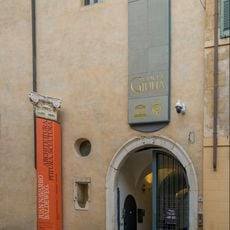
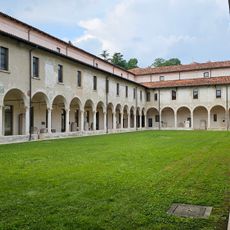
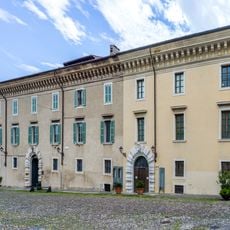
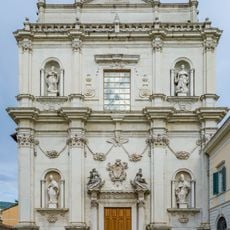
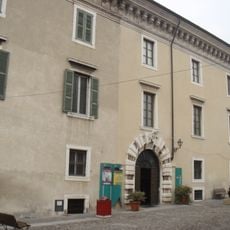
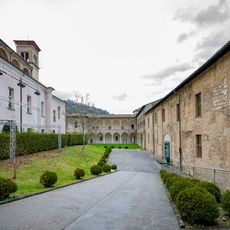
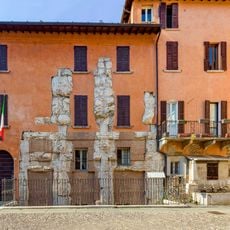
Palazzo Poncarali Oldofredi is a 17th-century palace in Brescia with a horseshoe-shaped plan: a central body and two side wings around a courtyard porticoed on three sides, with five bays on the north and four on the east and west. Its façade was deliberately left rough and unplastered, following 17th-century fashion, and has remained unchanged for three centuries. The entrance portal is flanked by two telamon busts supporting the balcony above.
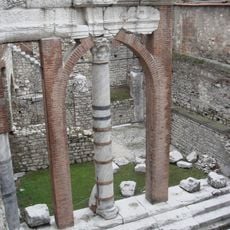
The area around the palace was already used in Roman times: remains of a thermal complex with service rooms and basins, probably of the imperial age, were found in the courtyard. The structure was abandoned around the 3rd–4th century and later reused as a necropolis in the early Middle Ages, with several late-antique 'alla cappuccina' tombs. The present building was erected in the 17th century by the Provaglio family.
The main hall displays neoclassical frescoes showing ten medallions of notable Italians and mythological scenes that reflect the family's standing and taste. This decoration shows how the residents used art to express their values and education.
The building now functions as a state classical high school called Arnaldo, with modern classrooms housed in former stables that have been converted. The courtyard and architecture may be accessible to visitors at certain times, but it is best to check ahead since the building primarily operates as a school.
The entrance portal carries two busts of telamons holding up the balcony above, a solution the source calls rather original and unusual among Brescia's noble residences. The facade itself was deliberately left rough and unplastered, following 17th-century fashion, and stayed that way for three centuries.
The community of curious travelers
AroundUs brings together thousands of curated places, local tips, and hidden gems, enriched daily by 93,127 contributors worldwide.