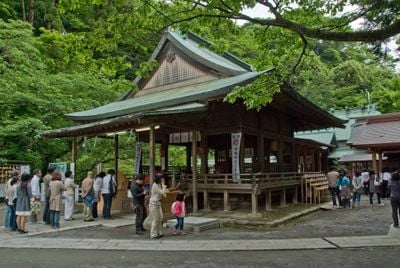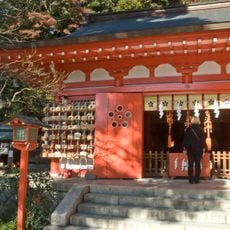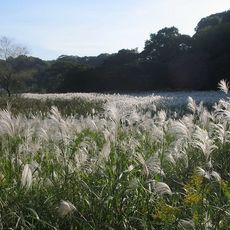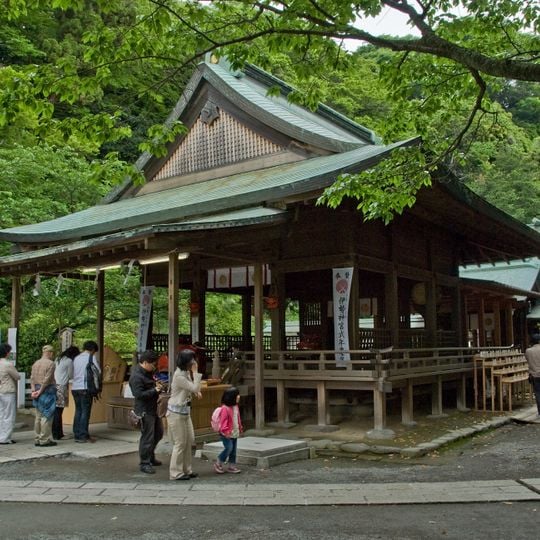
Kamakura-gū, Shinto shrine in Nikaidō, Kamakura, Japan.
Kamakura-gū is a Shinto shrine in Nikaidō, Kamakura, built on a dark-wood hall raised on stout posts, with a green gabled roof and a light lattice front wall. White lanterns and two long paper banners hang below the eaves, and a railed veranda reached by stone steps wraps the platform against a wooded slope.
Emperor Meiji founded the shrine in 1869 as a memorial to Prince Morinaga, who fought against the rule of the Kamakura samurai. Ashikaga Tadayoshi had the prince executed two years after his victory, linking the site to political conflicts of the 14th century.
The shrine takes its popular name, Ōtōnomiya or Daitōnomiya, from Prince Morinaga's title. Near the worship hall stands a life-size statue of warrior Murakami Yoshiteru, carved in 2004 from a 103-year-old keyaki tree; visitors rub it for protection and recovery from illness. A red lion-head charm, the shishagashira-mamori, recalls the small lion charm the prince kept in his helmet.
Take the Keihin Kyuko bus bound for Kamakura-gū from stop ⑤ at the east exit of Kamakura Station (JR Yokosuka Line, Enoden); get off at Kamakura-gū and the shrine is immediately there. The cave behind the main hall and the treasure hall, built in 1873 as Emperor Meiji's lodging, both charge admission. A free rest house next to the shrine office has chairs, tables and vending machines.
A cave on the grounds marks the spot where Prince Morinaga was held captive before his execution. Visitors can see the narrow opening that serves as a reminder of this dark episode in Japanese history.
The community of curious travelers
AroundUs brings together thousands of curated places, local tips, and hidden gems, enriched daily by 93,256 contributors worldwide.