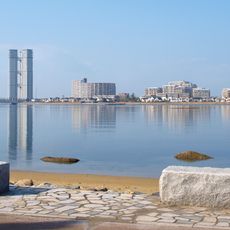
Umi no Nakamichi, Tombolo in Higashi-ku, Fukuoka, Japan.
Umi no Nakamichi is an 8-kilometer sand formation connecting Kyushu Island to Shikanoshima Island, with the Genkai Sea to the north and Hakata Bay to the south. The landmass creates a natural barrier between two distinct water bodies while serving as a bridge between the two islands.
The Nara-period Chikuzen no Kuni Fudoki refers to the sandbar as Uchiage no Hama, also called Fukiage no Hama. In the Empress Jingu legend, she received a jewel from the sea god Isora at Fukiage no Saki here. Pottery for salt-making from the 8th to 10th centuries, found at the Umi no Nakamichi ruins near Shioya Bana, shows local fishing communities produced salt.
The name Umi no Nakamichi was already used by Nata villagers in the early 18th century, as recorded in Kaibara Ekiken's Chikuzen no Kuni Zoku Fudoki, though the same work called the place Nata no Hama and applied the name to a sandbar near Tsuyazaki. On the Nata dunes, the black-pine grove of Nata Matsubara surrounds Shishiki Shrine, also called Saburo Tenjin, which honours Honoakari and Toyotama-hime.
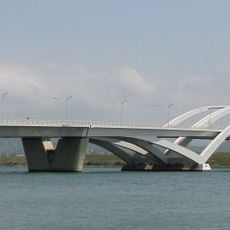
The area is easily reached from Fukuoka City via four stations on the JR Kashii Line and the Umi no Nakamichi Bridge. Visitors should expect different conditions depending on the season and tides.
The narrowest stretch, about one kilometre before Shika Island, is called Michikire, meaning "the path is cut": at high tide seawater can separate the sandbar, and a bridge now carries the road across. The 18th-century Chikuzen no Kuni Zoku Fudoki notes that in its day the path was more often broken than joined.
The community of curious travelers
AroundUs brings together thousands of curated places, local tips, and hidden gems, enriched daily by 93,223 contributors worldwide.