Takamatsu Castle, Flatland castle in Okayama, Japan
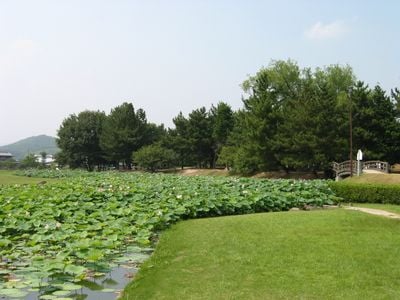
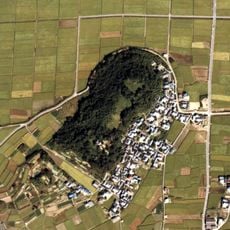
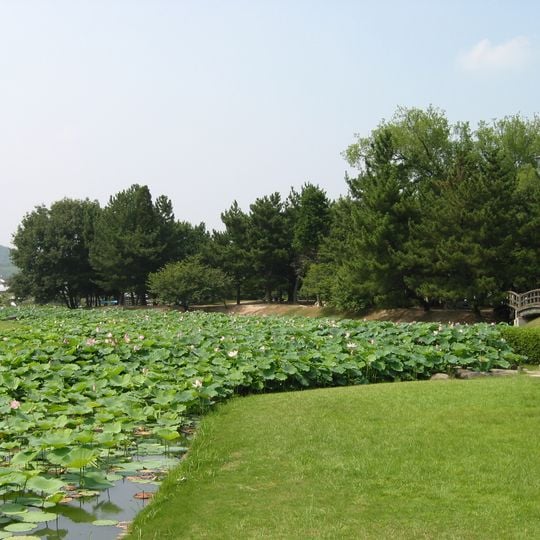
Takamatsu Castle, also called Bitchu-Takamatsu Castle, was a flatland castle built with earthen ramparts rather than stone walls, its low wetland setting forming a natural moat. Today little remains beyond part of the stone masonry and Hideyoshi's siege embankment; the site is a park with a monument to Shimizu Muneharu's suicide and a museum. A curved wooden footbridge stands at the edge of a broad expanse of lotus leaves.
The castle was built by the Ishikawa clan, retainers of the Mimura clan who ruled Bitchu from Matsuyama Castle; the date is uncertain. After the Mimura and Ishikawa fell to the Mori in the 1575 Bitchu war, Shimizu Muneharu became lord. In 1582 Hashiba Hideyoshi besieged it, and on Kuroda Kanbei's advice a dam was raised in about eleven days, flooding the castle in the rainy season. Muneharu killed himself, and the castle was abandoned after the one-castle decree.
The lotus now growing in the former marsh is called Muneharu lotus, after Shimizu Muneharu, the lord who took his own life in 1582 so his garrison could live. The castle park holds his head mound and a small memorial shrine, and the site museum displays a diorama of the water siege.
The castle ruins and the dam site lie about 10 minutes on foot from Bitchu-Takamatsu Station on the JR Kibi Line, or roughly 10 minutes by car from the Okayama interchange. Free parking is available on the south and west sides of the castle park. The site museum closes on Mondays.
The castle stood on low wetland, and the marsh itself served as its natural moat; no stone walls were built, only earthen ramparts. In 1582 Kuroda Kanbei proposed damming the ground around it, and the levee was finished in 11 days, flooding the site. The lotus now growing in the marsh is called Muneharu lotus.
The community of curious travelers
AroundUs brings together thousands of curated places, local tips, and hidden gems, enriched daily by 93,635 contributors worldwide.