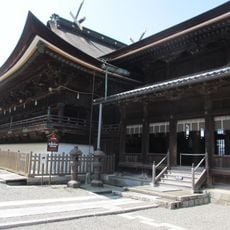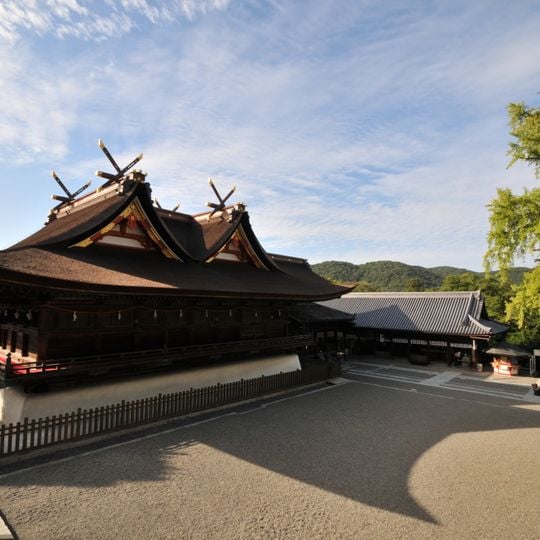
Kibitsu Shrine, Shinto shrine in Kibitsu, Okayama, Japan
Kibitsu sits in Okayama Prefecture and has served as an active shrine for the local community since the 15th century. The buildings stand on a forested hillside accessed by a covered corridor extending over 300 meters (980 feet).
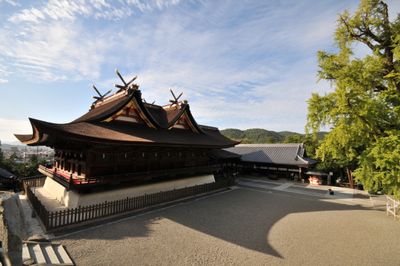
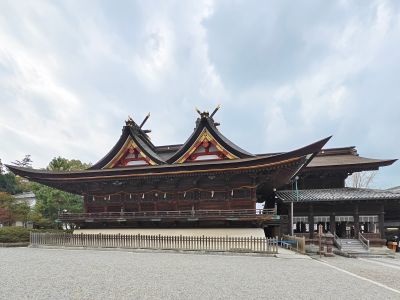
The shrine's records trace its founding to Kaya no Omi Narumi, a fifth-generation descendant of the deity Okibitsuhiko no Mikoto, who built a sanctuary over the earlier thatched palace. The present main hall and worship hall were begun in 1390 under shogun Ashikaga Yoshimitsu on Emperor Gokomatsu's order and moved into place in 1425. The pair was first protected under the Ancient Shrines and Temples Preservation Law in 1902 and designated a National Treasure on 29 March 1952.
The main hall combines the usually separate honden sanctuary and haiden worship space under one continuous roof, a rare construction form in Japan. This layout creates a shared space for worshippers and shrine staff during ceremonies.
The covered corridor offers shelter from rain and sun, though the slope requires comfortable shoes and some stamina. Early morning and weekdays usually see quieter conditions than weekends.
The Narukama Shinji is held every day except Friday in the Okama-den, rebuilt in 1606 by the mining engineer Yasuhara Tomokazu. A priest heats a kettle in the inner room; the sound of the boiling rice is read as a good or bad omen. The ritual appears in Ueda Akinari's Ugetsu Monogatari, in the tale "Kibitsu no Kama".
The community of curious travelers
AroundUs brings together thousands of curated places, local tips, and hidden gems, enriched daily by 92,700 contributors worldwide.