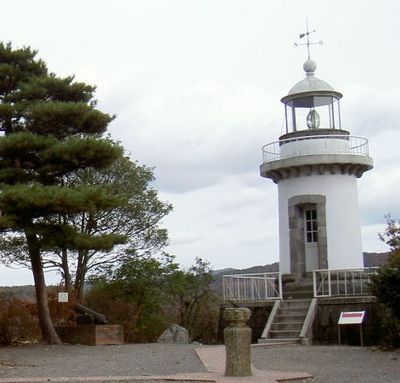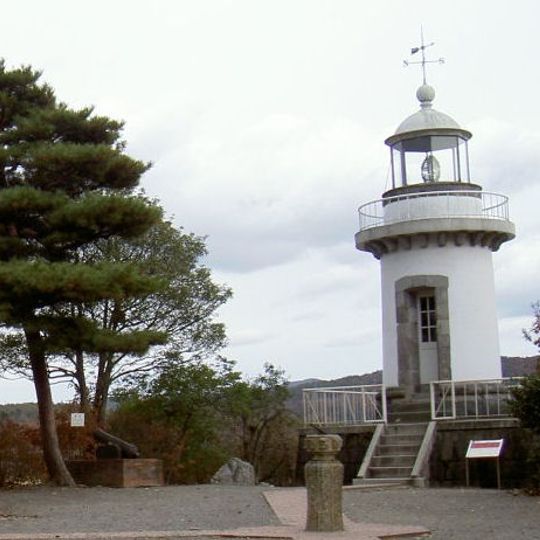
Shinagawa Lighthouse, Lighthouse in Inuyama, Japan.
Shinagawa Lighthouse is a nine-meter brick structure with a cylindrical shape featuring a gallery, lantern, and fifth-order Fresnel lens. The construction displays the classic features of a modern navigation tower from the late 1800s.
Léonce Verny, a French engineer, built this as the third of four lighthouses he designed for Japan. It was first lit on 5 March 1870 and served at Shinagawa until 1957. It was then moved to Meiji Mura, an open-air museum in Inuyama, Aichi Prefecture. Later lighthouses were built by Scottish engineer Richard Henry Brunton until Japanese engineers took over in 1880.
The tower is one of four lighthouses built in Japan by the French engineer Léonce Verny; later towers were the work of the Scottish engineer Richard Henry Brunton until Japanese engineers took over construction in 1880. It was first lit on 5 March 1870 and served at Shinagawa until 1957, when it was moved to Meiji Mura in Inuyama.
The lighthouse now stands in Museum Meiji-mura in Inuyama and can be inspected by visitors from the outside. The museum is easily accessible and the tower is clearly visible on the grounds, so you can view its architecture from different angles.
The lighthouse was first lit on 5 March 1870, making it the third of four towers built by the French engineer Léonce Verny. It served at Shinagawa until 1957, when it was retired and later moved to Meiji Mura in Inuyama, Aichi Prefecture.
The community of curious travelers
AroundUs brings together thousands of curated places, local tips, and hidden gems, enriched daily by 93,449 contributors worldwide.