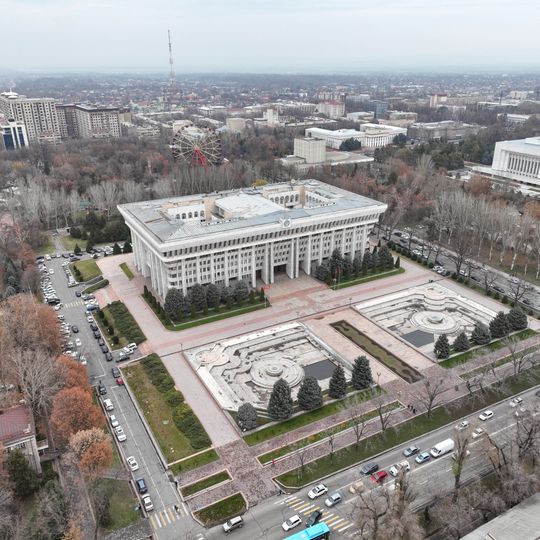
White House, Presidential office building in Bishkek, Kyrgyzstan.
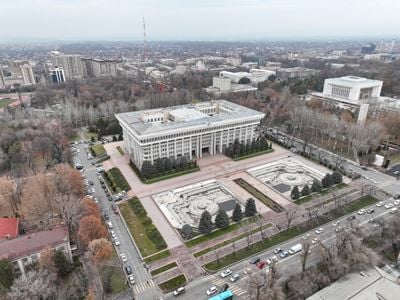
The White House is a seven-storey building clad in marble from the Chichkan deposit, designed by architects of the Frunzegorproyekt institute and modelled on Moscow's Gosplan building. Its long facade is divided by closely spaced columns above a solid base, with a broad central entrance and symmetrical low wings. The national crest sits on the front, above a large bed of red flowers.
The building was completed in 1985 as the headquarters of the Communist Party Central Committee. After the Soviet Union's collapse, it became the administrative center for independent Kyrgyzstan.
The crest on the facade was the Kyrgyz SSR emblem until it was replaced by the emblem of the Kyrgyz Republic. In front of the building lies a large bed of red flowers, planted to represent the country's Soviet ties. Inside there was once a winter garden with exotic birds and plants.
The building is a working parliament and presidential office, so entry is closed to visitors; the marble facade, the crest and the red flower bed are seen from Ala-Too Square and Chuy Avenue. The square in front is where crowds gathered in 2005 and 2010, and it stays open to pedestrians.
The tunnel rumor is unconfirmed: sources say only that an underground complex is said to lie beneath Ala-Too Square, linked to the White House by tunnels. The building itself holds 236 offices, a 650-seat plenary hall, 10 passenger and 5 freight lifts, two canteens and two prayer rooms.
The community of curious travelers
AroundUs brings together thousands of curated places, local tips, and hidden gems, enriched daily by 93,468 contributors worldwide.