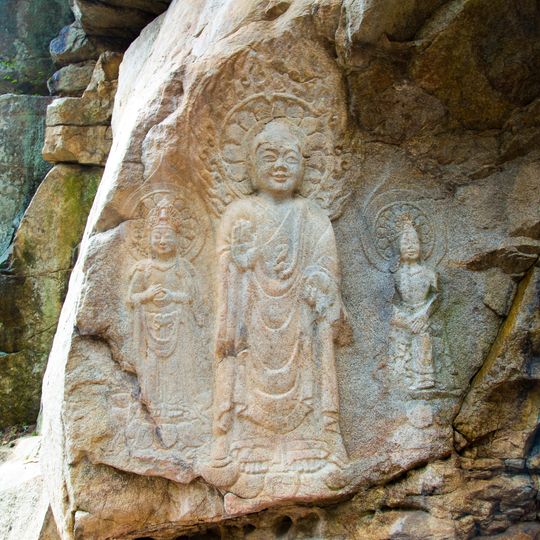
Rock-carved triad buddha in Seosan, Rock relief Buddhist sculpture in Gayasan, Seosan, South Korea.
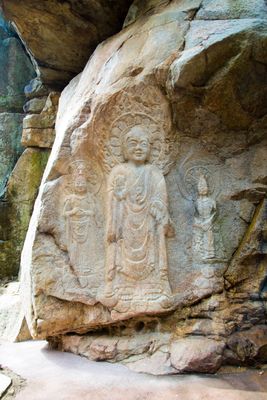
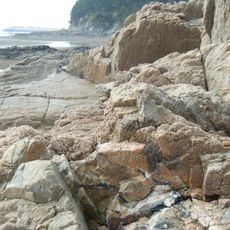
The Rock-carved triad buddha in Seosan is cut into a rough tan and grey cliff face at Gayasan. The central standing Buddha, 208 cm high, has a round halo with lotus petals, a robe in U-shaped folds, one hand raised at the chest and the other holding cloth. To its left stands a smaller crowned bodhisattva with hands at the waist; to its right a bare-headed figure, also with hands at the waist.
This rock carving dates to the late Baekje Kingdom period, between the 6th and early 7th centuries, showcasing the stone-working techniques of that era. The period saw increasing Buddhist influence on Korean culture and religious practice, reflected in the proliferation of such devotional sculptures.
Locals call the carving "the smile of Baekje" for the gentle expression on all three faces. The triad represents Shakyamuni, Maitreya and Dipankara from the Lotus Sutra, showing that Lotus Sutra thought was current in Baekje society. The central Buddha's halo is carved with lotus flowers, a ring of circles and flame patterns, plus three small Buddhas.
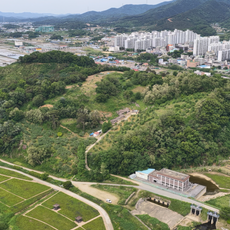
The location sits near Unsan village in Seosan and is reachable by car, though access to the carving involves steep steps and rough pathways. Wear sturdy footwear and be prepared for a site with no visitor facilities, just the rock sculpture in its natural setting.
The triad illustrates the Lotus Sutra's prophecy of three Buddhas: Shakyamuni, Maitreya and Dipankara. It is regarded as the forerunner of the 응진전 triads built in Joseon-era temples. The carving was rediscovered in April 1959 by Hong Sa-jun during a survey of the nearby Bowonsa temple site.
The community of curious travelers
AroundUs brings together thousands of curated places, local tips, and hidden gems, enriched daily by 93,669 contributors worldwide.