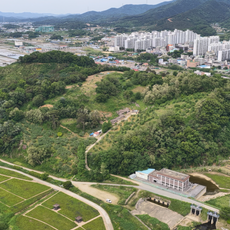
Buseoksa, Buddhist temple in Buseok-myeon, South Korea.
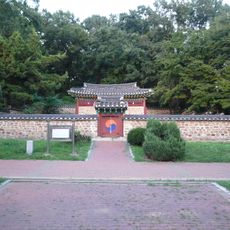
Buseoksa is a Buddhist temple at the foot of Dobisan in Chwipyeong-ri, Buseok-myeon, Seosan, Chungcheongnam-do, South Korea. It is a branch temple of Sudeoksa in the Jogye Order's 7th district and is designated Chungcheongnam-do Cultural Property No. 195. The complex includes the Geungnakjeon and Bonghyanggak halls, which together enshrine eight Buddha statues.
The temple was founded in 676 under King Munmu of the Silla dynasty and is among the oldest Buddhist sites in Korea. Its Muryangsujeon Hall has survived from that early period, making it one of the few remaining wooden structures of its age on the Korean peninsula.
The temple's name, "Floating Stone Temple," is tied to a local legend about the monk Uisang and a Tang Chinese woman, and a separate tradition says the site was named for a hermitage built by Yu Bang-taek, a Goryeo loyalist, after the dynasty fell. Eight Buddha statues are enshrined in the Geungnakjeon and Bonghyanggak halls. The temple is a designated cultural property of Chungcheongnam-do.
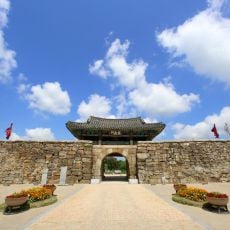
The complex is explored on foot by walking gradually uphill along the stone walls and terraced paths. The ground can be uneven in places, so solid shoes are a good idea, particularly after rain.
Local records tell of a Chinese woman named Sunmyo who is said to have turned into a dragon to protect the temple. A small shrine called Seonmyogak was built inside the complex in her honor and can still be visited today.
The community of curious travelers
AroundUs brings together thousands of curated places, local tips, and hidden gems, enriched daily by 94,676 contributors worldwide.