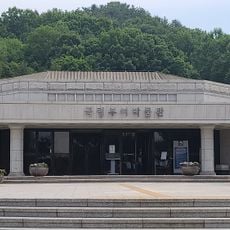
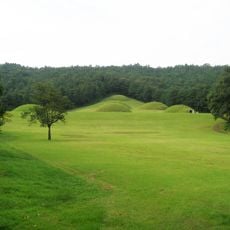
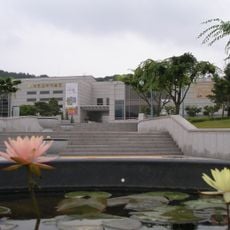
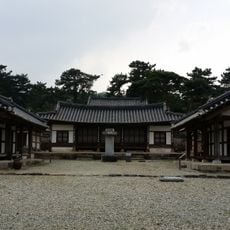
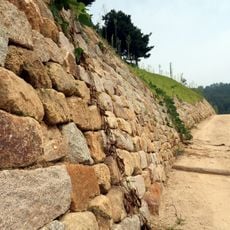
Songguk-ri, Archaeological site in Buyeo, South Korea.
Songguk-ri is an archaeological site near Buyeo containing remains of ancient dwellings from the Bronze Age. The excavations reveal how people constructed and arranged their homes during this early period of Korean history.
The site was systematically examined starting in 1975 and reveals how people lived in Korea during the Bronze Age. Artifacts found there date back to roughly 2500 to 2300 years ago, showing the beginnings of organized society.
The site gives its name to the Songguk-ri style, the typological label for Middle Mumun pit-houses across southern Korea. Rice remains analysed here indicate that in the Bronze Age rice was a community food rather than a luxury or currency. Triangular stone harvesting knives, developed from lunate-shaped knives, are characteristic of the culture and resemble those found at Yayoi sites in Japan.
The excavated pit-houses, palisade and stone-cist burial lie in the fields around Songguk-ri village in Buyeo-gun, Chungcheongnam-do, at the coordinates 36.26781, 127.03054. The site is registered as Historical Site No. 249 and was reviewed in 2022. Excavation reports were published by the National Museum of Korea, Gongju National Museum and Buyeo National Museum.
The high-status stone-cist burial held a Liaoning-style bronze dagger, several large tubular greenstone ornaments and a finely ground stone dagger. Bronze hairpins from the site were cast in a mould found at Neungsan-ri, Buyeo. Triangular stone harvesting knives, developed from lunate knives, are characteristic of Songguk-ri culture and resemble those of Yayoi sites in Japan.
The community of curious travelers
AroundUs brings together thousands of curated places, local tips, and hidden gems, enriched daily by 93,595 contributors worldwide.