Nakhwaam Rock, Cultural heritage rock formation in Buyeo-gun, South Korea.
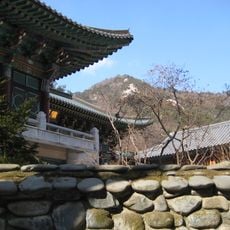
Nakhwaam Rock is a granite outcrop on the cliff face of Busosan Mountain in Buyeo, overlooking the Baengmagang River. The rock is narrow, and above it stands the hexagonal Baekhwajeong Pavilion, built in 1929. Below, the characters "Nakhwaam" are carved into the stone, attributed to Song Si-yeol (1607–1689).
The legend of 3,000 court ladies leaping into the Baengma River dates to the 660 fall of Sabi, but the first written mention is in the 13th-century Samguk yusa, which records King Uija and his concubines, not 3,000 women. The name Nakhwaam appears in the Goryeo period; the figure 3,000 was first used by Kim Heun in a 15th-century poem and popularized in the 20th century.
The name Nakhwaam (落花岩) means "falling-flower rock". The earliest record of the story is in the Samguk yusa, which cites the Baekje gogi: King Uija and his consorts leapt into the river rather than be captured. The figure of 3,000 palace women first appears in a poem by Kim Heun (1448–?) and was popularized in Yun Seung-han's 1941 novel Kim Yushin.
The site offers no parking facilities or restroom amenities, so visitors should prepare in advance for their journey. It is wise to arrange transportation and basic necessities before heading out to see the rock.
The "three thousand court ladies" is not a historical record: the first mention of the number appears in a poem by Kim Heun (1448–?), and the phrase was popularized by Yun Seung-han's 1941 novel Kim Yushin and the 1962 National History Dictionary. The rock is also too narrow to hold that many people.
The community of curious travelers
AroundUs brings together thousands of curated places, local tips, and hidden gems, enriched daily by 93,482 contributors worldwide.