Akyrtas, Archaeological site in Jambyl Region, Kazakhstan.
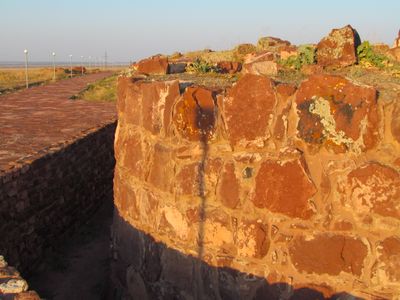
Akyrtas is a rectangular palace complex begun in the 8th–9th centuries on a hilltop 40 km east of Taraz, near the Aksholak railway station. Its walls, built of large stone blocks about 40×70×70 cm, survive in stretches of roughly 160, 146 and 140 m, with four gates: one north, three south. Rooms for the owner, guests, servants, guards and horses cluster around an inner courtyard that held a water reservoir.
Construction began in the second half of the 8th century, possibly after the 751 Battle of Talas, when Karluk and Arab forces defeated the Chinese and peaceful relations followed. The complex was never finished. Scholars have proposed a Buddhist or Nestorian monastery, an unfinished fortress-palace, or a caravanserai; its plan resembles medieval buildings in Iraq and Syria, and Arab sources may call it Kasribas on the Silk Road.
The name Akyrtas comes from the Kazakh word for a pen for livestock, which the four-cornered plan is said to resemble. Researchers have proposed Buddhist, Nestorian and palace interpretations, and since 1996 Kazakh and French scholars have linked the layout to medieval buildings in Iraq and Syria. The 8th-century Arab geographers Ibn Khordadbeh and Ibn Qudamah mention a caravan stop called Kasribas on the Silk Road, which may be this site.
This site is far from towns and cities, so you should arrange your own transportation and bring food and water before visiting. The open steppe offers little shelter, so prepare for changing weather and bring appropriate clothing and sun protection.
The name Akyrtas means "white stone" in Kazakh, though the walls today show reddish-brown blocks patched with pale orange, tan and cream lichen. Some researchers link the site to Kasribas, a stop on the Silk Road named in the accounts of Arab geographers Ibn Khordadbeh and Ibn Qudamah.
The community of curious travelers
AroundUs brings together thousands of curated places, local tips, and hidden gems, enriched daily by 93,607 contributors worldwide.