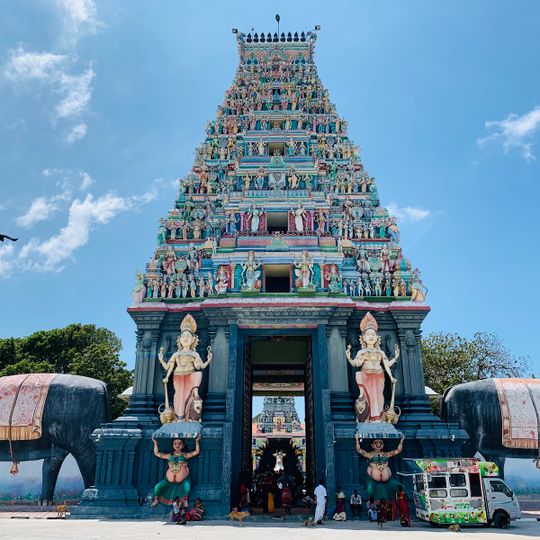
Nainativu Nagapooshani Amman Temple, Hindu temple on Nainativu island, Jaffna District, Sri Lanka
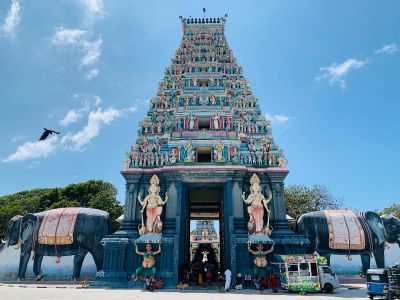
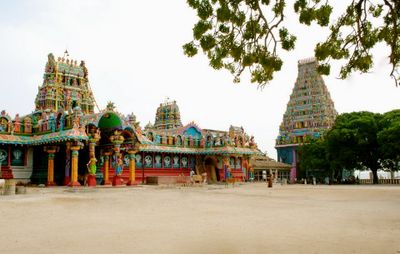
Nainativu Nagapooshani Amman Temple is a Hindu temple complex on Nainativu island in the Palk Bay, Sri Lanka. It has four gopurams: the tallest, the eastern Raja Raja Gopuram, rises 108 feet, while the others are 20–25 feet high. The complex contains an estimated 10,000 sculptures, and the main shrine holds a five-headed serpent stone.
The present temple was built between 1720 and 1790, after the Portuguese destroyed an earlier structure in 1620. A 12th-century Tamil inscription found on the premises records an edict of the Sinhala king Parakramabahu I (1153–1186) to his Tamil officials in Jaffna on handling shipwrecked foreign traders. The site is mentioned in the Tamil epics Manimekalai and Kundalakesi.
The temple is one of the 51 Shakta pithas, and Tamil literature such as Manimekalai and Kundalakesi mentions it. The annual 16-day Mahostavam festival in the Tamil month of Aani (June/July) draws over 100,000 pilgrims. During the festival, the goddess is carried in a palanquin to the Gangatharani tank on the 15th day and in a float procession on the sea on the 16th day.
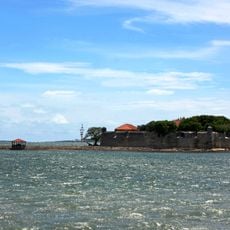
The temple stands on Nainativu island in Palk Bay, reached by ferry from Jaffna; the crossing is short. The complex has four gopurams, the tallest being the eastern Raja Raja Gopuram at 108 feet. The annual 16-day Mahostavam festival falls in the Tamil month of Aani (June/July), when up to 100,000 pilgrims visit. The temple provides lodging for pilgrims who come from afar.
The main shrine contains an ancient five-headed serpent sculpture that researchers link to early Naga worship traditions. This snake deity representation connects the site to prehistoric religious practices of the region.
The community of curious travelers
AroundUs brings together thousands of curated places, local tips, and hidden gems, enriched daily by 93,467 contributors worldwide.