Pyramids of Meroe, Archaeological site in Meroe, Sudan
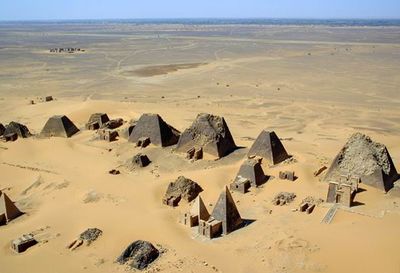
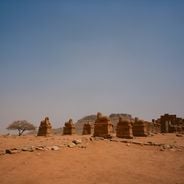
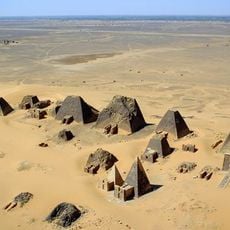
The Pyramids of Meroe are a group of steep-sided Nubian pyramids built of layered sandstone in sandy brown and dark grey tones, standing on flat sandy ground near the village of Bagrawiya, about 200 kilometres northeast of Khartoum. The pyramids have broad bases tapering to pointed tops, with smaller, lower structures beside them; some are more eroded than others, with rubble at their bases, and a few small box-like stone structures with dark openings sit near the larger pyramids.
The first pyramid at Meroë securely attributed to a ruler belongs to Ergamenes, who reigned around 280 BC. Pyramid building continued until about 300 AD, spanning the later Kingdom of Kush. The three cemeteries together hold over a thousand graves, at least 147 of them pyramids. The site became a UNESCO World Heritage Site in 2011.
The mortuary temples in front of the pyramids carry reliefs naming the deceased and showing them with underworld deities. The earliest, from the 3rd century BC, use Egyptian-style offering scenes with hieroglyphs; later walls depict the weighing of the heart before Osiris, and from Natakamani's reign the seated tomb owner dominates the side walls.
The site lies far from larger towns and requires a multi-day journey by off-road vehicle across unpaved tracks. Water and shade are scarce, so visiting early in the morning or late afternoon with ample drinking supplies is wise.
The pyramids' steep 72-degree angle sets them apart from Egypt's roughly 54-degree pyramids, and most were stepped rather than smooth-faced, with flattened tops possibly crowned by a small flat cylinder. Their burial chambers lie beneath the structure, entered from in front of the mortuary temple, never inside the pyramid itself.
The community of curious travelers
AroundUs brings together thousands of curated places, local tips, and hidden gems, enriched daily by 93,469 contributors worldwide.