Västerås Cathedral, Lutheran cathedral in Västerås, Sweden
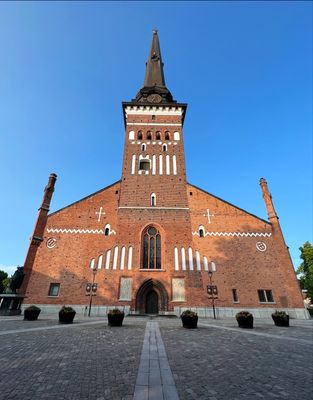
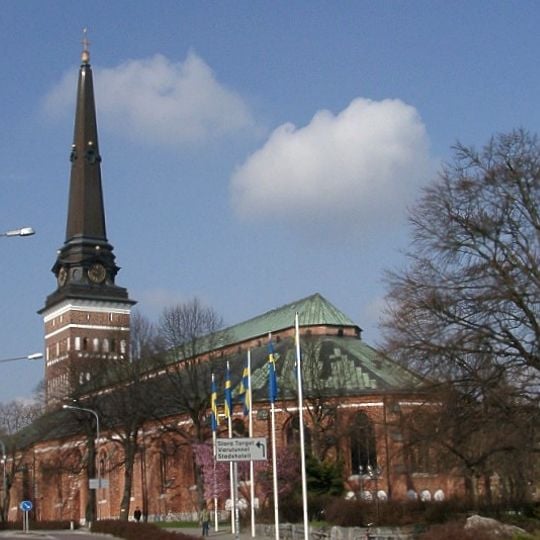
Västerås Cathedral is a five-aisled hall church in Scandinavian Brick Gothic, with a copper-covered roof and a single west tower carrying an obelisk-shaped, copper-clad spire. The tower rises 91.8 metres, with clock faces near the top and a slender dark needle spire above. The west facade has white-plastered blind arcades, and the choir ends in a semicircular apse.
A Romanesque basilica with a nave and two side aisles was built on the site in the 1230s, and the church was consecrated on 16 August 1271 to the Virgin Mary and John the Baptist. In the 1460s Bishop Lydeke Abelsson extended it eastward, and a chapel added in the southwestern corner in 1517 completed its present size. The copper outer roof dates from the 17th century, and the Baroque spire was designed by Nicodemus Tessin the Younger in 1694.
The cathedral is dedicated to the Virgin Mary and John the Baptist, and Västerås is one of Sweden's medieval churches named for Our Lady. The city coat of arms carries a rose and the Marian monogram, while the diocese's arms show the Lamb of God, the image John the Baptist used for Christ.
The cathedral stands in the northern part of Västerås inner city, with level ground around it and the Svartån river to the south. Enter through the west tower, where the whitewashed blind arcades of the facade are visible before you go in. The five aisles open into one another, so the high altar in the semicircular apse is reached by walking straight east from the entrance.
The 1694 spire, 91.8 metres tall, makes the cathedral Västerås Municipality's second-highest structure after the 325-metre Lillhäradsmasten about 15 km away. Karl XI paid for the Tessin design, which replaced a Renaissance cupola and spire lost to fire.
The community of curious travelers
AroundUs brings together thousands of curated places, local tips, and hidden gems, enriched daily by 93,394 contributors worldwide.