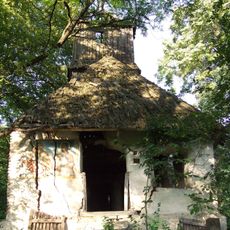
Horezu monastery, Orthodox monastery in Horezu, Romania
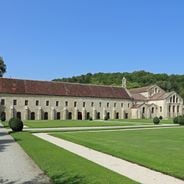
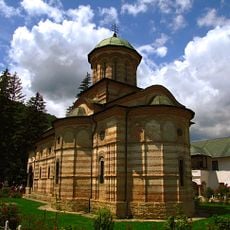
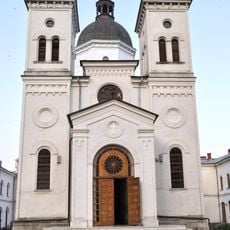
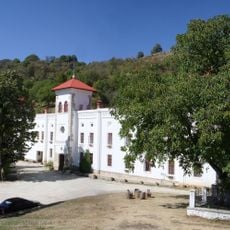
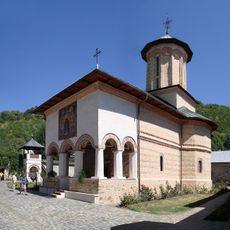
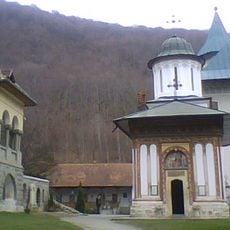
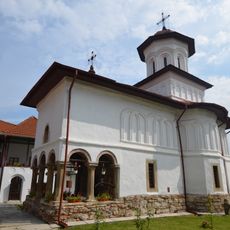
Horezu Monastery, founded by Prince Constantin Brâncoveanu, is a walled monastic complex on the Romanii de Jos valley. Its main church, dedicated to Saints Constantine and Helena, has a trilobed plan and a Brâncovenesc porch of ten carved stone columns. The rectangular enclosure holds the monks' arcaded cells to the north, the princely residence with bell tower to the south, and the refectory to the west.
The monastery was established in 1690 by Prince Constantin Brancoveanu as a religious center in the region. The complex marked a turning point in how Romanian architectural and artistic traditions developed during that period.
The name Hurezi comes from the huhurez owl heard in the surrounding forests; the town across the hill later took the name Horezu. In the pronaos, a painted gallery shows the Brâncoveanu, Basarab and Cantacuzino families, ending with the votive portrait of Brâncoveanu's own household. The mural cycle was completed on 30 September 1694 by painters Constantin Ioan, Andrei, Stan, Neagoe and Ichim.
The monastery lies in Romanii de Jos, on the valley of the Romanii de Jos river, below the Căpățânii Mountains. The main enclosure is rectangular: cells with an arcade run along the north side, the princely residence with bell tower and council hall on the south, and the refectory with a chapel above on the west. Four churches stand in a line on the east-west axis, so allow time to walk the whole ensemble.
The monastery walls contain detailed portraits from 1694 showing Prince Constantin Brancoveanu, his wife, and their eleven children rendered in original fresco technique. These family portraits have remained preserved on the walls over the centuries.
The community of curious travelers
AroundUs brings together thousands of curated places, local tips, and hidden gems, enriched daily by 94,430 contributors worldwide.