See the monuments around you in AROpen chests in the app
Around Us is built for your phone — point your camera at the streets and discover the monuments and places around you in augmented reality.Around Us is built for your phone — chests unlock when you walk, explore and capture nearby places.
From forgotten Greek cities to Ottoman villages, the Turkish Aegean region offers places full of memory and authenticity.
The Turkish Aegean region spans thousands of years of history. Here, the remains of great ancient Greek cities like Ephesus, with its still-visible Library of Celsus, and Pergamon, built on the heights of the plain, come together. The Greeks left their temples, theaters, and sanctuaries here. Later, the Ottomans built villages with stone houses, some of which, like Birgi or Eski Datça, still keep their cobbled lanes and traditional architecture. Between these traces of the past, nature itself is striking: the white terraces of Pamukkale rise from the ground, while Lake Bafa creates a singular landscape at the foot of Mount Latmos.
This collection offers you 35 places to explore this region. You will find world-famous archaeological sites, quiet villages where you can walk between stone houses, and remarkable natural landscapes. Each place tells a part of the Aegean story. Major sites like Ephesus and Pergamon stand alongside more discreet discoveries, Greek sanctuaries lost in the hills, well-kept Ottoman villages, and spectacular rock formations. Whether you want to understand Greek antiquity, discover Ottoman life, or simply walk through singular landscapes, the region has something for every curious traveler.
From forgotten Greek cities to Ottoman villages, the Turkish Aegean region offers places full of memory and authenticity.
The Turkish Aegean region spans thousands of years of history. Here, the remains of great ancient Greek cities like Ephesus, with its still-visible Library of Celsus, and Pergamon, built on the heights of the plain, come together. The Greeks left their temples, theaters, and sanctuaries here. Later, the Ottomans built villages with stone houses, some of which, like Birgi or Eski Datça, still keep their cobbled lanes and traditional architecture. Between these traces of the past, nature itself is striking: the white terraces of Pamukkale rise from the ground, while Lake Bafa creates a singular landscape at the foot of Mount Latmos.
This collection offers you 35 places to explore this region. You will find world-famous archaeological sites, quiet villages where you can walk between stone houses, and remarkable natural landscapes. Each place tells a part of the Aegean story. Major sites like Ephesus and Pergamon stand alongside more discreet discoveries, Greek sanctuaries lost in the hills, well-kept Ottoman villages, and spectacular rock formations. Whether you want to understand Greek antiquity, discover Ottoman life, or simply walk through singular landscapes, the region has something for every curious traveler.
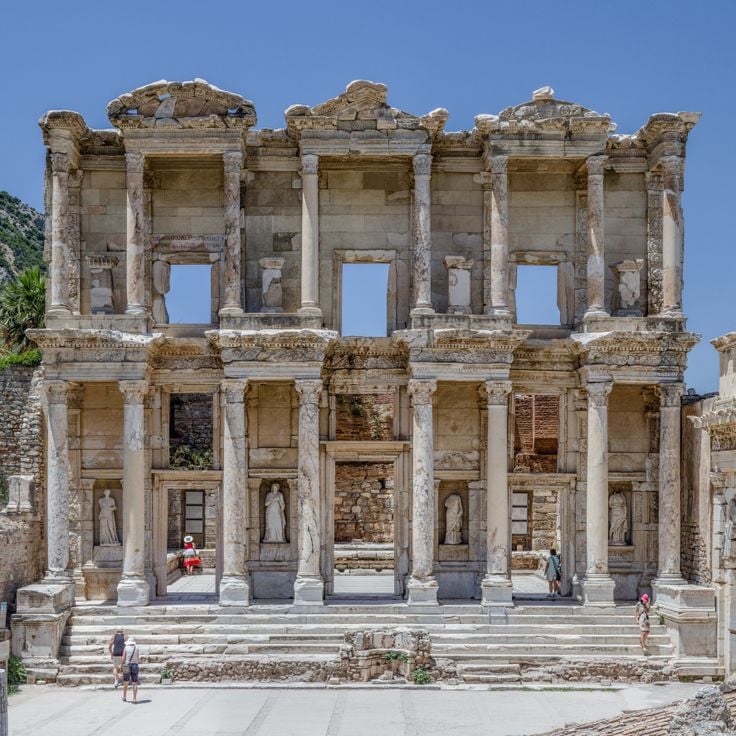
Ephesus is one of the best preserved ancient cities along the Aegean coast. Walking through its stone streets, you pass the two-story facade of the Library of Celsus, the large open-air theater, and the ruins of temples and private homes. The city was once a major trading hub and is now a UNESCO World Heritage Site. Plan for at least a half day to walk the main avenue and side paths at a comfortable pace.
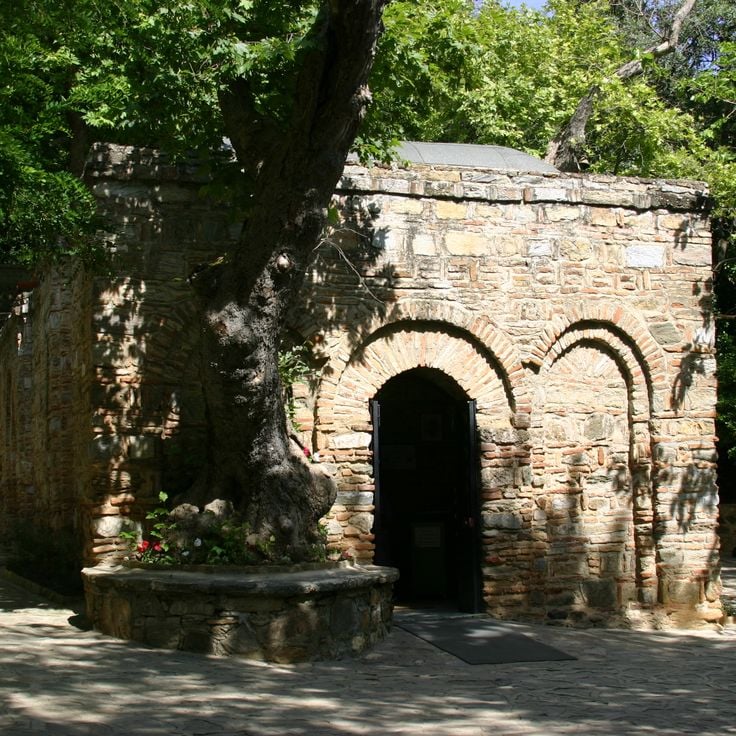
The House of the Virgin Mary sits on a wooded hill above the ruins of Ephesus, a short drive from Selçuk. Tradition holds that Mary spent her final years here, and the site draws Christian pilgrims as well as Muslim visitors who also venerate her. The small stone chapel at the center of the site is simple and spare. Candles burn at the entrance, and a wall nearby is covered with notes and prayers left by visitors. The surrounding forest adds to the feeling of stepping away from the world for a moment.
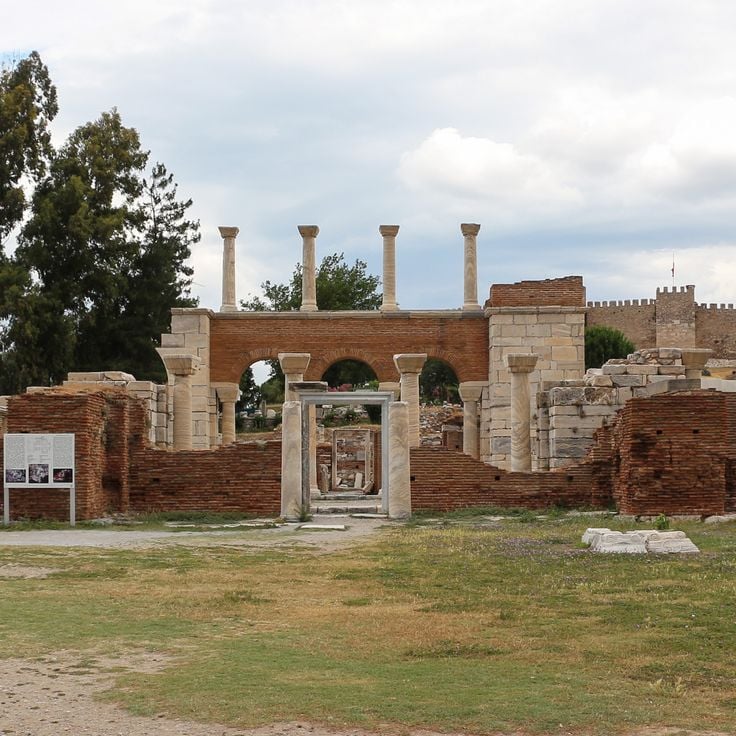
The Basilica of Saint John in Selçuk was built by the Byzantine emperor Justinian in the 6th century over a tomb believed to be that of John the Apostle. What remains today are foundations, a few re-erected columns, and the outlines of the nave and apse. Walking through the ruins gives a clear sense of how large the original church once was. The site sits on Ayasuluk Hill, with views over the surrounding plain and the nearby hilltop fortress.
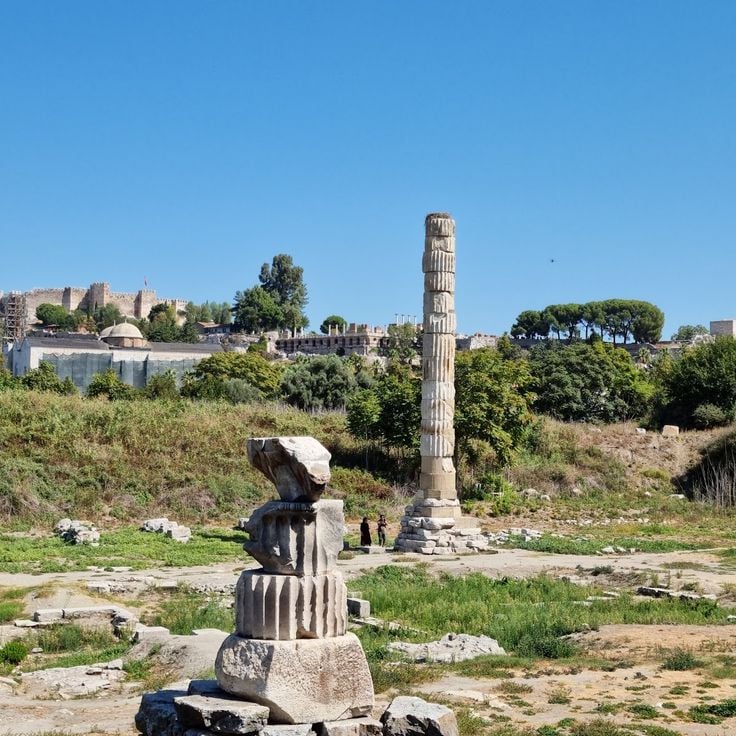
The Temple of Artemis in Selçuk was once one of the Seven Wonders of the Ancient World. Today, only a single column still stands on the site. Over the centuries, most of the stones were taken and reused in other buildings, including the Hagia Sophia in Istanbul. Walking around the ruins, you get a real sense of how large and important this sanctuary once was in the Greek world.
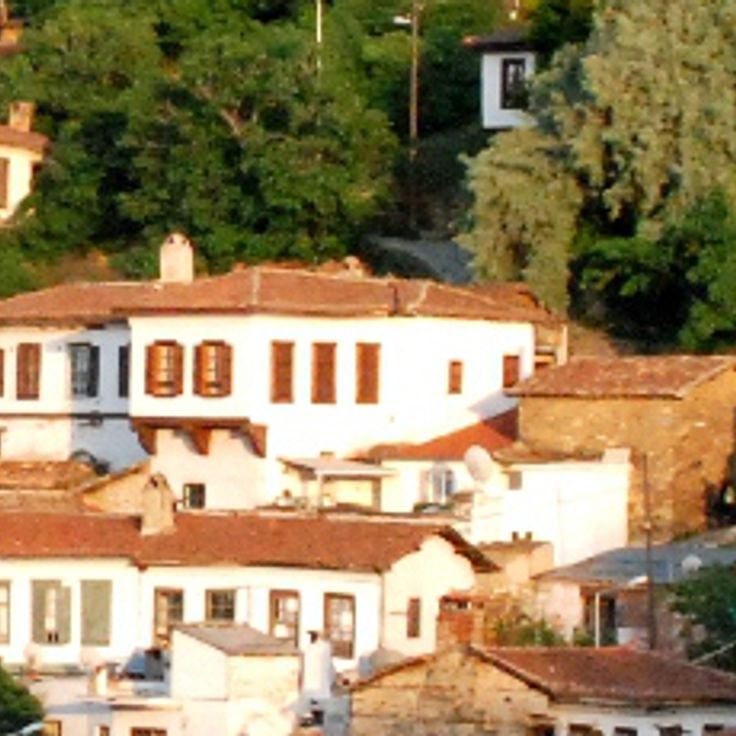
Şirince is a hillside village near Selçuk, built mostly in the 19th century by a Greek community that once lived here. Its stone houses with wooden balconies line narrow cobblestone alleys that climb up through orchards and vineyards. Today the village draws visitors looking to walk through old streets, taste local fruit wines and see what a traditional Aegean village looks and feels like.
The acropolis of Pergamon rises above the modern town of Bergama, sitting high on a hill over the surrounding plain. This ancient Greek city is one of the most striking sites in the Turkish Aegean. Visitors can walk among the ruins of temples, colonnaded streets, and a steep theater carved into the hillside. The site has been recognized by UNESCO as a World Heritage site.
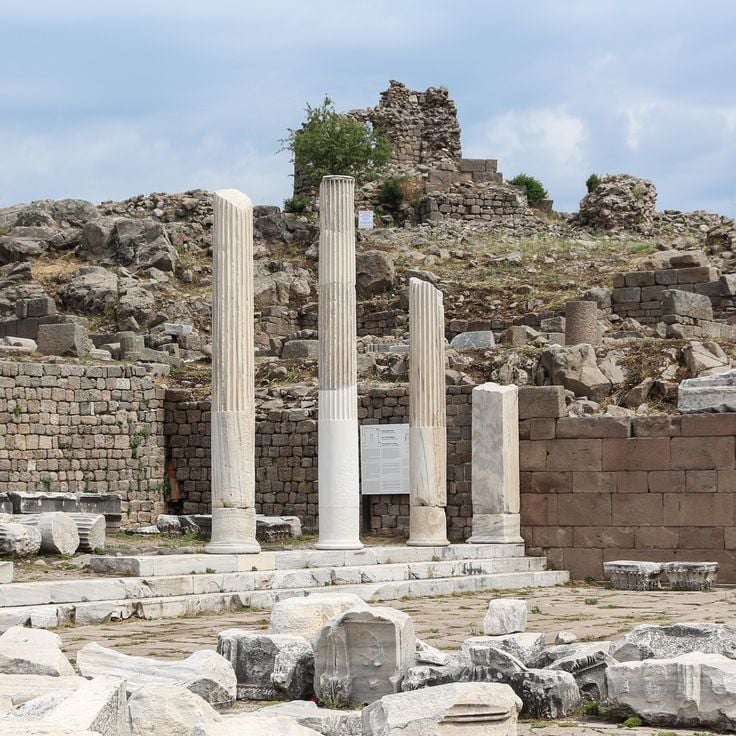
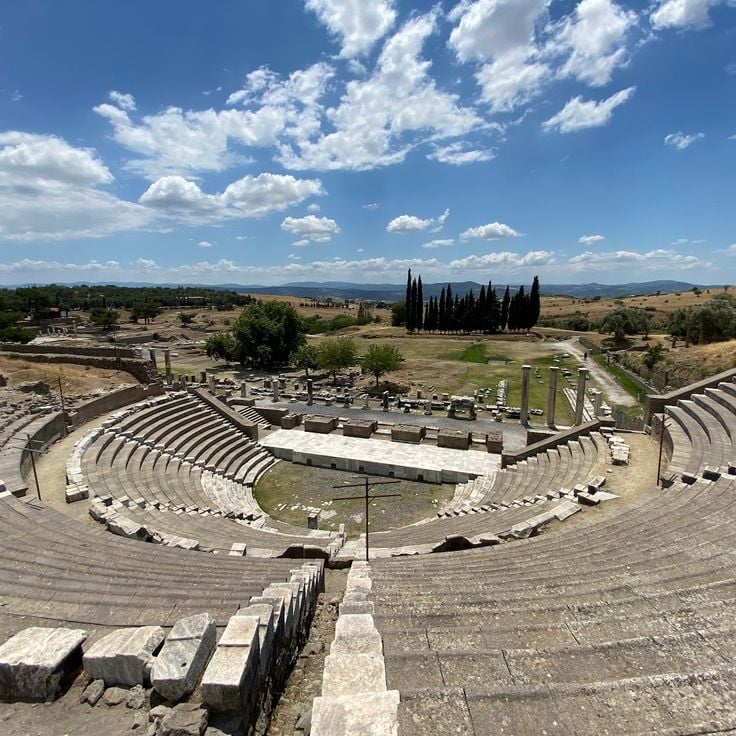
The Asclepion of Pergamon sits on the edge of the ancient city and was one of the most visited healing sanctuaries in the Greek world. People traveled from across the Mediterranean to seek treatment here. The site combined religious worship with practical care: patients bathed in sacred waters, walked along colonnaded paths, and slept in the sanctuary hoping for healing dreams sent by the god Asclepius. Today, the colonnaded walkways, a small theater, and the remains of the bath complex are still visible and give a clear sense of how the place once functioned.
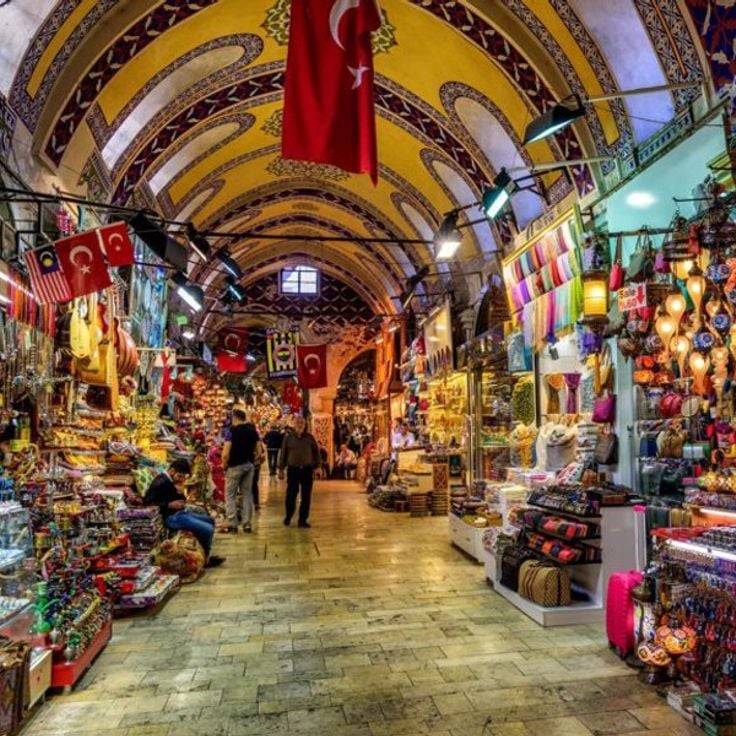
Kemeraltı is the historic bazaar district of İzmir, one of the oldest trading areas on the Turkish Aegean coast. Its narrow lanes are lined with Ottoman-era caravanserais, old mosques, tea houses and small shops selling everything from spices to fabric. This is where people from İzmir come to buy everyday goods, meet friends and spend time. Walking through the old town around the bazaar, you can still see traces of the city's Greek, Jewish and Ottoman past in the buildings and street layout.
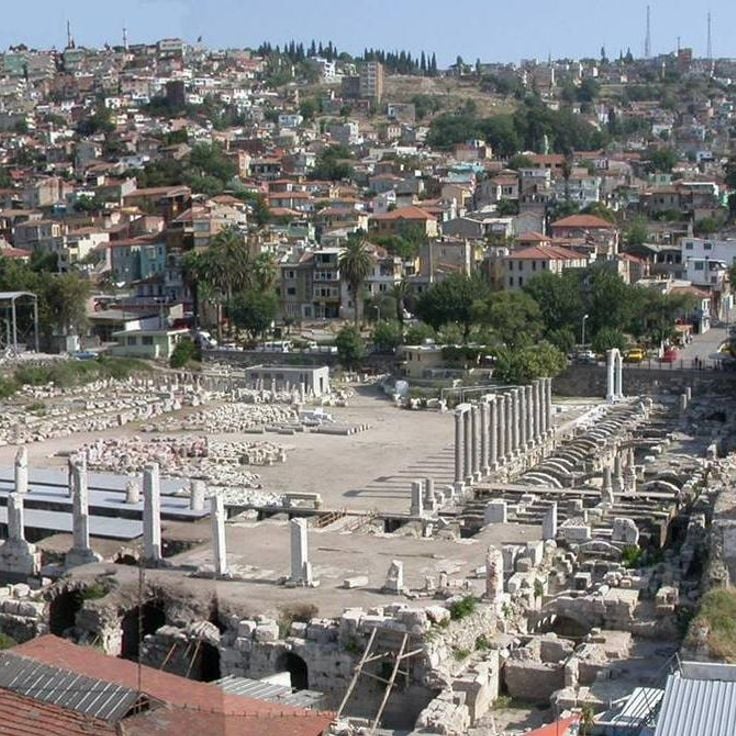
The Agora of Smyrna sits in the middle of modern Izmir, surrounded by city streets and apartment buildings. It is one of the few places where you can see ancient Greek ruins right at the heart of a living city. The site shows columns, arches and underground storage rooms that date back to a reconstruction carried out in the 2nd century, after an earthquake. Walking through it feels like stepping between two worlds at once.
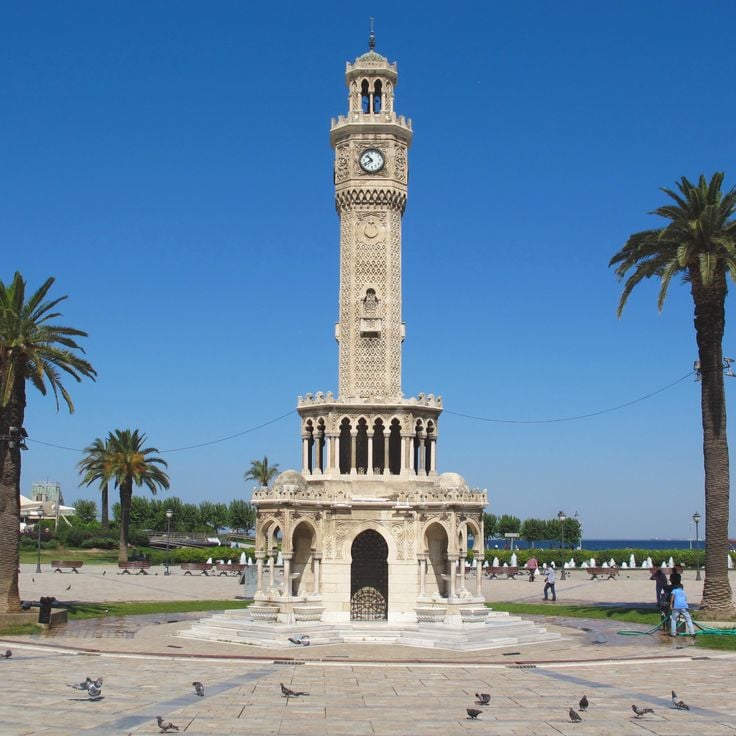
The Clock Tower on Konak Square is the most recognizable landmark in İzmir. Built in 1901 in an Ottoman style, it stands at the center of the old city, right on the edge of the bay. At any time of day, locals gather around the square: in the morning on their way to work, at noon for lunch, and in the evening for a stroll along the waterfront. The tower works as a natural meeting point and a starting place for exploring the city on foot.
Alaçatı is a stone village on the Çeşme peninsula, known for its narrow paved lanes and old stone houses, many of which have been turned into cafés, small hotels, and shops. Several old windmills still stand on the edges of the village. The nearby coast is a popular spot for windsurfing, thanks to the steady winds that blow across the bay. In summer, the streets fill with visitors who come to walk through the old town and sit at outdoor tables.
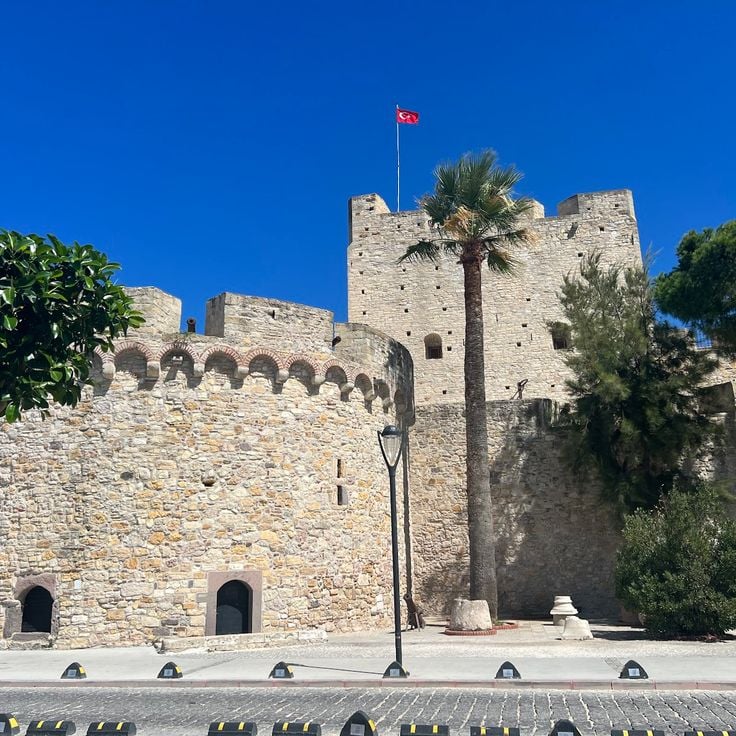
Çeşme is a seaside town on the Turkish Aegean coast, sitting almost directly across from the Greek island of Chios. A 16th-century Ottoman fortress rises above the harbor and can be seen from far out at sea. In summer, the streets near the waterfront fill with people eating at outdoor tables and watching the boats come and go. The white houses, the fishing boats, and the old castle walls together give the town a character that is easy to read at a glance.
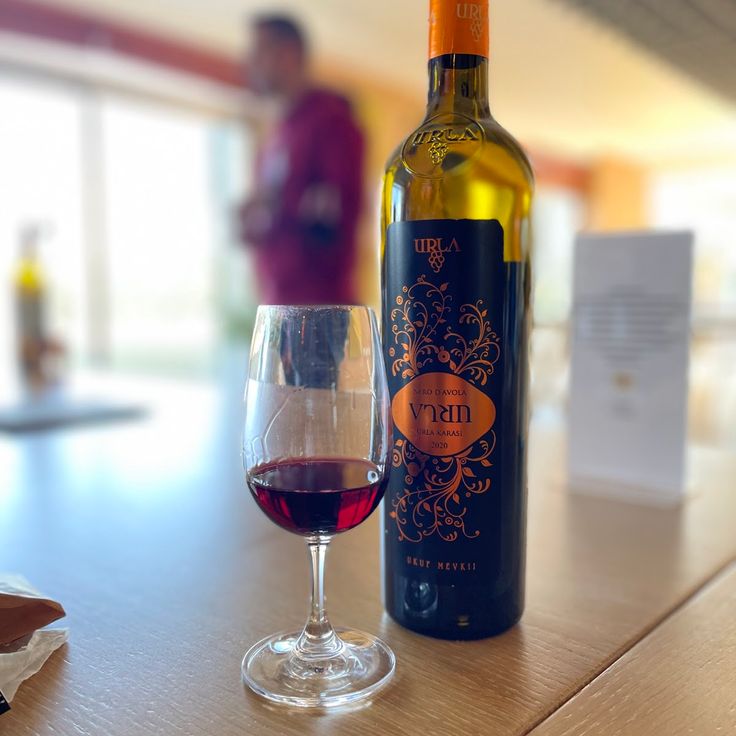
Urla is a small town west of Izmir, set among vineyards and olive groves along the Aegean coast. It has become one of the main wine-producing areas in the region. A wine route connects several small estates where visitors can taste local varieties. Between the vineyards, villages offer restaurants that cook with seasonal and local ingredients. Urla brings a different side of the Aegean together with the ancient ruins and stone villages found elsewhere in this collection.
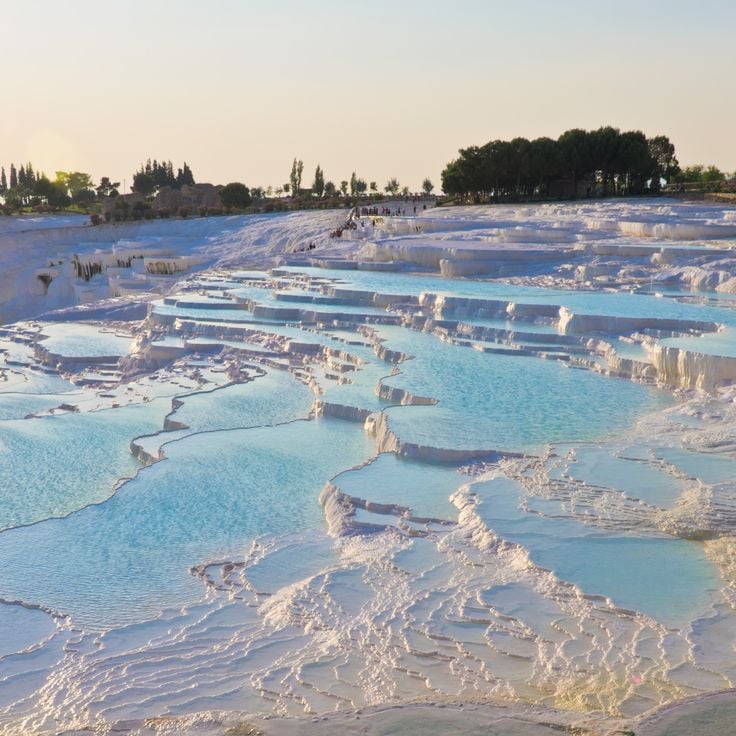
Pamukkale, near Denizli, is known for its white travertine terraces fed by warm thermal springs. Water has been flowing down the hillside for centuries, slowly forming these bright, stepped pools. Visitors walk barefoot across the terraces, where the water is warm and the surface feels smooth underfoot. Just behind them stand the ruins of Hierapolis, an ancient city the Romans built around the same springs.
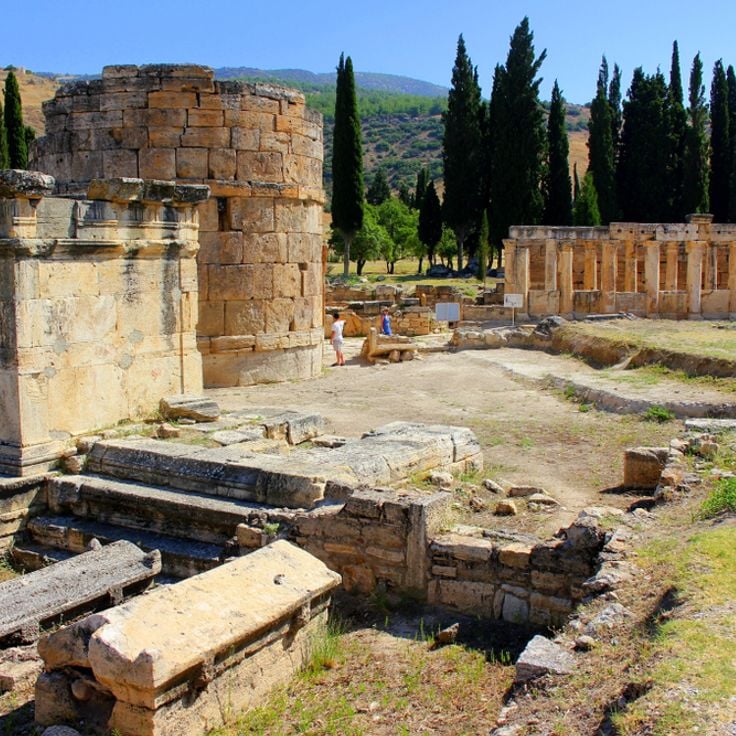
Hierapolis sits on the plateau just above the white calcium terraces of Pamukkale. This ancient city was once a popular thermal resort, drawing visitors from across the Roman world. Today you can walk through the ruins of a large theater, explore one of the longest ancient necropolises in Asia Minor, and see the remains of baths and temples. The view from the plateau across the plain below adds a lot to the experience. Hierapolis is listed as a UNESCO World Heritage Site together with Pamukkale.
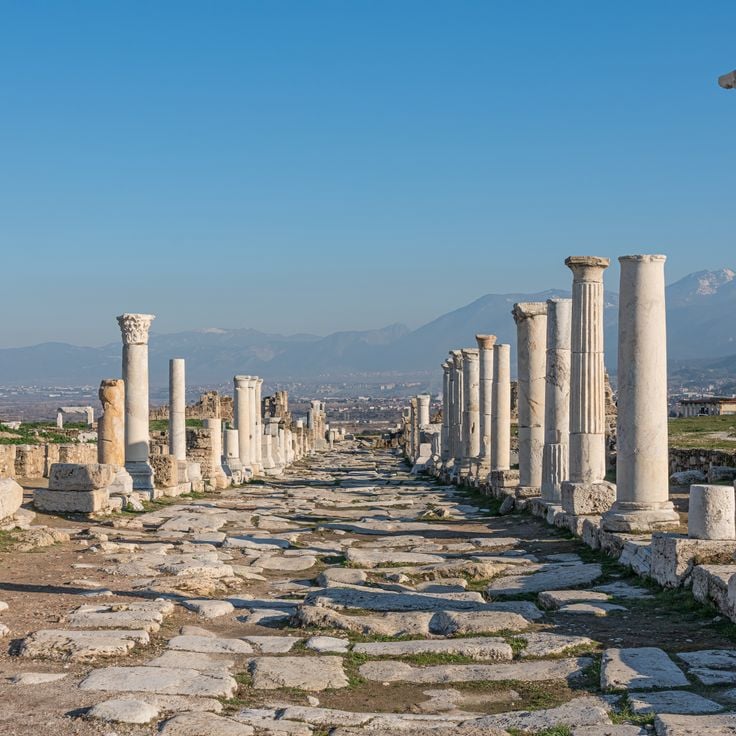
Laodicea sits on the outskirts of Denizli and is one of the largest ancient cities in western Anatolia. A theater, a stadium, temples and early Christian churches all stand in the open air, easy to walk through. In antiquity, the city was a major trading hub and one of the seven churches addressed in the Book of Revelation. The ruins are spread across a wide, flat area and can be explored on foot.
Aphrodisias sits in a valley in the Aydın province and is one of the best-preserved ancient cities in Turkey. The city was long known for its school of sculpture, which used marble quarried nearby. Visitors can still walk past the Temple of Aphrodite, the large stadium, and the Tetrapylon gateway. The site has been on the UNESCO World Heritage List since 2017.
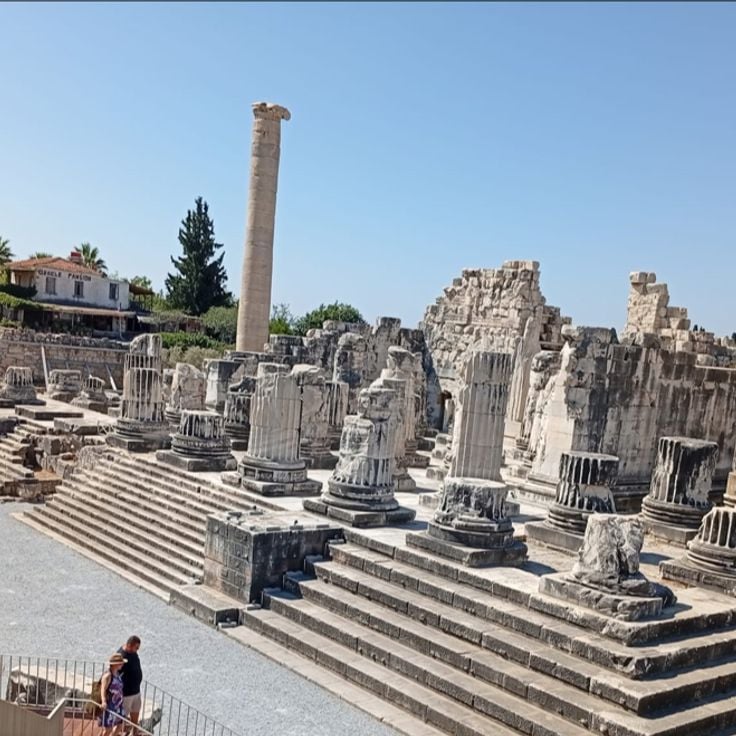
The Temple of Apollo at Didyma stands near the modern town of Didim, south of Miletus. It was one of the largest sanctuaries in the Greek world and held a famous oracle that drew people from across the Mediterranean. The columns still standing are very tall, giving a clear sense of how large the building once was. Construction began in the 4th century BC and was never fully completed. Today you can walk between the columns and stone blocks and take in the scale of the place at your own pace.
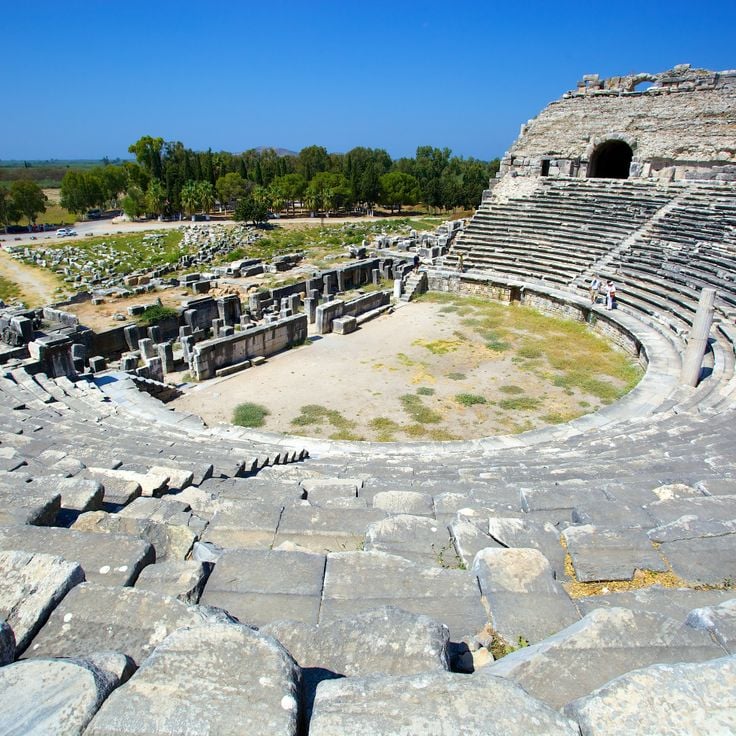
Miletus was once one of the great port cities of the ancient Greek world. Located near Aydın, it sat at the edge of the Aegean and grew into a center of trade and philosophy. Thinkers like Thales and Anaximander came from here. Today, visitors can walk through the remains of the city and see its large theater, carved into the hillside and still standing after many centuries.
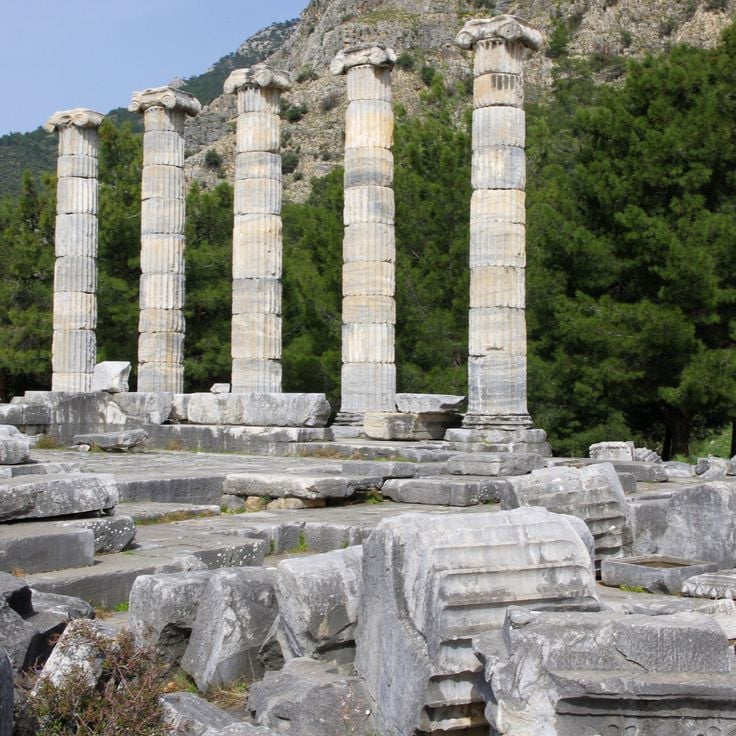
Priene is an ancient Greek city built into the slopes of Mount Mykale. Its streets follow a grid plan laid out more than 2,000 years ago. The temple of Athena, the theater, and the agora are still visible today. Because Priene draws fewer visitors than Ephesus or Pergamon, you can walk through the ruins at your own pace and get a real sense of how the city once looked.
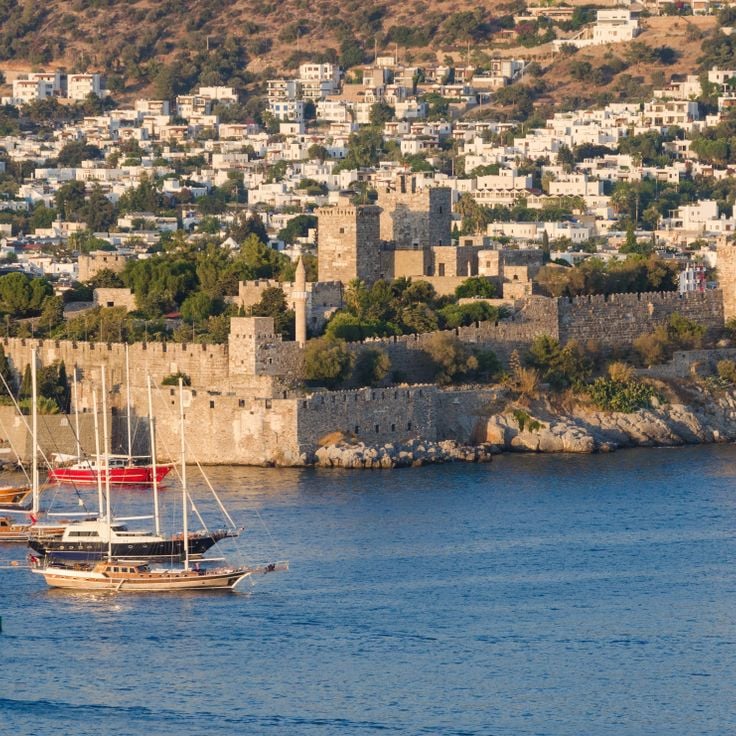
Bodrum and the Castle of Saint Peter sit on the Turkish Aegean coast. The castle was built by the Knights of Saint John in the 15th century and rises above the harbor. Inside, it houses the Museum of Underwater Archaeology, where objects recovered from ancient shipwrecks found off the coast are on display. The town itself is known for its white houses, narrow lanes, and the busy waterfront where fishing boats and private yachts anchor side by side.
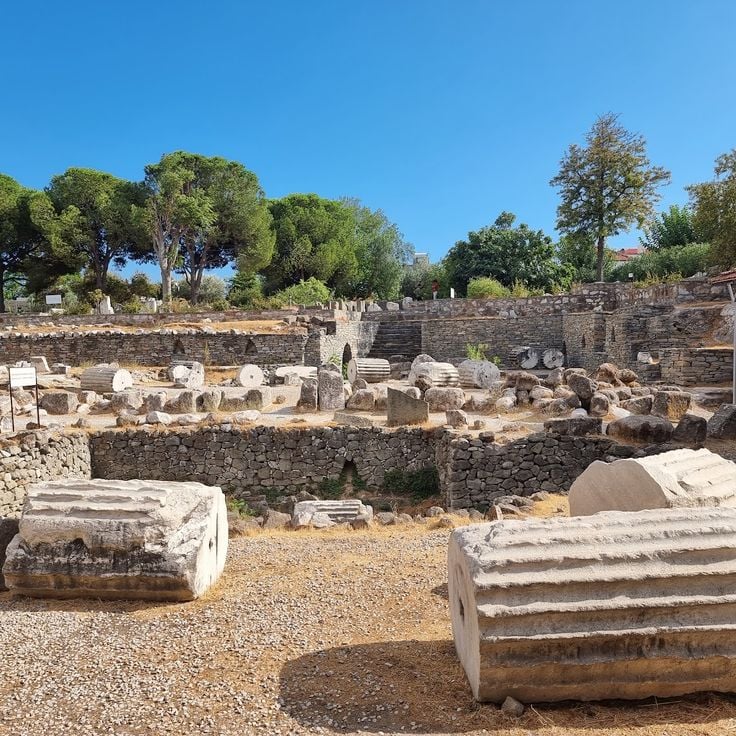
The Mausoleum of Halicarnassus, in Bodrum, was once one of the Seven Wonders of the Ancient World. Today, only the foundations and a few stone fragments remain, but the site still tells a story: this was a giant tomb built for King Maussollos in the 4th century BC. Many of the original sculptures were taken to the British Museum in London. Walking through the ruins, you get a sense of how large and carefully built this monument once was.
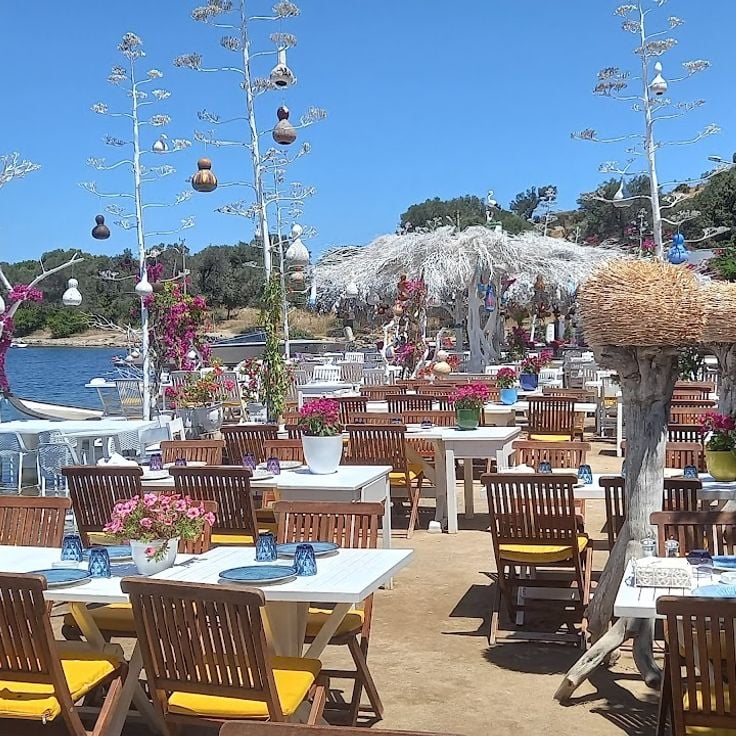
Gümüşlük is a small fishing village on the Aegean coast, west of Bodrum. Restaurants line the waterfront, where you can eat just a few feet (a few meters) from the sea while boats rock in the harbor. Beneath and along the shoreline lie the remains of ancient Myndos, a Greek city whose walls and foundations are still partly visible. The village draws visitors looking for a quieter side of the Bodrum peninsula, away from the more crowded coastal towns.
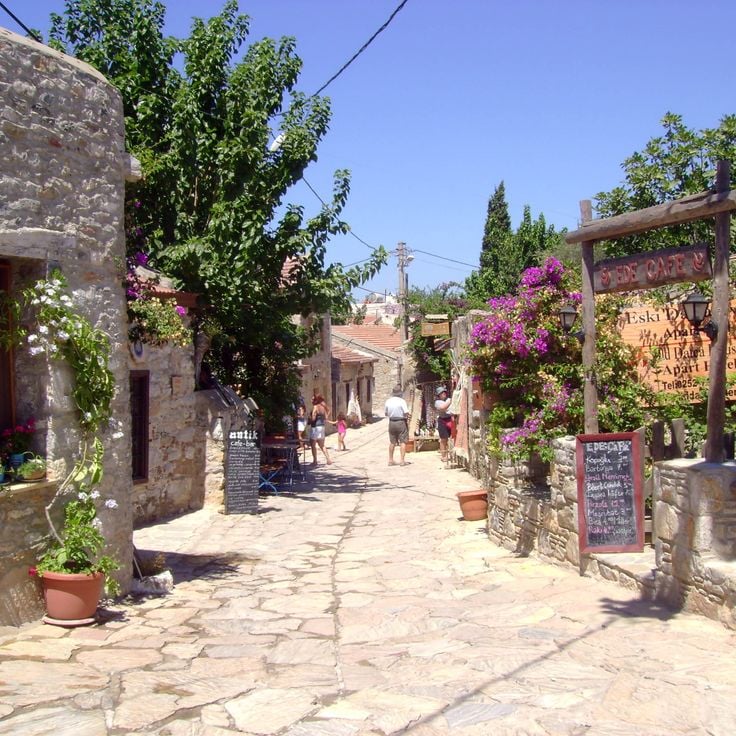
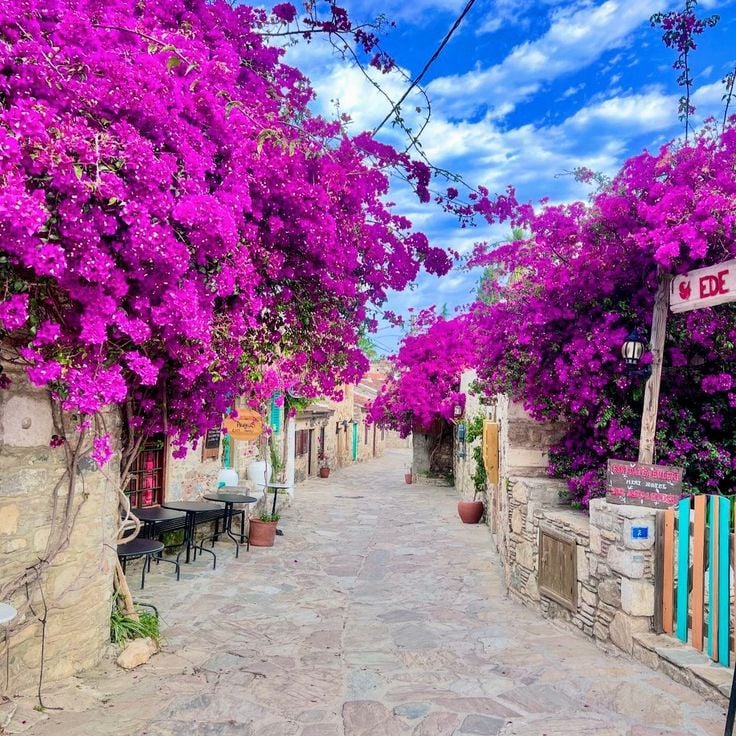
The Datça Peninsula stretches far into the Aegean Sea, separating it from the Mediterranean. The landscape is dry and hilly, covered with almond trees, and dotted with small coves where the water is remarkably clear. Eski Datça, the old village, has narrow stone streets and traditional houses that have changed little over time. At the far end of the peninsula, the ruins of Knidos sit right at the water's edge, where two seas meet. Datça is one of the most remote corners of the Turkish Aegean, and that distance has helped it stay as it is.
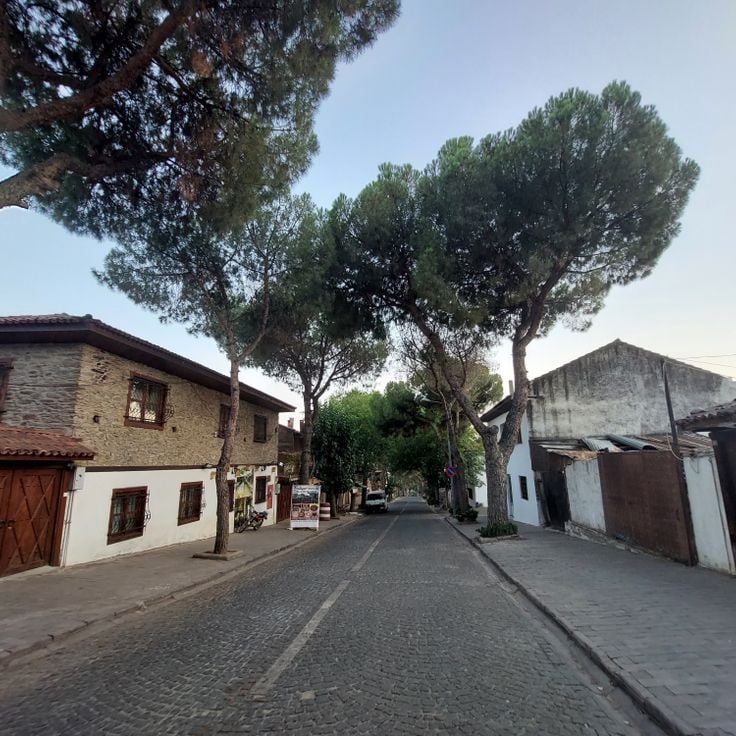
Eski Datça, the old quarter of Datça, is a village of cobblestone lanes and stone houses that have been carefully restored. Bougainvillea climbs the facades, and the narrow streets invite a slow walk. For those looking to see traditional Ottoman architecture along the Aegean coast, this old quarter is one of the most genuine examples in the region.
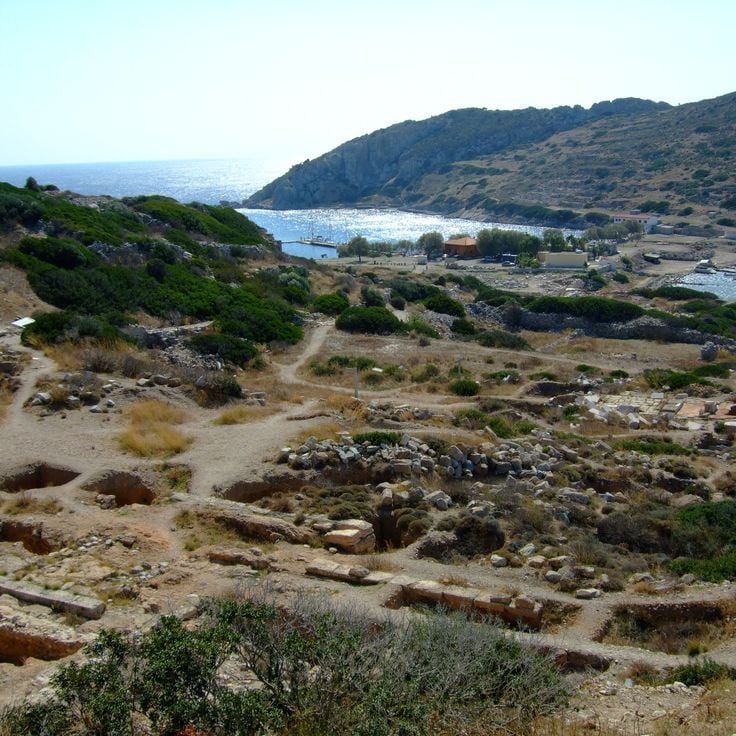
Knidos sits at the far tip of the Datça Peninsula, where the Aegean and the Mediterranean meet. This ancient city was once a major trading port and home to one of the most talked-about temples of Aphrodite in the ancient world. Today, the ruins spread across two levels along the rocky shore, with a harbor, stretches of wall, a theater, and several temple platforms still visible. The setting, open to both seas at once, gives the place a rare feeling that few ancient sites can match.
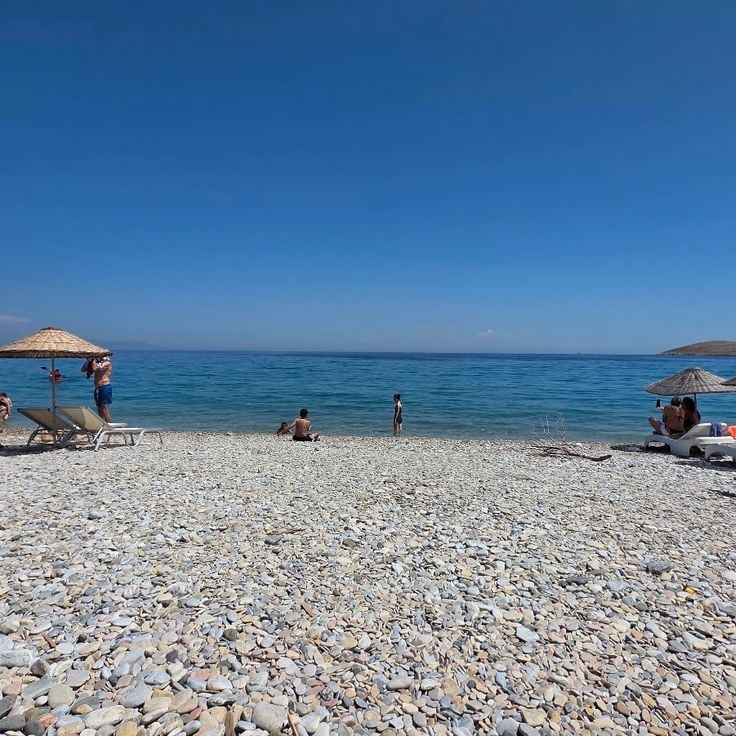
Palamutbükü is a small bay on the Datça Peninsula, with calm water and a long sandy beach bordered by rocky coves. A fishing village sits at the water's edge, living at a slow pace tied to the sea and the seasons. The surrounding coastline remains largely undeveloped, and smaller coves nearby can be reached on foot or by boat. It is one of those places along the Aegean coast where life feels unhurried and the water stays clear through summer.
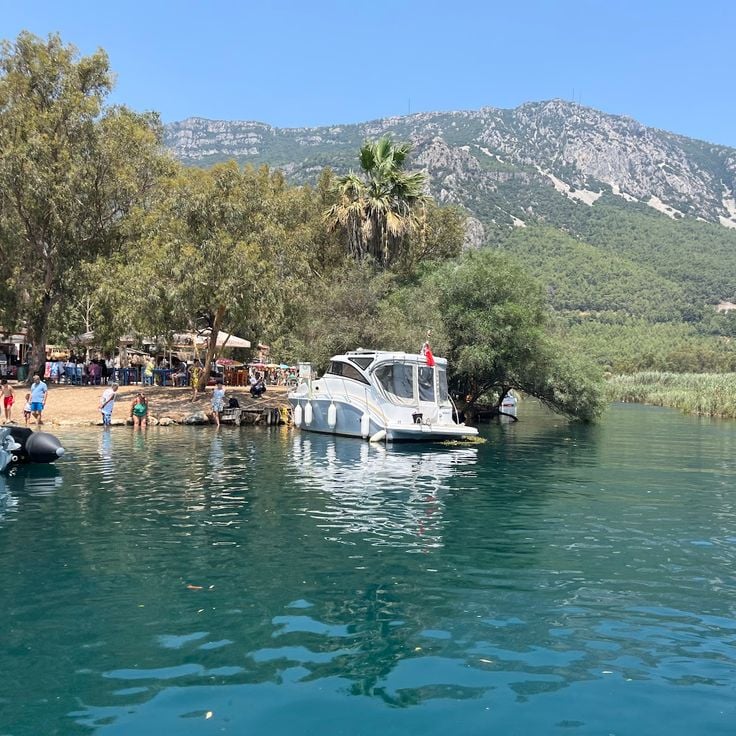
Akyaka sits at the far end of the Gulf of Gökova, where the Azmak River slowly flows into the sea. The water is cool and clear, running through reeds and trees before reaching the coast. Small boats drift along the river, and people eat at simple restaurants on the banks. The town itself has wooden houses with sloping roofs, built in a local style promoted by a Turkish architect in the 20th century. Akyaka feels more like a slow village than a seaside resort.
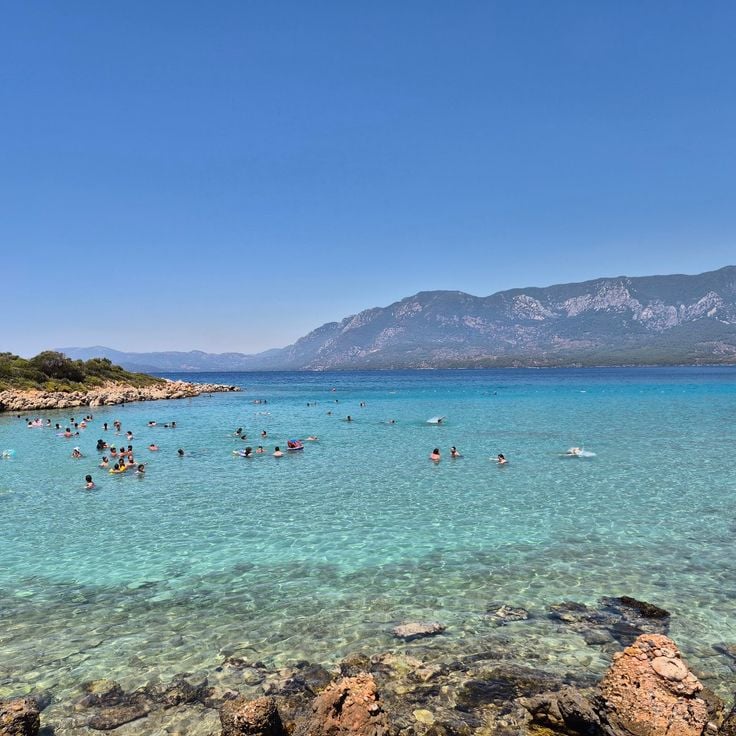
Sedir Island sits in the Gulf of Gökova and draws visitors mainly for its beach, where the sand is said to have been brought from Egypt on Cleopatra's orders. Whether or not the story is true, the sand has a texture found nowhere else in the area. The island also holds the ruins of the ancient city of Cedrae, with old walls and a small theater still visible among the shrubs. Day boats stop here regularly, making it an easy visit from the coast.
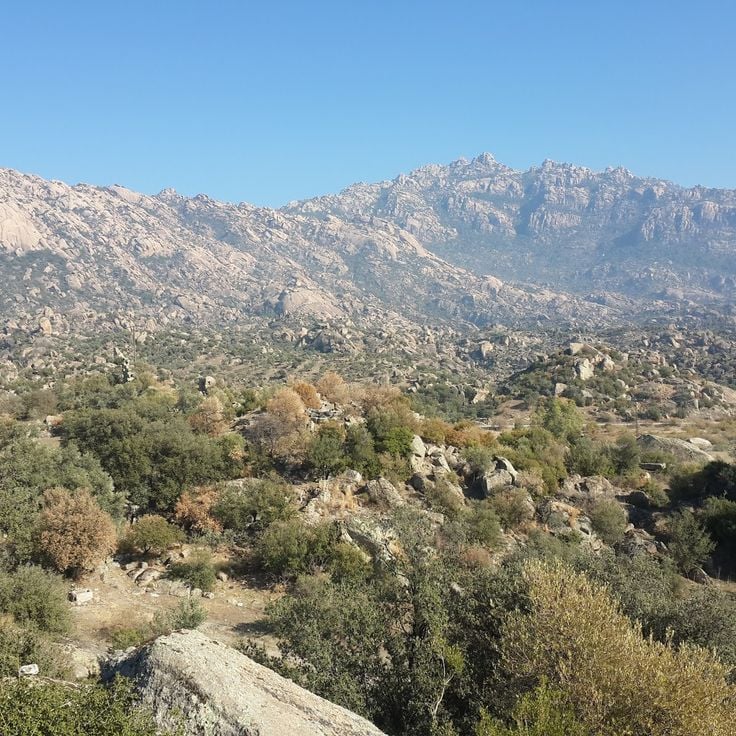
Lake Bafa sits in western Turkey, where the provinces of Aydın and Muğla meet. It was once a bay open to the sea, and over time the coastline shifted, turning it into an inland lake. Today, huge granite boulders from the Latmos mountain rise above the water, and Byzantine monasteries cling to the rocks nearby. Old olive groves line the shores, and the light on the water changes throughout the day. Trails lead into the hills, past ancient ruins and rock carvings that date back thousands of years. This corner of the Aegean is less visited than Ephesus or Pamukkale, but it offers a lot to those who come.
Birgi is a small Ottoman village near Ödemiş where stone houses with wooden balconies line narrow cobblestone streets. The place feels largely untouched. Few visitors come here, which makes it easy to walk around and take in the old architecture at your own pace. A 14th-century mosque and several historic mansions, including the Çakırağa Konak, give the village its character. Birgi is one of the few places in the Turkish Aegean where Ottoman village life is still so visible.
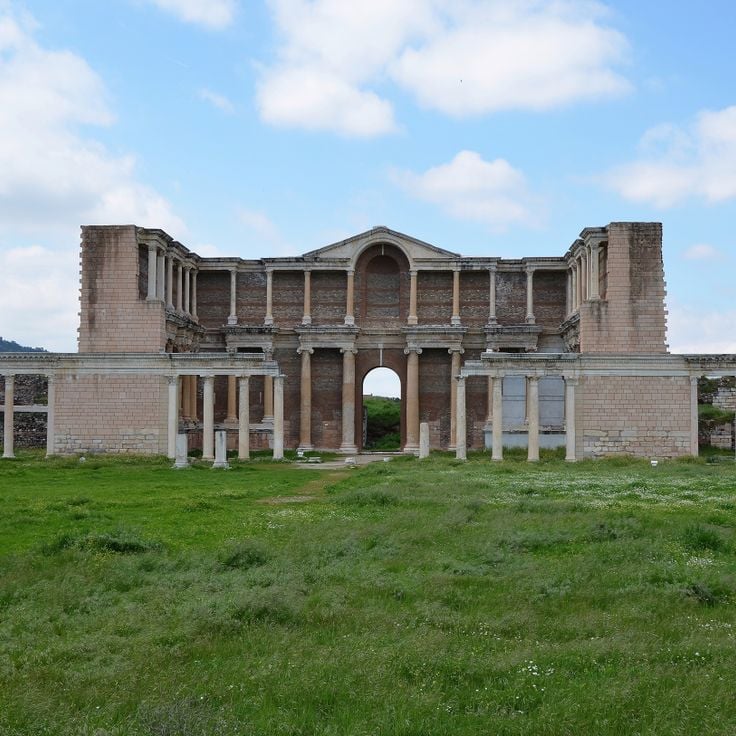
Sardes was once the capital of the Lydian kingdom, ruled by King Croesus, whose name became a byword for wealth in the ancient world. Located near Manisa, the site preserves the standing columns of a Temple of Artemis, a large ancient synagogue, and the ruins of a Roman gymnasium. Walking through Sardes gives a clear sense of how many different civilizations used this same ground over the centuries. The site joined the UNESCO World Heritage List in 2025.
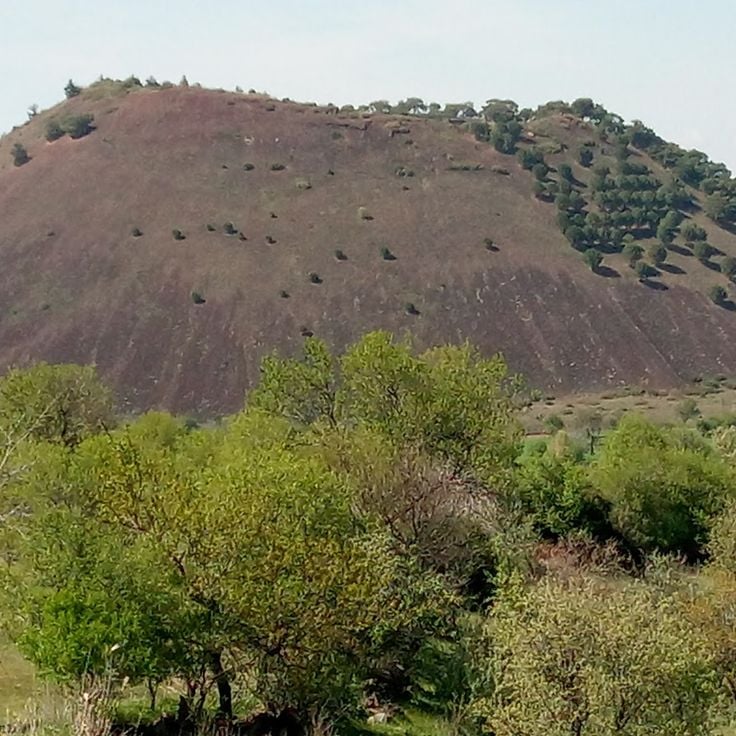
Kula and its fairy chimneys sit in the Manisa province and represent one of the more out-of-the-way stops in this Aegean collection. The land here is volcanic, shaped over centuries by lava flows that left behind tall, narrow rock towers rising from the ground. Among these formations, old stone houses recall the Ottoman past of the area. Walking through Kula means seeing two very different worlds side by side: the raw volcanic ground and the built history of the people who settled here.
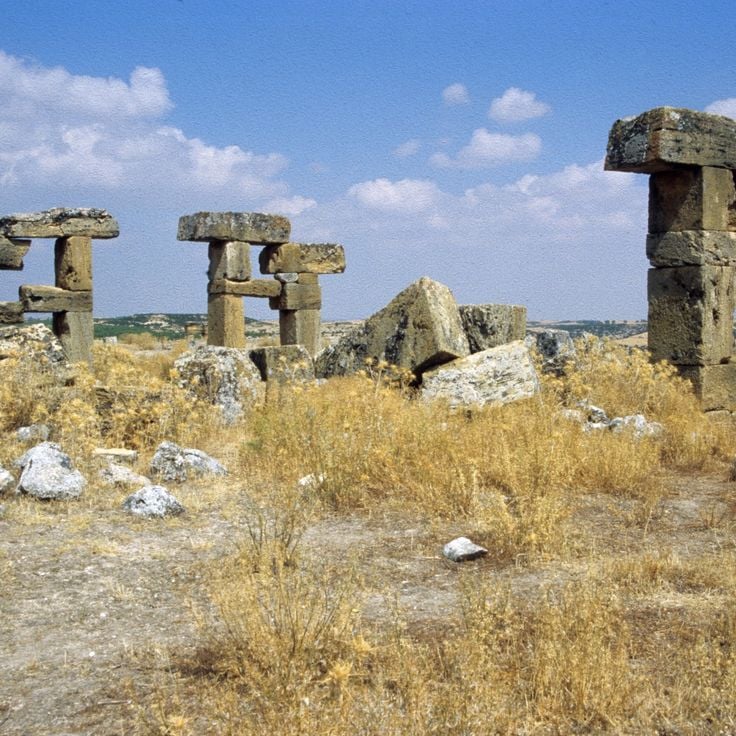
The ancient city of Blaundos sits on a plateau in the southeast of Uşak province, surrounded by deep canyons. Very few visitors make it out here. You can see the remains of a theater, rock-cut tombs and scattered ruins slowly being reclaimed by vegetation. The road leading there runs through a bare landscape that is worth the trip on its own.
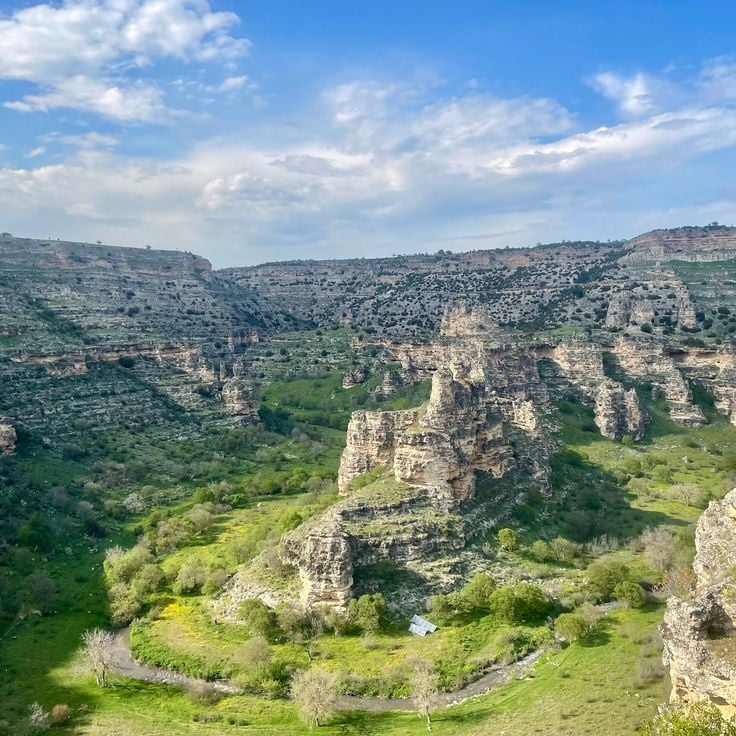
The Ulubey Canyon sits in Uşak province and ranks among the deepest gorges in Turkey. Steep rock walls rise on both sides, with a narrow riverbed running below. Walking through it feels very different from visiting the ancient cities nearby. The path passes through tight passages, past rough stone walls and small caves carved into the rock. It offers a raw, earthy contrast to the ruins and marble columns found elsewhere in the Aegean region.
Ephesus is one of the best preserved ancient cities along the Aegean coast. Walking through its stone streets, you pass the two-story facade of the Library of Celsus, the large open-air theater, and the ruins of temples and private homes. The city was once a major trading hub and is now a UNESCO World Heritage Site. Plan for at least a half day to walk the main avenue and side paths at a comfortable pace.
The House of the Virgin Mary sits on a wooded hill above the ruins of Ephesus, a short drive from Selçuk. Tradition holds that Mary spent her final years here, and the site draws Christian pilgrims as well as Muslim visitors who also venerate her. The small stone chapel at the center of the site is simple and spare. Candles burn at the entrance, and a wall nearby is covered with notes and prayers left by visitors. The surrounding forest adds to the feeling of stepping away from the world for a moment.
The Basilica of Saint John in Selçuk was built by the Byzantine emperor Justinian in the 6th century over a tomb believed to be that of John the Apostle. What remains today are foundations, a few re-erected columns, and the outlines of the nave and apse. Walking through the ruins gives a clear sense of how large the original church once was. The site sits on Ayasuluk Hill, with views over the surrounding plain and the nearby hilltop fortress.
The Temple of Artemis in Selçuk was once one of the Seven Wonders of the Ancient World. Today, only a single column still stands on the site. Over the centuries, most of the stones were taken and reused in other buildings, including the Hagia Sophia in Istanbul. Walking around the ruins, you get a real sense of how large and important this sanctuary once was in the Greek world.
Şirince is a hillside village near Selçuk, built mostly in the 19th century by a Greek community that once lived here. Its stone houses with wooden balconies line narrow cobblestone alleys that climb up through orchards and vineyards. Today the village draws visitors looking to walk through old streets, taste local fruit wines and see what a traditional Aegean village looks and feels like.
The acropolis of Pergamon rises above the modern town of Bergama, sitting high on a hill over the surrounding plain. This ancient Greek city is one of the most striking sites in the Turkish Aegean. Visitors can walk among the ruins of temples, colonnaded streets, and a steep theater carved into the hillside. The site has been recognized by UNESCO as a World Heritage site.
The Asclepion of Pergamon sits on the edge of the ancient city and was one of the most visited healing sanctuaries in the Greek world. People traveled from across the Mediterranean to seek treatment here. The site combined religious worship with practical care: patients bathed in sacred waters, walked along colonnaded paths, and slept in the sanctuary hoping for healing dreams sent by the god Asclepius. Today, the colonnaded walkways, a small theater, and the remains of the bath complex are still visible and give a clear sense of how the place once functioned.
Kemeraltı is the historic bazaar district of İzmir, one of the oldest trading areas on the Turkish Aegean coast. Its narrow lanes are lined with Ottoman-era caravanserais, old mosques, tea houses and small shops selling everything from spices to fabric. This is where people from İzmir come to buy everyday goods, meet friends and spend time. Walking through the old town around the bazaar, you can still see traces of the city's Greek, Jewish and Ottoman past in the buildings and street layout.
The Agora of Smyrna sits in the middle of modern Izmir, surrounded by city streets and apartment buildings. It is one of the few places where you can see ancient Greek ruins right at the heart of a living city. The site shows columns, arches and underground storage rooms that date back to a reconstruction carried out in the 2nd century, after an earthquake. Walking through it feels like stepping between two worlds at once.
The Clock Tower on Konak Square is the most recognizable landmark in İzmir. Built in 1901 in an Ottoman style, it stands at the center of the old city, right on the edge of the bay. At any time of day, locals gather around the square: in the morning on their way to work, at noon for lunch, and in the evening for a stroll along the waterfront. The tower works as a natural meeting point and a starting place for exploring the city on foot.
Alaçatı is a stone village on the Çeşme peninsula, known for its narrow paved lanes and old stone houses, many of which have been turned into cafés, small hotels, and shops. Several old windmills still stand on the edges of the village. The nearby coast is a popular spot for windsurfing, thanks to the steady winds that blow across the bay. In summer, the streets fill with visitors who come to walk through the old town and sit at outdoor tables.
Çeşme is a seaside town on the Turkish Aegean coast, sitting almost directly across from the Greek island of Chios. A 16th-century Ottoman fortress rises above the harbor and can be seen from far out at sea. In summer, the streets near the waterfront fill with people eating at outdoor tables and watching the boats come and go. The white houses, the fishing boats, and the old castle walls together give the town a character that is easy to read at a glance.
Urla is a small town west of Izmir, set among vineyards and olive groves along the Aegean coast. It has become one of the main wine-producing areas in the region. A wine route connects several small estates where visitors can taste local varieties. Between the vineyards, villages offer restaurants that cook with seasonal and local ingredients. Urla brings a different side of the Aegean together with the ancient ruins and stone villages found elsewhere in this collection.
Pamukkale, near Denizli, is known for its white travertine terraces fed by warm thermal springs. Water has been flowing down the hillside for centuries, slowly forming these bright, stepped pools. Visitors walk barefoot across the terraces, where the water is warm and the surface feels smooth underfoot. Just behind them stand the ruins of Hierapolis, an ancient city the Romans built around the same springs.
Hierapolis sits on the plateau just above the white calcium terraces of Pamukkale. This ancient city was once a popular thermal resort, drawing visitors from across the Roman world. Today you can walk through the ruins of a large theater, explore one of the longest ancient necropolises in Asia Minor, and see the remains of baths and temples. The view from the plateau across the plain below adds a lot to the experience. Hierapolis is listed as a UNESCO World Heritage Site together with Pamukkale.
Laodicea sits on the outskirts of Denizli and is one of the largest ancient cities in western Anatolia. A theater, a stadium, temples and early Christian churches all stand in the open air, easy to walk through. In antiquity, the city was a major trading hub and one of the seven churches addressed in the Book of Revelation. The ruins are spread across a wide, flat area and can be explored on foot.
Aphrodisias sits in a valley in the Aydın province and is one of the best-preserved ancient cities in Turkey. The city was long known for its school of sculpture, which used marble quarried nearby. Visitors can still walk past the Temple of Aphrodite, the large stadium, and the Tetrapylon gateway. The site has been on the UNESCO World Heritage List since 2017.
The Temple of Apollo at Didyma stands near the modern town of Didim, south of Miletus. It was one of the largest sanctuaries in the Greek world and held a famous oracle that drew people from across the Mediterranean. The columns still standing are very tall, giving a clear sense of how large the building once was. Construction began in the 4th century BC and was never fully completed. Today you can walk between the columns and stone blocks and take in the scale of the place at your own pace.
Miletus was once one of the great port cities of the ancient Greek world. Located near Aydın, it sat at the edge of the Aegean and grew into a center of trade and philosophy. Thinkers like Thales and Anaximander came from here. Today, visitors can walk through the remains of the city and see its large theater, carved into the hillside and still standing after many centuries.
Priene is an ancient Greek city built into the slopes of Mount Mykale. Its streets follow a grid plan laid out more than 2,000 years ago. The temple of Athena, the theater, and the agora are still visible today. Because Priene draws fewer visitors than Ephesus or Pergamon, you can walk through the ruins at your own pace and get a real sense of how the city once looked.
Bodrum and the Castle of Saint Peter sit on the Turkish Aegean coast. The castle was built by the Knights of Saint John in the 15th century and rises above the harbor. Inside, it houses the Museum of Underwater Archaeology, where objects recovered from ancient shipwrecks found off the coast are on display. The town itself is known for its white houses, narrow lanes, and the busy waterfront where fishing boats and private yachts anchor side by side.
The Mausoleum of Halicarnassus, in Bodrum, was once one of the Seven Wonders of the Ancient World. Today, only the foundations and a few stone fragments remain, but the site still tells a story: this was a giant tomb built for King Maussollos in the 4th century BC. Many of the original sculptures were taken to the British Museum in London. Walking through the ruins, you get a sense of how large and carefully built this monument once was.
Gümüşlük is a small fishing village on the Aegean coast, west of Bodrum. Restaurants line the waterfront, where you can eat just a few feet (a few meters) from the sea while boats rock in the harbor. Beneath and along the shoreline lie the remains of ancient Myndos, a Greek city whose walls and foundations are still partly visible. The village draws visitors looking for a quieter side of the Bodrum peninsula, away from the more crowded coastal towns.
The Datça Peninsula stretches far into the Aegean Sea, separating it from the Mediterranean. The landscape is dry and hilly, covered with almond trees, and dotted with small coves where the water is remarkably clear. Eski Datça, the old village, has narrow stone streets and traditional houses that have changed little over time. At the far end of the peninsula, the ruins of Knidos sit right at the water's edge, where two seas meet. Datça is one of the most remote corners of the Turkish Aegean, and that distance has helped it stay as it is.
Eski Datça, the old quarter of Datça, is a village of cobblestone lanes and stone houses that have been carefully restored. Bougainvillea climbs the facades, and the narrow streets invite a slow walk. For those looking to see traditional Ottoman architecture along the Aegean coast, this old quarter is one of the most genuine examples in the region.
Knidos sits at the far tip of the Datça Peninsula, where the Aegean and the Mediterranean meet. This ancient city was once a major trading port and home to one of the most talked-about temples of Aphrodite in the ancient world. Today, the ruins spread across two levels along the rocky shore, with a harbor, stretches of wall, a theater, and several temple platforms still visible. The setting, open to both seas at once, gives the place a rare feeling that few ancient sites can match.
Palamutbükü is a small bay on the Datça Peninsula, with calm water and a long sandy beach bordered by rocky coves. A fishing village sits at the water's edge, living at a slow pace tied to the sea and the seasons. The surrounding coastline remains largely undeveloped, and smaller coves nearby can be reached on foot or by boat. It is one of those places along the Aegean coast where life feels unhurried and the water stays clear through summer.
Akyaka sits at the far end of the Gulf of Gökova, where the Azmak River slowly flows into the sea. The water is cool and clear, running through reeds and trees before reaching the coast. Small boats drift along the river, and people eat at simple restaurants on the banks. The town itself has wooden houses with sloping roofs, built in a local style promoted by a Turkish architect in the 20th century. Akyaka feels more like a slow village than a seaside resort.
Sedir Island sits in the Gulf of Gökova and draws visitors mainly for its beach, where the sand is said to have been brought from Egypt on Cleopatra's orders. Whether or not the story is true, the sand has a texture found nowhere else in the area. The island also holds the ruins of the ancient city of Cedrae, with old walls and a small theater still visible among the shrubs. Day boats stop here regularly, making it an easy visit from the coast.
Lake Bafa sits in western Turkey, where the provinces of Aydın and Muğla meet. It was once a bay open to the sea, and over time the coastline shifted, turning it into an inland lake. Today, huge granite boulders from the Latmos mountain rise above the water, and Byzantine monasteries cling to the rocks nearby. Old olive groves line the shores, and the light on the water changes throughout the day. Trails lead into the hills, past ancient ruins and rock carvings that date back thousands of years. This corner of the Aegean is less visited than Ephesus or Pamukkale, but it offers a lot to those who come.
Birgi is a small Ottoman village near Ödemiş where stone houses with wooden balconies line narrow cobblestone streets. The place feels largely untouched. Few visitors come here, which makes it easy to walk around and take in the old architecture at your own pace. A 14th-century mosque and several historic mansions, including the Çakırağa Konak, give the village its character. Birgi is one of the few places in the Turkish Aegean where Ottoman village life is still so visible.
Sardes was once the capital of the Lydian kingdom, ruled by King Croesus, whose name became a byword for wealth in the ancient world. Located near Manisa, the site preserves the standing columns of a Temple of Artemis, a large ancient synagogue, and the ruins of a Roman gymnasium. Walking through Sardes gives a clear sense of how many different civilizations used this same ground over the centuries. The site joined the UNESCO World Heritage List in 2025.
Kula and its fairy chimneys sit in the Manisa province and represent one of the more out-of-the-way stops in this Aegean collection. The land here is volcanic, shaped over centuries by lava flows that left behind tall, narrow rock towers rising from the ground. Among these formations, old stone houses recall the Ottoman past of the area. Walking through Kula means seeing two very different worlds side by side: the raw volcanic ground and the built history of the people who settled here.
The ancient city of Blaundos sits on a plateau in the southeast of Uşak province, surrounded by deep canyons. Very few visitors make it out here. You can see the remains of a theater, rock-cut tombs and scattered ruins slowly being reclaimed by vegetation. The road leading there runs through a bare landscape that is worth the trip on its own.
The Ulubey Canyon sits in Uşak province and ranks among the deepest gorges in Turkey. Steep rock walls rise on both sides, with a narrow riverbed running below. Walking through it feels very different from visiting the ancient cities nearby. The path passes through tight passages, past rough stone walls and small caves carved into the rock. It offers a raw, earthy contrast to the ruins and marble columns found elsewhere in the Aegean region.
Ephesus is one of the best preserved ancient cities along the Aegean coast. Walking through its stone streets, you pass the two-story facade of the Library of Celsus, the large open-air theater, and the ruins of temples and private homes. The city was once a major trading hub and is now a UNESCO World Heritage Site. Plan for at least a half day to walk the main avenue and side paths at a comfortable pace.
The House of the Virgin Mary sits on a wooded hill above the ruins of Ephesus, a short drive from Selçuk. Tradition holds that Mary spent her final years here, and the site draws Christian pilgrims as well as Muslim visitors who also venerate her. The small stone chapel at the center of the site is simple and spare. Candles burn at the entrance, and a wall nearby is covered with notes and prayers left by visitors. The surrounding forest adds to the feeling of stepping away from the world for a moment.
The Basilica of Saint John in Selçuk was built by the Byzantine emperor Justinian in the 6th century over a tomb believed to be that of John the Apostle. What remains today are foundations, a few re-erected columns, and the outlines of the nave and apse. Walking through the ruins gives a clear sense of how large the original church once was. The site sits on Ayasuluk Hill, with views over the surrounding plain and the nearby hilltop fortress.
The Temple of Artemis in Selçuk was once one of the Seven Wonders of the Ancient World. Today, only a single column still stands on the site. Over the centuries, most of the stones were taken and reused in other buildings, including the Hagia Sophia in Istanbul. Walking around the ruins, you get a real sense of how large and important this sanctuary once was in the Greek world.
Şirince is a hillside village near Selçuk, built mostly in the 19th century by a Greek community that once lived here. Its stone houses with wooden balconies line narrow cobblestone alleys that climb up through orchards and vineyards. Today the village draws visitors looking to walk through old streets, taste local fruit wines and see what a traditional Aegean village looks and feels like.
The acropolis of Pergamon rises above the modern town of Bergama, sitting high on a hill over the surrounding plain. This ancient Greek city is one of the most striking sites in the Turkish Aegean. Visitors can walk among the ruins of temples, colonnaded streets, and a steep theater carved into the hillside. The site has been recognized by UNESCO as a World Heritage site.
The Asclepion of Pergamon sits on the edge of the ancient city and was one of the most visited healing sanctuaries in the Greek world. People traveled from across the Mediterranean to seek treatment here. The site combined religious worship with practical care: patients bathed in sacred waters, walked along colonnaded paths, and slept in the sanctuary hoping for healing dreams sent by the god Asclepius. Today, the colonnaded walkways, a small theater, and the remains of the bath complex are still visible and give a clear sense of how the place once functioned.
Kemeraltı is the historic bazaar district of İzmir, one of the oldest trading areas on the Turkish Aegean coast. Its narrow lanes are lined with Ottoman-era caravanserais, old mosques, tea houses and small shops selling everything from spices to fabric. This is where people from İzmir come to buy everyday goods, meet friends and spend time. Walking through the old town around the bazaar, you can still see traces of the city's Greek, Jewish and Ottoman past in the buildings and street layout.
The Agora of Smyrna sits in the middle of modern Izmir, surrounded by city streets and apartment buildings. It is one of the few places where you can see ancient Greek ruins right at the heart of a living city. The site shows columns, arches and underground storage rooms that date back to a reconstruction carried out in the 2nd century, after an earthquake. Walking through it feels like stepping between two worlds at once.
The Clock Tower on Konak Square is the most recognizable landmark in İzmir. Built in 1901 in an Ottoman style, it stands at the center of the old city, right on the edge of the bay. At any time of day, locals gather around the square: in the morning on their way to work, at noon for lunch, and in the evening for a stroll along the waterfront. The tower works as a natural meeting point and a starting place for exploring the city on foot.
Alaçatı is a stone village on the Çeşme peninsula, known for its narrow paved lanes and old stone houses, many of which have been turned into cafés, small hotels, and shops. Several old windmills still stand on the edges of the village. The nearby coast is a popular spot for windsurfing, thanks to the steady winds that blow across the bay. In summer, the streets fill with visitors who come to walk through the old town and sit at outdoor tables.
Çeşme is a seaside town on the Turkish Aegean coast, sitting almost directly across from the Greek island of Chios. A 16th-century Ottoman fortress rises above the harbor and can be seen from far out at sea. In summer, the streets near the waterfront fill with people eating at outdoor tables and watching the boats come and go. The white houses, the fishing boats, and the old castle walls together give the town a character that is easy to read at a glance.
Urla is a small town west of Izmir, set among vineyards and olive groves along the Aegean coast. It has become one of the main wine-producing areas in the region. A wine route connects several small estates where visitors can taste local varieties. Between the vineyards, villages offer restaurants that cook with seasonal and local ingredients. Urla brings a different side of the Aegean together with the ancient ruins and stone villages found elsewhere in this collection.
Pamukkale, near Denizli, is known for its white travertine terraces fed by warm thermal springs. Water has been flowing down the hillside for centuries, slowly forming these bright, stepped pools. Visitors walk barefoot across the terraces, where the water is warm and the surface feels smooth underfoot. Just behind them stand the ruins of Hierapolis, an ancient city the Romans built around the same springs.
Hierapolis sits on the plateau just above the white calcium terraces of Pamukkale. This ancient city was once a popular thermal resort, drawing visitors from across the Roman world. Today you can walk through the ruins of a large theater, explore one of the longest ancient necropolises in Asia Minor, and see the remains of baths and temples. The view from the plateau across the plain below adds a lot to the experience. Hierapolis is listed as a UNESCO World Heritage Site together with Pamukkale.
Laodicea sits on the outskirts of Denizli and is one of the largest ancient cities in western Anatolia. A theater, a stadium, temples and early Christian churches all stand in the open air, easy to walk through. In antiquity, the city was a major trading hub and one of the seven churches addressed in the Book of Revelation. The ruins are spread across a wide, flat area and can be explored on foot.
Aphrodisias sits in a valley in the Aydın province and is one of the best-preserved ancient cities in Turkey. The city was long known for its school of sculpture, which used marble quarried nearby. Visitors can still walk past the Temple of Aphrodite, the large stadium, and the Tetrapylon gateway. The site has been on the UNESCO World Heritage List since 2017.
The Temple of Apollo at Didyma stands near the modern town of Didim, south of Miletus. It was one of the largest sanctuaries in the Greek world and held a famous oracle that drew people from across the Mediterranean. The columns still standing are very tall, giving a clear sense of how large the building once was. Construction began in the 4th century BC and was never fully completed. Today you can walk between the columns and stone blocks and take in the scale of the place at your own pace.
Miletus was once one of the great port cities of the ancient Greek world. Located near Aydın, it sat at the edge of the Aegean and grew into a center of trade and philosophy. Thinkers like Thales and Anaximander came from here. Today, visitors can walk through the remains of the city and see its large theater, carved into the hillside and still standing after many centuries.
Priene is an ancient Greek city built into the slopes of Mount Mykale. Its streets follow a grid plan laid out more than 2,000 years ago. The temple of Athena, the theater, and the agora are still visible today. Because Priene draws fewer visitors than Ephesus or Pergamon, you can walk through the ruins at your own pace and get a real sense of how the city once looked.
Bodrum and the Castle of Saint Peter sit on the Turkish Aegean coast. The castle was built by the Knights of Saint John in the 15th century and rises above the harbor. Inside, it houses the Museum of Underwater Archaeology, where objects recovered from ancient shipwrecks found off the coast are on display. The town itself is known for its white houses, narrow lanes, and the busy waterfront where fishing boats and private yachts anchor side by side.
The Mausoleum of Halicarnassus, in Bodrum, was once one of the Seven Wonders of the Ancient World. Today, only the foundations and a few stone fragments remain, but the site still tells a story: this was a giant tomb built for King Maussollos in the 4th century BC. Many of the original sculptures were taken to the British Museum in London. Walking through the ruins, you get a sense of how large and carefully built this monument once was.
Gümüşlük is a small fishing village on the Aegean coast, west of Bodrum. Restaurants line the waterfront, where you can eat just a few feet (a few meters) from the sea while boats rock in the harbor. Beneath and along the shoreline lie the remains of ancient Myndos, a Greek city whose walls and foundations are still partly visible. The village draws visitors looking for a quieter side of the Bodrum peninsula, away from the more crowded coastal towns.
The Datça Peninsula stretches far into the Aegean Sea, separating it from the Mediterranean. The landscape is dry and hilly, covered with almond trees, and dotted with small coves where the water is remarkably clear. Eski Datça, the old village, has narrow stone streets and traditional houses that have changed little over time. At the far end of the peninsula, the ruins of Knidos sit right at the water's edge, where two seas meet. Datça is one of the most remote corners of the Turkish Aegean, and that distance has helped it stay as it is.
Eski Datça, the old quarter of Datça, is a village of cobblestone lanes and stone houses that have been carefully restored. Bougainvillea climbs the facades, and the narrow streets invite a slow walk. For those looking to see traditional Ottoman architecture along the Aegean coast, this old quarter is one of the most genuine examples in the region.
Knidos sits at the far tip of the Datça Peninsula, where the Aegean and the Mediterranean meet. This ancient city was once a major trading port and home to one of the most talked-about temples of Aphrodite in the ancient world. Today, the ruins spread across two levels along the rocky shore, with a harbor, stretches of wall, a theater, and several temple platforms still visible. The setting, open to both seas at once, gives the place a rare feeling that few ancient sites can match.
Palamutbükü is a small bay on the Datça Peninsula, with calm water and a long sandy beach bordered by rocky coves. A fishing village sits at the water's edge, living at a slow pace tied to the sea and the seasons. The surrounding coastline remains largely undeveloped, and smaller coves nearby can be reached on foot or by boat. It is one of those places along the Aegean coast where life feels unhurried and the water stays clear through summer.
Akyaka sits at the far end of the Gulf of Gökova, where the Azmak River slowly flows into the sea. The water is cool and clear, running through reeds and trees before reaching the coast. Small boats drift along the river, and people eat at simple restaurants on the banks. The town itself has wooden houses with sloping roofs, built in a local style promoted by a Turkish architect in the 20th century. Akyaka feels more like a slow village than a seaside resort.
Sedir Island sits in the Gulf of Gökova and draws visitors mainly for its beach, where the sand is said to have been brought from Egypt on Cleopatra's orders. Whether or not the story is true, the sand has a texture found nowhere else in the area. The island also holds the ruins of the ancient city of Cedrae, with old walls and a small theater still visible among the shrubs. Day boats stop here regularly, making it an easy visit from the coast.
Lake Bafa sits in western Turkey, where the provinces of Aydın and Muğla meet. It was once a bay open to the sea, and over time the coastline shifted, turning it into an inland lake. Today, huge granite boulders from the Latmos mountain rise above the water, and Byzantine monasteries cling to the rocks nearby. Old olive groves line the shores, and the light on the water changes throughout the day. Trails lead into the hills, past ancient ruins and rock carvings that date back thousands of years. This corner of the Aegean is less visited than Ephesus or Pamukkale, but it offers a lot to those who come.
Birgi is a small Ottoman village near Ödemiş where stone houses with wooden balconies line narrow cobblestone streets. The place feels largely untouched. Few visitors come here, which makes it easy to walk around and take in the old architecture at your own pace. A 14th-century mosque and several historic mansions, including the Çakırağa Konak, give the village its character. Birgi is one of the few places in the Turkish Aegean where Ottoman village life is still so visible.
Sardes was once the capital of the Lydian kingdom, ruled by King Croesus, whose name became a byword for wealth in the ancient world. Located near Manisa, the site preserves the standing columns of a Temple of Artemis, a large ancient synagogue, and the ruins of a Roman gymnasium. Walking through Sardes gives a clear sense of how many different civilizations used this same ground over the centuries. The site joined the UNESCO World Heritage List in 2025.
Kula and its fairy chimneys sit in the Manisa province and represent one of the more out-of-the-way stops in this Aegean collection. The land here is volcanic, shaped over centuries by lava flows that left behind tall, narrow rock towers rising from the ground. Among these formations, old stone houses recall the Ottoman past of the area. Walking through Kula means seeing two very different worlds side by side: the raw volcanic ground and the built history of the people who settled here.
The ancient city of Blaundos sits on a plateau in the southeast of Uşak province, surrounded by deep canyons. Very few visitors make it out here. You can see the remains of a theater, rock-cut tombs and scattered ruins slowly being reclaimed by vegetation. The road leading there runs through a bare landscape that is worth the trip on its own.
The Ulubey Canyon sits in Uşak province and ranks among the deepest gorges in Turkey. Steep rock walls rise on both sides, with a narrow riverbed running below. Walking through it feels very different from visiting the ancient cities nearby. The path passes through tight passages, past rough stone walls and small caves carved into the rock. It offers a raw, earthy contrast to the ruins and marble columns found elsewhere in the Aegean region.
You will visit the world-famous major sites, but also places where few tourists go. Between the ruins and the villages, you walk through history. One tip: leave early in the morning to avoid the crowds at the main sites and discover the authentic feel of the places.