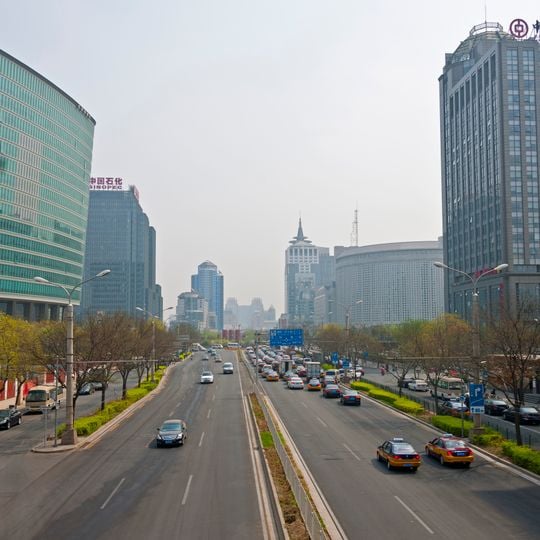
Chaoyangmen, Ming Dynasty gate in Dongcheng District, China.
Chaoyangmen is no longer a standing gate: the Ming-era gate tower and its platform were torn down in 1953 and the archery tower in 1958, and the site is now a junction on the eastern 2nd Ring Road. The former gate tower measured 31.35 m wide and 19.2 m deep, and stood 32 m tall with its platform; its barbican was 68 m wide and 62 m deep, with a gate tower and archery tower built like those of Chongwenmen.
Chaoyangmen began as Qihua Gate of the Yuan capital Dadu. On 14 September 1368 Ming troops entered the city through this gate, ending the Yuan dynasty; it was later renamed for facing east to meet the morning sun. Its archery tower was destroyed by Japanese artillery in 1900 and rebuilt in 1903. The barbican was removed in 1915 for the ring railway, the gate tower and platform in 1953, and the archery tower in 1958.
The gate was named for facing east, greeting the rising sun each day; it was also called Qihuamen, its Yuan-dynasty name still used colloquially. As Beijing's grain gate, it carried the emblem of a grain ear carved above the arch, and was nicknamed Dumen, the gate of rest.
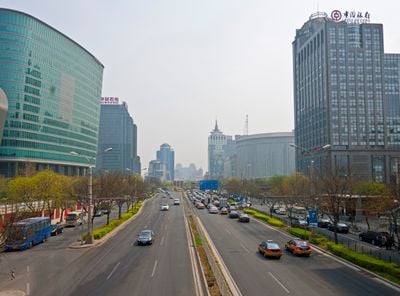
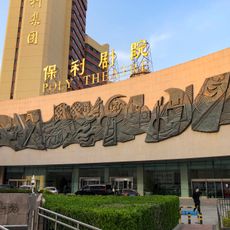
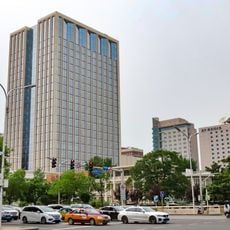
The gate itself no longer stands: the site is now the Chaoyangmen interchange on the eastern 2nd Ring Road, where the moat and walls once ran. Beijing Subway Line 2 and Line 6 meet at Chaoyangmen station, whose exits open beside the overpass. West lies Chaoyangmen Inner Street toward Dongsi and Wangfujing; east, Chaoyangmen Outer Street leads to the Chaowai area and Zhihua Temple.
The gate itself is gone: it was torn down in 1953, its archery tower in 1958, and the 2nd Ring Road now runs where the walls and moat stood. What survives is the name, carried by the bridge, the subway interchange of Lines 2 and 6, and the boundary between Dongcheng and Chaoyang Districts.
The community of curious travelers
AroundUs brings together thousands of curated places, local tips, and hidden gems, enriched daily by 93,685 contributors worldwide.