Chenghuang temple of Guangzhou, Taoist temple in Guangzhou, China.
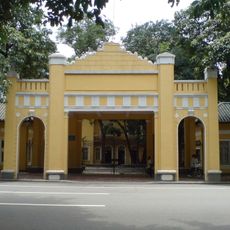
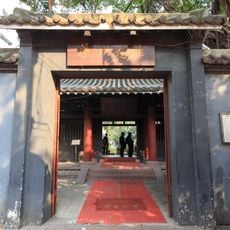
Chenghuang Temple of Guangzhou faces south on Zhongshan 4th Road in Yuexiu District. The rebuilt complex covers over 500 square metres and consists of a memorial archway, a front hall or mountain gate, a prayer pavilion and a main hall. Inside, the main statue represents Liu Yan, king of Southern Han, flanked by figures of Hai Rui and Yang Jiaoshan.
Built in 1370 under the Ming Hongwu emperor, it was the largest City God temple in Lingnan. In the Yongzheng era (1723–1735) it was elevated to a provincial City God temple, ranking alongside Beijing's. In 1920 road widening for Hui'ai Road (now Zhongshan 4th Road) demolished most of it, leaving only the main hall and prayer pavilion; the stone lions were buried beneath the street.
The temple is dedicated to the City God, a deity believed to watch over the welfare and protection of Guangzhou in Chinese tradition. Visitors observe worshippers lighting incense and making offerings, reflecting the living faith of the local community.
The temple is at 48 Zhongyou Street, off Zhongshan 4th Road in Yuexiu District, entered through a paifang moved 24 metres north in 2020. Worshippers may take only three sticks of the temple's own eco-friendly incense, given for a voluntary donation of any amount. The temple is free to enter and reopened on 30 October 2010.
The main hall's current statues are not the originals: the central figure is Liu Yan, king of Southern Han in the Five Dynasties period, flanked by the Ming officials Hai Rui and Yang Jiaoshan. The temple's own legend, recorded in the Song dynasty Taiping Guangji, tells of the Tang man Cui Wei, who met the "Envoy of Yangcheng" in a tomb and later recognized the City God as that envoy, then repainted the statue and enlarged the temple.
The community of curious travelers
AroundUs brings together thousands of curated places, local tips, and hidden gems, enriched daily by 94,976 contributors worldwide.