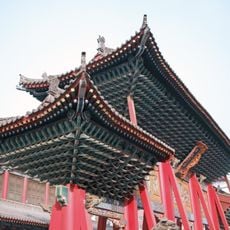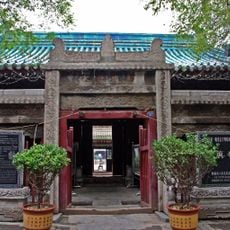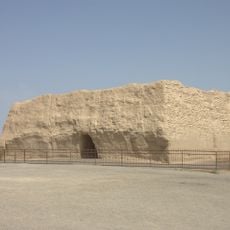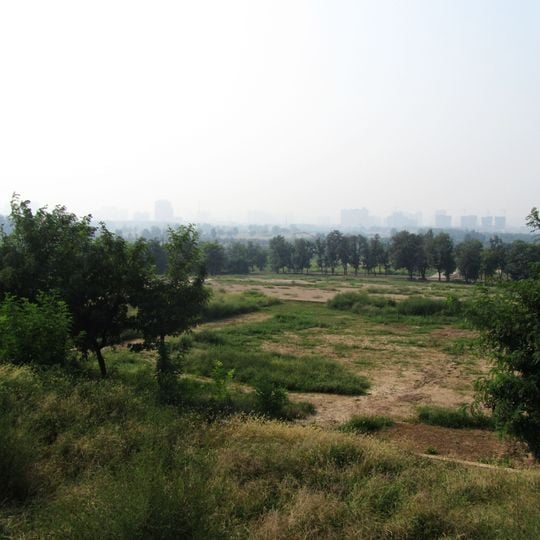
Weiyang Palace, Imperial palace complex in Chang'an, China
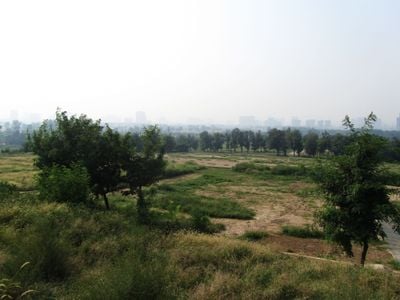
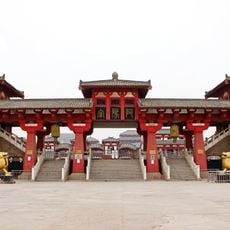
Weiyang Palace is the walled imperial palace of Han Chang'an, built from 200 to 198 BC under chancellor Xiao He. Its rammed-earth wall runs 8,800 metres around a near-square of about 2,150 by 2,250 metres. At the centre, the Front Hall platform rises in three terraces on Longshou Hill; the Jiaofang Hall foundation lies 360 metres north, and the Shiqu and Tianlu pavilions stand in the northwest.
The palace was founded around 200 BCE under Emperor Gaozu and served as the seat of government for the Han dynasty for hundreds of years. After the dynasty's fall, the site was abandoned and eventually became an archaeological site studied and preserved for modern understanding.
The name Weiyang means "not yet halfway", read together with Changle Palace (built two years earlier) as "perpetual happiness has not yet reached its midpoint". The Jiaofang Hall took its name from pepper powder mixed into the wall plaster, giving warm-coloured, fragrant interiors. Excavated at the government office site were over 50,000 inscribed ox-bone slips, 6.8–7.2 cm long, records of goods presented to the palace.
Comfortable footwear is important since the grounds are expansive and require walking to explore different areas. Visiting during cooler months makes for a more pleasant experience, and taking time to read the information panels helps you understand what once stood in each location.
The wooden slips found at Weiyang are not administrative records but a fire-blackened batch of medical texts, one bearing the words "Feng Zongshan nüfang" (Feng Zongshan's women's prescriptions). Separately, over 50,000 inscribed ox-bone slips from the government office site, each 6.8–7.2 cm long, recorded goods presented to the palace.
The community of curious travelers
AroundUs brings together thousands of curated places, local tips, and hidden gems, enriched daily by 94,461 contributors worldwide.