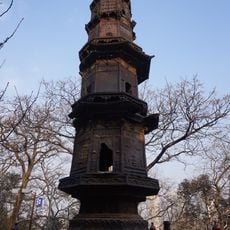
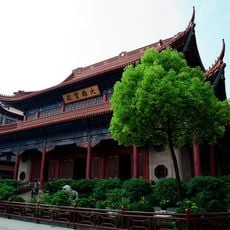
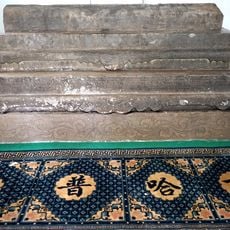
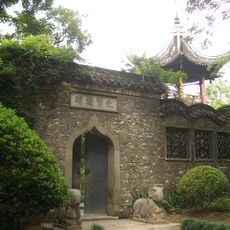
Wenchang Pavilion, Heritage pavilion in Yangzhou, China.
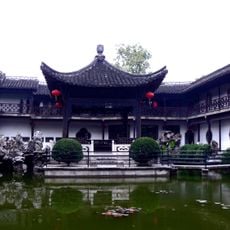
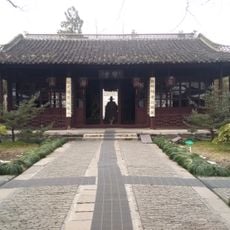
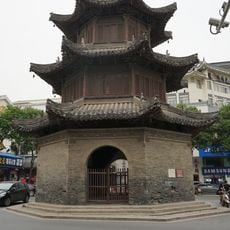
Wenchang Pavilion is a three-story structure in Yangzhou with nine angled roofs and traditional eaves that create a balanced architectural composition. The building stands in the city center with a symmetrical design that reflects classical Chinese construction principles.
In 1496 Ye Yuan, co-administrator of Yangzhou, built the Wenjin Bridge over the Wenhe River beside the prefectural school. In 1585 the salt inspector Cai Shiding added the pavilion on the bridge; fire destroyed it in 1595 and magistrate Zhang Ning rebuilt it in 1596. The river was filled in between 1952 and 1959, burying the bridge while the pavilion stayed above ground.
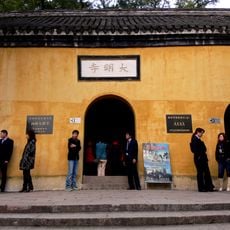
The pavilion is dedicated to Wenchang Dijun, the Daoist god of literature and examinations, not an emperor. A plaque reading "Han Shang Wenshu" hangs on the building, and its name links it to the Wenhe River and the prefectural school that once stood beside it. Around it, city celebrations still decorate the circular flower beds and light the pavilion at night.
The pavilion is located at a street intersection in central Yangzhou and is easy to reach on foot. Visitors can approach it freely at any time, making it simple to include in a walk through the city.
The pavilion stands on the buried Wenjin Bridge, built in 1496 over the Wenhe River. When the river was filled in between 1952 and 1959 to create Wenhe Road, the bridge disappeared underground while the pavilion remained above. The plaque 'Han Shang Wenshu' still hangs on the structure.
The community of curious travelers
AroundUs brings together thousands of curated places, local tips, and hidden gems, enriched daily by 93,091 contributors worldwide.