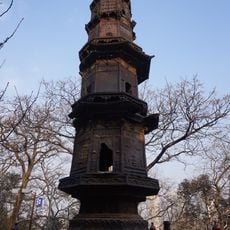
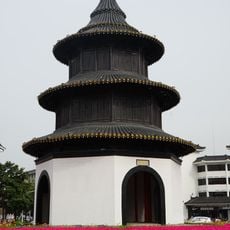
Crane Mosque, Ancient mosque in Guangling District, Yangzhou, China.
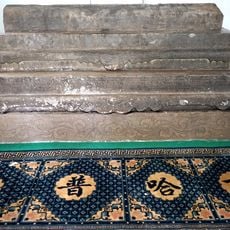
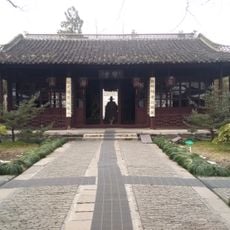
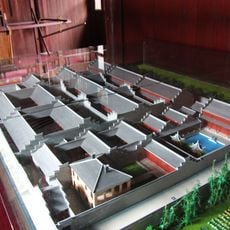
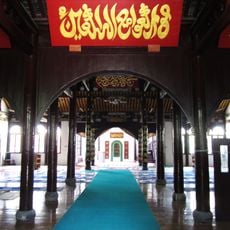
The Crane Mosque stands on Nanmen Street in Yangzhou's old city, east of Wenhe South Road. Its layout is said to resemble a crane: the entrance forms the head, a path the neck, and the prayer hall the body. The complex includes a prayer hall and stone furnishings, and it remains an active place of worship for Yangzhou's Muslims.
The mosque was reportedly built in 1275 by Puhaddin, an Arab Muslim and 16th-generation descendant of Muhammad, the year after his death. It was severely damaged during the Red Turban Rebellion that ended the Yuan dynasty. An Arab Muslim named Hasan rebuilt it in 1390 under the early Ming, and it was further renovated in 1523 under the Jiajing Emperor.
The name Xianhe ("Crane") refers to a Taoist immortal rather than the bird, though the complex is also said to follow a crane's outline. The mosque is still the main place of worship for Yangzhou's Muslims and keeps a small collection of documents on China's relations with Muslim countries.
The mosque stands on Nanmen Street in Yangzhou's old city, east of Wenhe South Road, in the Guangling District. It remains the main place of worship for the city's Muslims, so visitors should time their look around the courtyards and stone lecterns outside the hours of prayer and keep to the areas open to non-worshippers.
The crane shape is not just a nickname: the mosque's layout is traditionally read as a bird, with the entrance gate as the head, the prayer hall as the body and the side corridors as wings. The Chinese name 仙鶴 refers to a Taoist immortal's crane rather than to the animal alone.
The community of curious travelers
AroundUs brings together thousands of curated places, local tips, and hidden gems, enriched daily by 94,354 contributors worldwide.