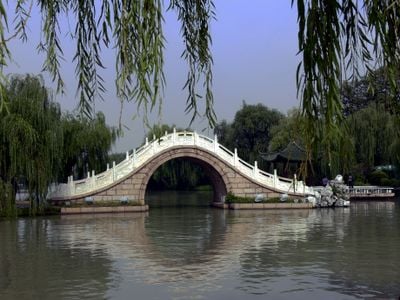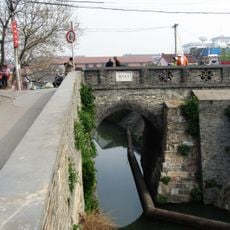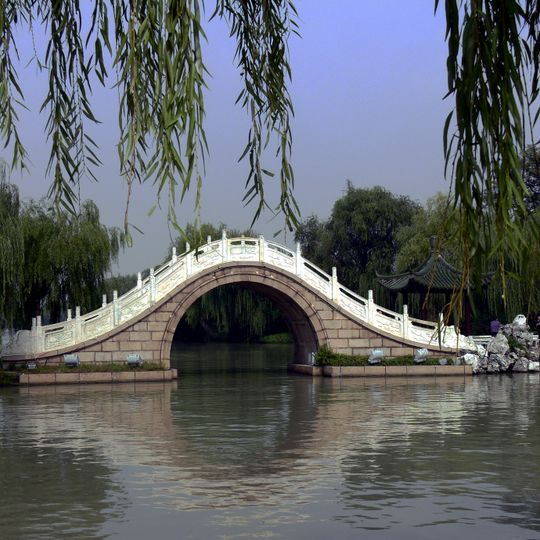
Twenty four bridge, Moon bridge in Shouxihu Subdistrict, China.
The Twenty Four Bridge features a rounded arch design that connects two points across a waterway in the Shouxihu area of Yangzhou City.
The bridge gained its name from the Twenty Four Solar Terms, which Chinese farmers used to track seasonal changes throughout the agricultural calendar.
The structure represents a meeting point where residents gather during traditional festivals and celebrations throughout the year in Yangzhou.
Located at Number 28 Dahongqiao Road in Weiyang District, the bridge remains open twenty-four hours daily without entrance fees for visitors.
The bridge combines architectural elements of both beam and pontoon designs, featuring specific construction techniques from historical Chinese engineering methods.
Location: Shouxihu Subdistrict
GPS coordinates: 32.41010,119.41108
Latest update: March 10, 2025 21:04
Moon bridges form semicircles that reflect as complete circles in the water. These structures originated in East Asia and combine practical function with deliberate design. The constructions appear in public gardens, botanical spaces and historic landscapes from Japan to California. The collection includes examples from different countries and periods. In Tokyo, the Drum Bridge spans a pond in Golden Gate Park, while the bridge at Kameido Tenjin Shrine forms part of a traditional shrine complex. Dahu Park in Taipei and Rikugien Garden in Tokyo show further variations of this building form. In China, examples range from the Jade Belt Arch in Beijing to multi-arched structures like the Twenty-Four Arch Bridge in Yangzhou. The Anshun Lang Bridge in Chengdu and the Stone Moon Bridge in Suzhou document different regional building styles. The form spread beyond Asia into botanical gardens and park settings worldwide. In the United States, moon bridges appear at Kubota Garden in Seattle, the Huntington Library in San Marino, and as the Humpback Bridge in Virginia. The Japanese garden in Toulouse presents a European example, while Hamilton Gardens in New Zealand holds the southernmost variation. Taiko Bashi in Kanagawa and Sorihashi in Sumiyoshi rank among the most traditional Japanese versions. Each location demonstrates its own interpretation of this architectural form.
Daming temple
1.3 km
Runyang Yangtze River Bridge
21.7 km
Geyuan
2.7 km
Jinshan Temple
20.6 km
He Garden
4.5 km
Ganlu Temple
21.4 km
Gaomin Temple
9.3 km
Tomb of Puhaddin
3.8 km
Choe Chiwon Museum
1.5 km
Zhaoguan (munisipyo sa Republikang Popular sa Tsina, Jiangsu Sheng)
24.1 km
Yucheng Postal Stop
40.4 km
Wenchang Pavilion
2.2 km
Crane Mosque
2.6 km
Yangzhou Museum
4.7 km
史可法纪念馆
2.3 km
Junyang bridge
21.7 km
小盘谷
3.7 km
定慧寺
20.1 km
Sacred Heart Cathedral of Yangzhou
4 km
吴氏宅第
3.7 km
Shanxiang Mosque
22.1 km
Jingzhong Temple
2.7 km
Siwang Pavilion
2 km
Cuiyuan Street Church
2.8 km
Dadongmen Bridge
2.3 km
Runyang Yangtze River South Bridge
22.9 km
Runyang Yangtze River North Bridge
20.8 km
Dawazi Shuiku
34.3 kmReviews
Visited this place? Tap the stars to rate it and share your experience / photos with the community! Try now! You can cancel it anytime.
Discover hidden gems everywhere you go!
From secret cafés to breathtaking viewpoints, skip the crowded tourist spots and find places that match your style. Our app makes it easy with voice search, smart filtering, route optimization, and insider tips from travelers worldwide. Download now for the complete mobile experience.
A unique approach to discovering new places❞
— Le Figaro
All the places worth exploring❞
— France Info
A tailor-made excursion in just a few clicks❞
— 20 Minutes