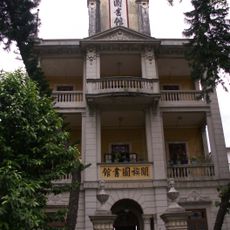
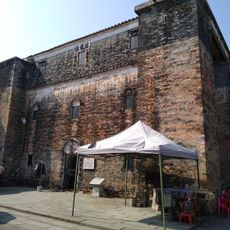
Confucian Temple, Confucian temple and museum in Huicheng Subdistrict, China
The Xinhui Confucian Temple is a museum complex containing multiple courtyards, inscribed stone tablets, and halls with examples of traditional Chinese architecture and design. The spaces hold historical documents and objects that illustrate daily life and learning practices from earlier eras.
The temple was established as a center where local scholars gathered to study Confucian texts and prepare for imperial examinations. Over centuries, it served as a key institution for transmitting knowledge and education within the region.
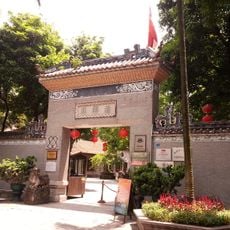
The complex is now the Xinhui Museum, opened after the site was listed as a Guangdong Provincial Cultural Relic Protection Unit in 1989. Its name, Xuegong, marks it as a Confucian academy rather than a temple, and the surviving Lingxing Gate, Hualong Bridge and Pan Pond still trace the ritual approach once walked by candidates for the imperial examinations.
The complex is entered through the surviving Lingxing Gate, with the Hualong Bridge crossing the Pan Pond just inside; the Dacheng Hall stands at the centre of the axis. The hall's red sandstone platform rises 1.6 metres and the terrace before it 0.72 metres, so steps and uneven stone are underfoot. The Dacheng Gate, east and west corridors and Zunjing Pavilion date from the post-1956 reconstruction.
The 1939 Japanese occupation left only the Lingxing Gate, Hualong Bridge, Pan Pond and Dacheng Hall standing; the Dacheng Gate, east and west corridors and Zunjing Pavilion were rebuilt on their original sites after 1956. The Dacheng Hall's red sandstone platform measures 25.8 m by 18.9 m and stands 1.6 m high.
The community of curious travelers
AroundUs brings together thousands of curated places, local tips, and hidden gems, enriched daily by 93,196 contributors worldwide.