Preußischer Landtag, Parliament building in Berlin-Mitte, Germany
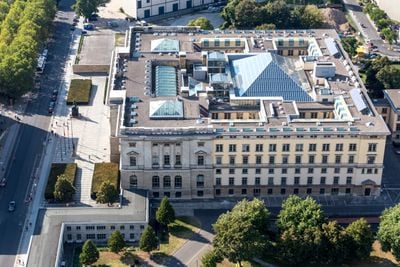
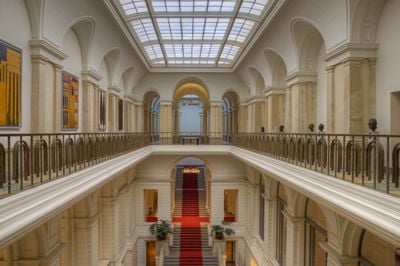
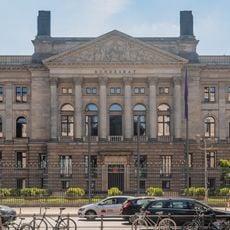
The Preußischer Landtag is a Neorenaissance parliament building on Niederkirchnerstraße in Berlin-Mitte, designed by Friedrich Schulze. Its long facade combines a rusticated light grey stone base with rows of rectangular and tall arched windows, a projecting central bay with columns, and pale cream upper floors. The flat roof carries a long ridged skylight, small pyramid skylights and a sloped blue-tinted glass section. Inside, a tall hall rises to a coffered glass skylight, with a balcony of dark metal balustrade and sculpted heads on the right, and a red-carpeted staircase descending the centre.
Friedrich Schulze built the house for the Prussian House of Representatives from 1892 to 1897 in the Neorenaissance style, and it opened with a parliamentary session on 16 January 1899. From 1918 the Landtag of the Free State of Prussia met here. From 1934 the Volksgerichtshof used it, later it served as Preußenhaus and Haus der Flieger, and in the GDR the Ministerrat and the Staatliche Plankommission worked in it. After renovation the Berlin Abgeordnetenhaus moved in on 29 April 1993.
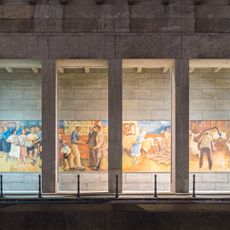
The interior displays allegorical statues representing Law and Justice, alongside murals depicting major Prussian cities including Berlin Castle and Magdeburg Cathedral. These artistic elements tell of the importance those cities held in Prussian history.
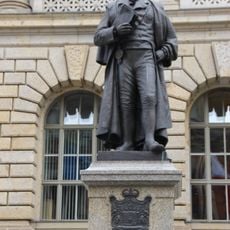
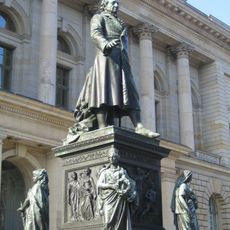
The building sits at the corner of Leipziger Straße and Niederkirchnerstraße, on the north side of the street; the entrance forecourt is named Margot-Friedländer-Platz. The two bronze statues on the forecourt honour the reformers Karl Freiherr vom Stein (left, since 2003) and Karl August Fürst von Hardenberg (right, since 2011); both stood on Dönhoffplatz before. Visits to the plenary hall and other rooms are only possible by prior arrangement, as the house serves the Berlin parliament.
The two bronze statues on the square in front did not start here: the monuments to the reformers Karl Freiherr vom Stein and Karl August Fürst von Hardenberg stood on Dönhoffplatz until they were moved, Stein in 2003 and Hardenberg in 2011. The square itself has borne the name Margot-Friedländer-Platz since 7 May 2026.
The community of curious travelers
AroundUs brings together thousands of curated places, local tips, and hidden gems, enriched daily by 93,196 contributors worldwide.