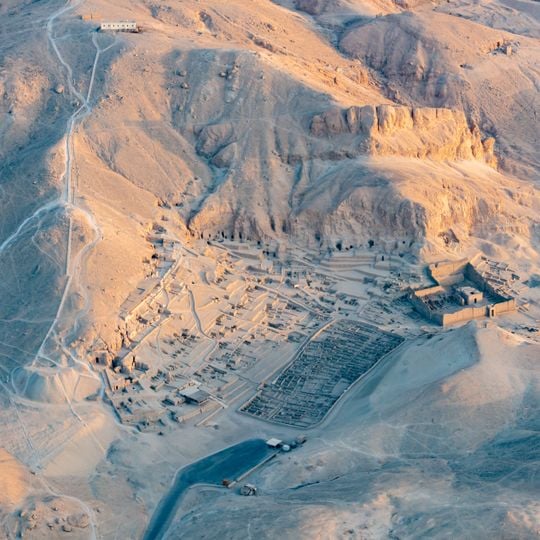
Deir el-Medina, Ancient workers village and necropolis in Luxor Governorate, Egypt.
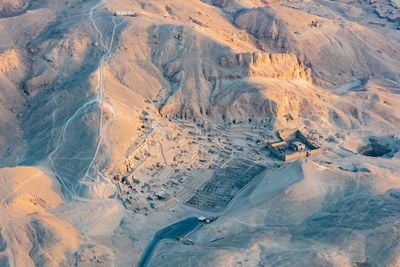
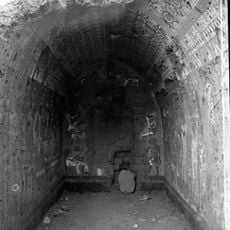
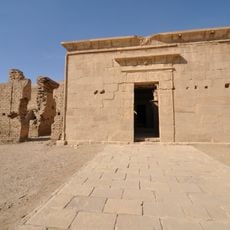
Deir el-Medina is an ancient Egyptian workmen's village on the west bank of the Nile opposite Luxor, home to the artisans who cut and decorated the tombs in the Valley of the Kings. Its mud-brick houses, built on stone foundations, stand in irregular terraces on a sandy slope, many reduced to low wall stubs, with a larger walled complex at one side and a grid of small plots below. A dark doorway and a rounded arch survive in one taller wall fragment.
The settlement existed from 1550 to 1080 BCE and housed the craftspeople who built the tombs in the Valley of the Kings. Over this span, residents adapted to changing economic conditions and modified their community.
The residents left writings on limestone and pottery about their daily routines, families, and work. These texts offer a rare window into the personal lives of ordinary people in ancient times.
The site sits near the Valley of the Kings and has marked pathways for visitors to follow. Allow plenty of time to walk through, especially if interested in archaeological details.
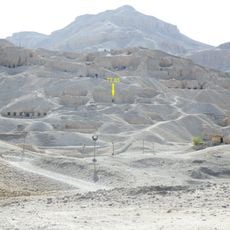
The peak above the village was renamed Mont Cernabru to honour Bernard Bruyère and Jaroslav Černý, who spent almost fifty years studying the site and could name many of its inhabitants. Černý joined Bruyère's excavation after 1922.
The community of curious travelers
AroundUs brings together thousands of curated places, local tips, and hidden gems, enriched daily by 94,622 contributors worldwide.