Merneptah Stele, Victory stele at Egyptian Museum, Egypt
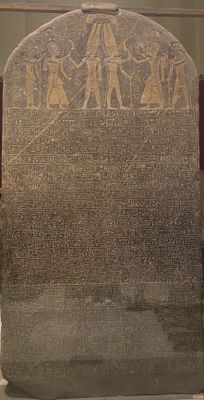
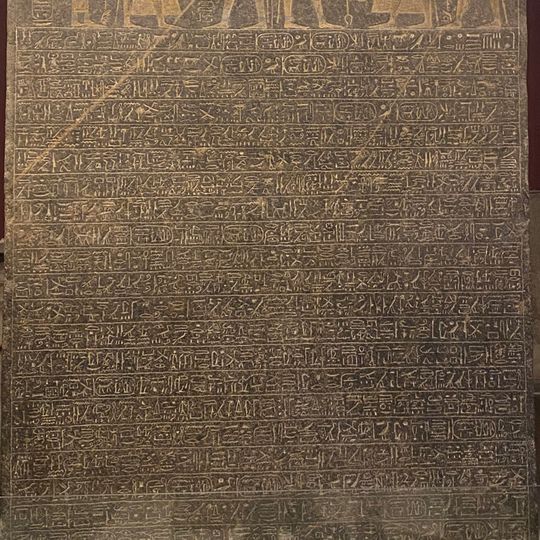
The Merneptah Stele is a granite sculpture at the Egyptian Museum in Cairo, covered with hieroglyphic inscriptions. The gray surface shows closely written columns of text that run across the entire front of the monument.
The stele was originally erected by Amenhotep III and later reinscribed on its rough back by Merneptah in his 5th year, 1208 BCE, to commemorate his victory over the Libu and their Sea People allies. The final lines record a separate campaign in Canaan, naming Ashkelon, Gezer, Yanoam and Israel. Flinders Petrie found it at Thebes in 1896.
The stele was carved on the rough back of a monument originally erected by Amenhotep III, whose temple it was taken from. Petrie's philologist Wilhelm Spiegelberg translated the text, and Petrie predicted the find would be better known than anything else he had excavated. The top scene keeps traces of yellow, red and blue paint.
The stele stands in the Egyptian Museum in Cairo, where it has been kept since its discovery at Thebes in 1896. Look for the black granite slab over 3 metres high; its rounded top carries the coloured scene of Amun handing a sword to the king, with Mut and Khonsu flanking him. The lower face is the reused rough back of a slab of Amenhotep III, so the cutting is uneven and some signs need close looking.
The inscription in line 27 mentions the name Israel for the first time outside religious writings in an ancient Egyptian source. This reference is the earliest known record of that name in a historical document.
The community of curious travelers
AroundUs brings together thousands of curated places, local tips, and hidden gems, enriched daily by 93,328 contributors worldwide.