Former Bank of Japan Hiroshima Branch, Banking heritage building in Fukuromachi, Japan.
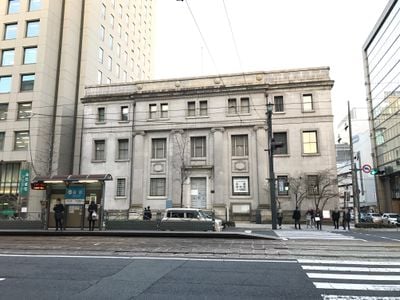
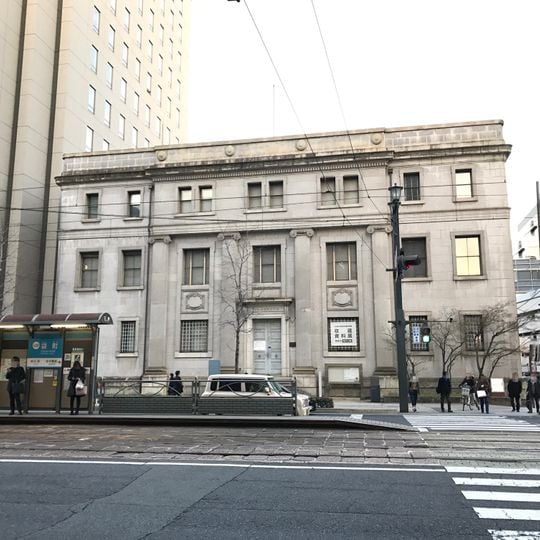
The Former Bank of Japan Hiroshima Branch is a three-story, steel-reinforced concrete building completed in August 1936, designed by Uheiji Nagano with the bank's temporary architecture department and built by Shimizu-gumi. Its symmetrical granite-clad facade has a central entrance framed by Ionic columns, rows of rectangular windows, and a parapet with round medallions; plaques read "竣工 昭和11年" and "日本銀行". Inside, a Corinthian-columned atrium was lost in the 1945 blast, but the Mosler vaults in the basement survive intact.
The building was constructed in 1936 and withstood the atomic blast from 380 meters away from ground zero. It resumed operations within 48 hours after August 6, 1945, becoming a symbol of the city's resilience during recovery.
The building's name, 旧日本銀行広島支店, marks it as the former Hiroshima branch of the Bank of Japan, which moved here from Mizucho in 1936. Since 2001 it has served as a venue for citizens' art and culture activities, and from 2015 to 2017 it displayed materials from the Hiroshima Peace Memorial Museum during that museum's renovation.
The building stands on the west side of Koi Castle-dori, a one-minute walk from the Hiroden Denshoku-machi tram stop on the Ujina line; buses from JR Hiroshima Station also stop at Fukuromachi. A permanent ramp and an elevator were installed at the rear (west) side during the 2009–2010 works, and a wooden temporary ramp at the front was removed. The adjacent east neighbour is the Rai San'yo Historical Museum.
The vaults were made by the American Mosler company, and the ones installed at completion in 1936 survive intact. The elevator had been removed earlier under the wartime metal collection order, so the blast came in through the empty shaft and blew away the iron grille in front of the vault.
The community of curious travelers
AroundUs brings together thousands of curated places, local tips, and hidden gems, enriched daily by 94,738 contributors worldwide.