Chōjagahara temple ruins, Archaeological site of Buddhist temple in Ōshū, Japan
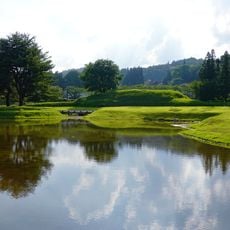
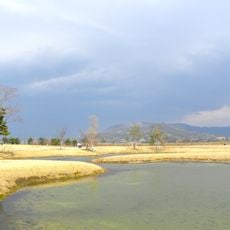
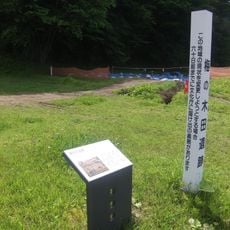
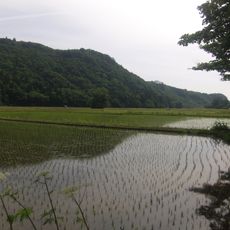
Chōjagahara temple ruins are the remains of a late Heian period Buddhist temple in Ōshū, about 1 km north of Chūson-ji. Excavations in 1958 revealed a compound roughly 100 m on each side, enclosed by an earthen wall and moats, with the foundations of a main hall, a western building and a south gate. The south gate and main hall are aligned on a central axis that extends toward the highest point of the Chūson-ji hill, and the gate sits 1 m lower so as not to block the view.
This site began as a palace of the Abe clan during the late Heian period before being transformed into a Buddhist temple. It was destroyed by fire during a major conflict in the 11th century and was never rebuilt.
The scattered artifacts found here, such as ink stones and roof tiles, reveal how monks and residents used this space for daily work and worship. These objects show connections to other temples in the region and offer clues about the rhythms of temple life centuries ago.
The site lies in the Tadanaka district of Iwaizumi, Ōshū, about 1 km north of Chūson-ji. By car it is roughly 5 minutes from the Hiraizumi-Maesawa interchange on the Tōhoku Expressway and about 10 minutes from JR Hiraizumi Station; there is no rail station within walking distance. The compound measured about 100 m on each side, so allow time to trace the gate and hall foundations on foot.
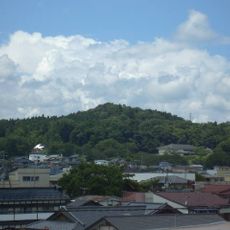
The temple's name is unknown, but its cornerstones were quarried on Mount Tsukainu, and the main hall and south gate sit on one axis that runs to the highest point of the Chūson-ji hill. The gate stands 1 m lower than the hall so it never blocks the view, and to the east the mountain is left unobstructed.
The community of curious travelers
AroundUs brings together thousands of curated places, local tips, and hidden gems, enriched daily by 93,580 contributors worldwide.