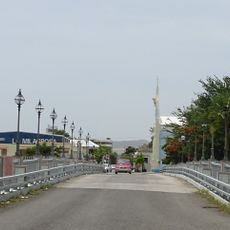
Acueducto de Ponce, Historic aqueduct in Ponce, Puerto Rico
The Acueducto de Ponce, formally Acueducto Alfonso XII, was a 4,100-meter gravity-fed water system designed in 1875 by Timoteo Luberza. Water ran from a masonry diversion weir on the Río Portugués through a brick conduit 0.52 m wide and 0.55 m deep with a semicircular crown, reaching a covered, cement-lined brick reservoir of 2,000 m³ on Cerro San Tomás. At its highest point it stood 50 feet tall.
Designed in 1875 by Timoteo Luberza, construction began on 21 August 1876, funded partly by Valentín Tricoche's 54,000 Spanish pesos donation, and cost $220,000. It was completed in 1880 and ran for 48 years until 1928, when a new pump-based system was inaugurated under mayor Guillermo Vivas Valdivieso. It was declared a National Historic Monument on 17 June 2015 and listed on the U.S. National Register of Historic Places on 30 December 2019.
Locals call the conduit's highest point El Puente de los Suicidios, the Bridge of Suicides. Part of the channel became a footbridge linking neighbouring communities after the rest was lost to urbanisation. The reservoir stood on Cerro San Tomás beside sector Mameyes in Barrio La Cantera.
The structure is located in different parts of the city and some sections can be viewed from public areas. Access varies across different segments, as some portions are affected by urban development or private land boundaries.
The aqueduct used the natural slope of the land to move water without needing pumps or engines. This simple but clever approach shows how engineers worked with the landscape itself as part of the system.
The community of curious travelers
AroundUs brings together thousands of curated places, local tips, and hidden gems, enriched daily by 92,648 contributors worldwide.