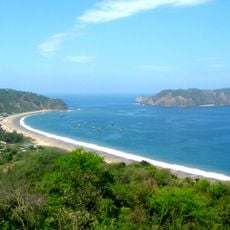
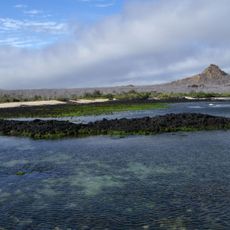
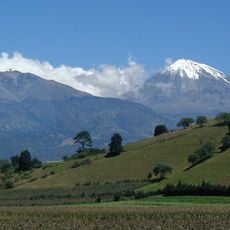
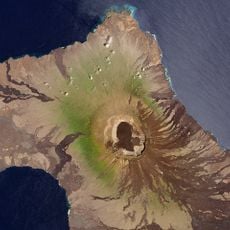
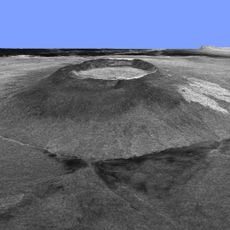
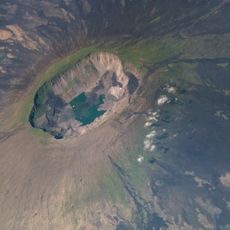
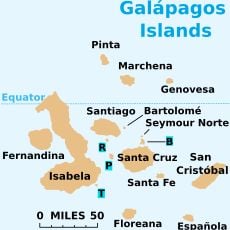
Cerro Azul, Shield volcano on Isabela Island, Galapagos Islands, Ecuador.
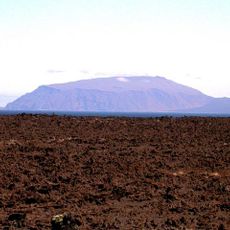
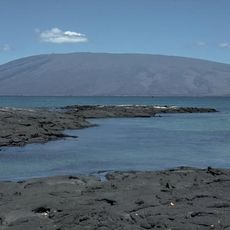
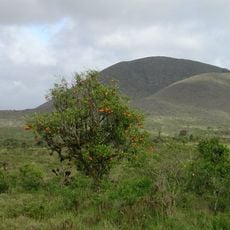
Volcán Cerro Azul is a shield volcano on Isabela Island in the Galapagos Islands, characterized by gentle slopes and a wide summit caldera. The landscape looks like an enormous dark dome rising slowly from the ocean, shaped entirely by hardened lava flows and cinder cones.
Cerro Azul's recorded eruptions began in 1932, followed by activity in 1940, 1943, 1949, 1951, 1959, 1968, 1979, 1998 and 2008. The 1998 event included fissure eruptions on the southeast flank and forced park authorities to relocate tortoises by land and helicopter; some were killed by lava or fires. The 2008 eruption also opened a fissure on the southeast flank, sending lava 10 km, with a second fissure in early June.
The tortoises on Cerro Azul are dome-shelled Geochelone vicina, whose range overlaps with the saddle-backed Geochelone guentheri of neighbouring Sierra Negra. The 1998 eruption forced park authorities to move tortoises by land and helicopter; others died from lava or the fires it set. The 2008 eruption left them unharmed.
The 2008 eruption opened a fissure on the southeast flank, where lava ran about 10 km from the vent, and a second fissure opened lower down in early June. Approach routes and landing points on that flank are therefore set by the park each season. Access is by boat on the western side of Isabela, where the ocean floor drops steeply.
The lava flows on the surface are less than 5,000 years old and came from recent volcanic activity. These very young lava fields stand in sharp contrast to the much older foundation structure of the entire volcano.
The community of curious travelers
AroundUs brings together thousands of curated places, local tips, and hidden gems, enriched daily by 93,903 contributors worldwide.