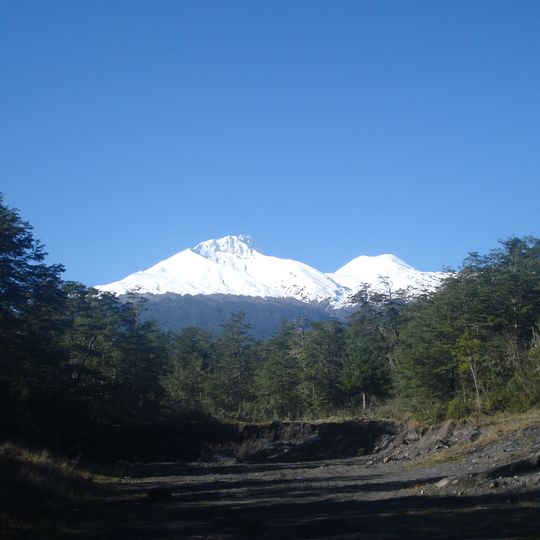
Mocho-Choshuenco, Stratovolcano in El Ranco Province, Chile
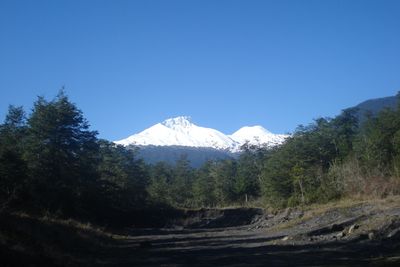
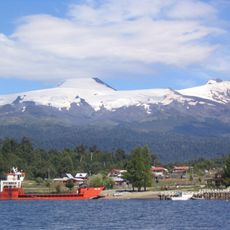
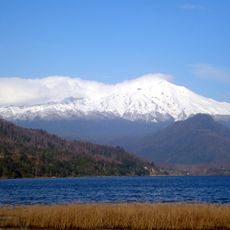
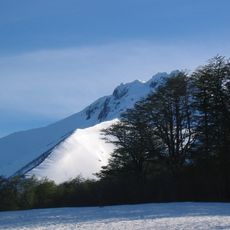
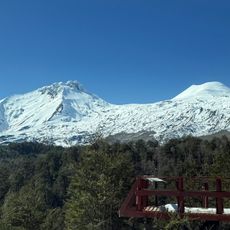
Mocho-Choshuenco is a compound stratovolcano in Los Ríos Region, Chile, formed by two cones: Choshuenco (2415 m) on the northwest rim of a 4 km wide caldera and Mocho (2422 m) to the southeast, whose flattened top gives it its name. An ice cap covers the uppermost part, and dark forested slopes rise from the base.
The earliest firmly recorded eruption of Mocho occurred in 1759, shown on Juan Ignacio Molina's 1795 map under the name Volcán de Valdivia. On 1 November 1864 the Chaiquemahuida cinder cone on Mocho's southwestern flank erupted for one to three days, producing pyroclastic flows; a missionary from Quinchilca reported a loud noise and an earthquake. A reported eruption on 16 June 1936, involving mudflows, is now doubted by volcanologists.
The name blends Spanish and Mapuche words, with Mocho meaning headless and Choshuenco referring to yellow waters. This linguistic mix reflects how indigenous and colonial cultures have shaped the region's identity.
The two summits share about 80% of the ascent route, some 1,200 m of the 1,500 m of elevation gain, and a broad ice saddle links their bases in under 40 minutes. The Andean club of the Universidad Austral de Chile keeps a refuge on the western slope as a base before the summits. Choshuenco has rock towers and crevasses on eternal snow, needing more technical gear.
The 4 km wide caldera formed when an ancestral volcano collapsed, and Choshuenco sits on its northwest rim. The Mocho cone rises above the caldera floor. The two summits are joined by an ice saddle that takes under 40 minutes to cross, and roughly 80% of the ascent route (1200 of 1500 m of elevation gain) is shared by both peaks.
The community of curious travelers
AroundUs brings together thousands of curated places, local tips, and hidden gems, enriched daily by 94,043 contributors worldwide.