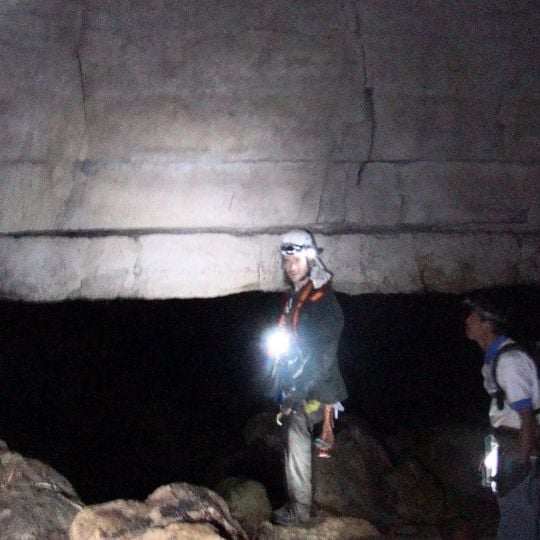
Cueva de los Tayos, Limestone cave in Morona-Santiago Province, Ecuador
Cueva de los Tayos lies in thinly bedded limestone and shale on the eastern slopes of the Andes, 2 km south of the Santiago River and 800 m west of the Coangos River. Its largest entrance is a shaft about 65 m deep, the Chimenea, which drops into 4.6 km of passages and a chamber measuring 90 by 240 m. The cave reaches a vertical range of 201 m, ending at a sump.
The cave formed part of Shuar territory long before written references appeared in 1860; gold-seekers and Ecuadorian military personnel visited it in the 1960s. In 1976 the Scottish adventurer Stan Hall organised an expedition with British and Ecuadorian teams, joined by Neil Armstrong and the Ecuadorian Army, which surveyed the cave for about a week. A 2012 expedition by the Polish explorer Yoris Jarzynski concluded that the passages are of natural origin.
The Shuar descend each spring using vine ladders and bamboo torches to collect fledgling oilbirds, called tayos, which give the cave its name. They regard the cave with respect, believing the spirits of their ancestors rest there. Shuar guides from the Coangos community accompany visitors and hold detailed knowledge of the passages.
Visiting requires permits, a flight to Yukianza, a bus ride, a boat trip, and a forest walk to reach the shaft. Descent and ascent are physically demanding and require good fitness.
Oilbirds inhabit the chambers and navigate through the dark by emitting clicking sounds. These birds produce an oily fruity fat that was once used as lamp fuel.
The community of curious travelers
AroundUs brings together thousands of curated places, local tips, and hidden gems, enriched daily by 92,550 contributors worldwide.


