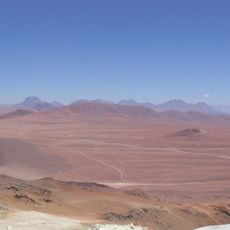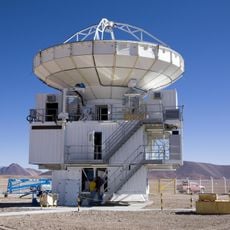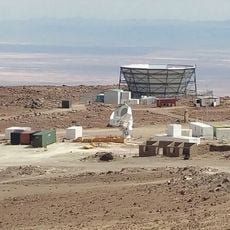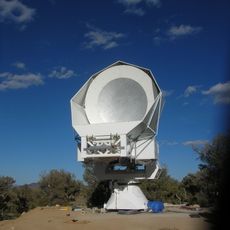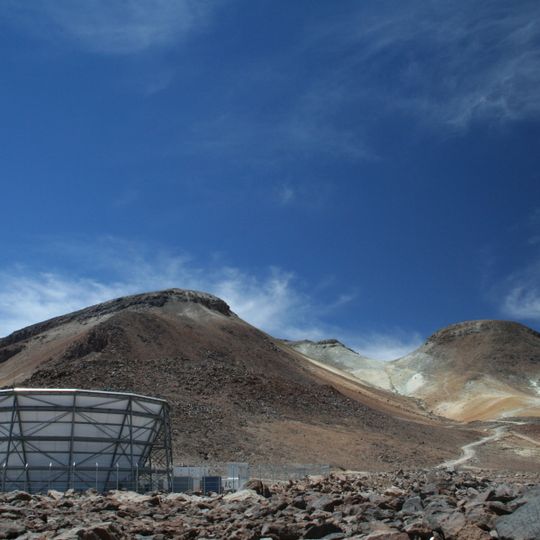
Atacama Cosmology Telescope, Cosmological millimeter-wave telescope on Cerro Toco, Atacama Desert, Chile
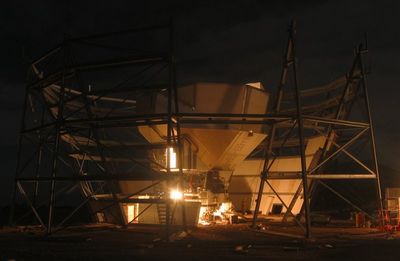
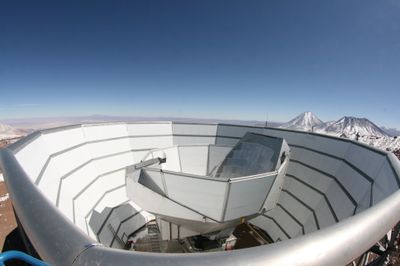
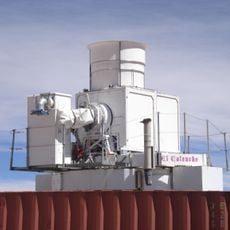
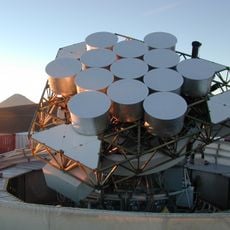
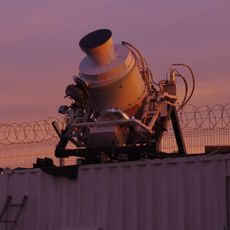
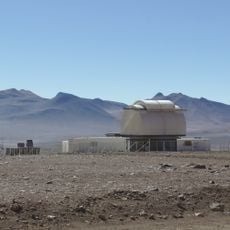
The Atacama Cosmology Telescope was an off-axis Gregorian telescope on Cerro Toco at 5,190 metres. Its primary mirror, 6 metres across, was made of 71 aluminium panels forming an ellipsoid; the 2-metre secondary had 11 panels. A ground screen surrounded the rotating 32-tonne structure, which scanned the sky at two degrees per second.
The telescope began operations in October 2007 and worked continuously until 2022 mapping radiation from the early universe. During this period, its observations contributed significantly to our understanding of cosmic history.
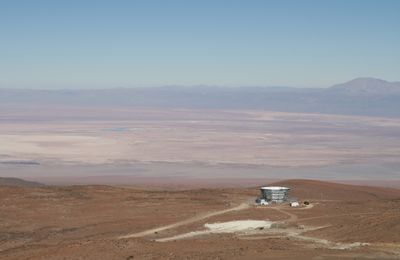
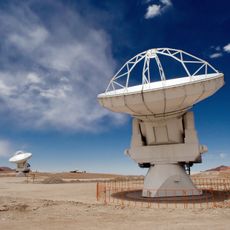
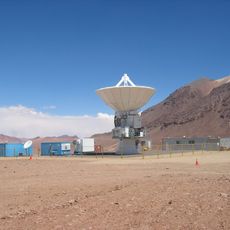
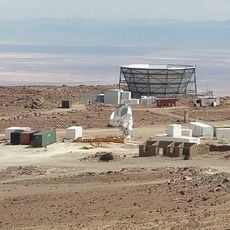
The name ACT is an acronym for Atacama Cosmology Telescope, and its receivers were built around cryogenically cooled silicon lenses, a material chosen for its high refractive index. The site lies on the Chajnantor plateau, where ACT shares the Llano de Chajnantor Observatory with CBI, ASTE, Nanten, APEX and ALMA.
The site lies on the Chajnantor plateau, 40 km from San Pedro de Atacama at 5,190 m, reached by road; the altitude makes acclimatisation advisable. The telescope is a research instrument, not open to visitors, and its observations ended in 2022. Other facilities of the Llano de Chajnantor group, such as ALMA and APEX, stand in the same region.
The telescope discovered structures in the cosmic background radiation that other instruments had missed, providing new insights into how matter is distributed throughout the universe. These observations revealed how galaxies appear distorted by cosmic curvature and allowed a better understanding of invisible matter.
The community of curious travelers
AroundUs brings together thousands of curated places, local tips, and hidden gems, enriched daily by 94,261 contributors worldwide.