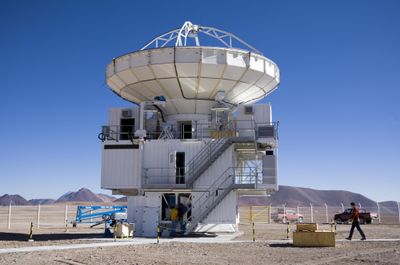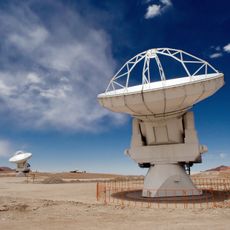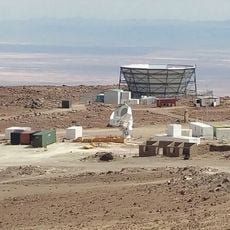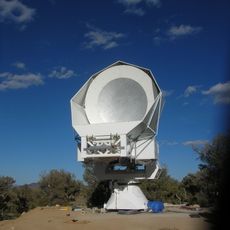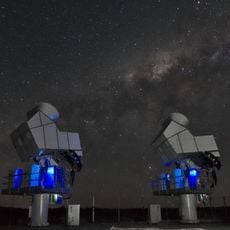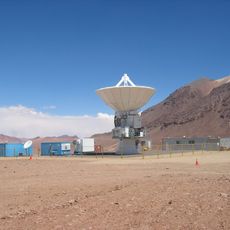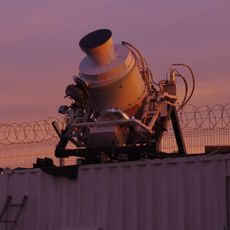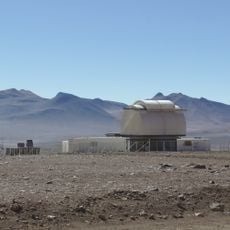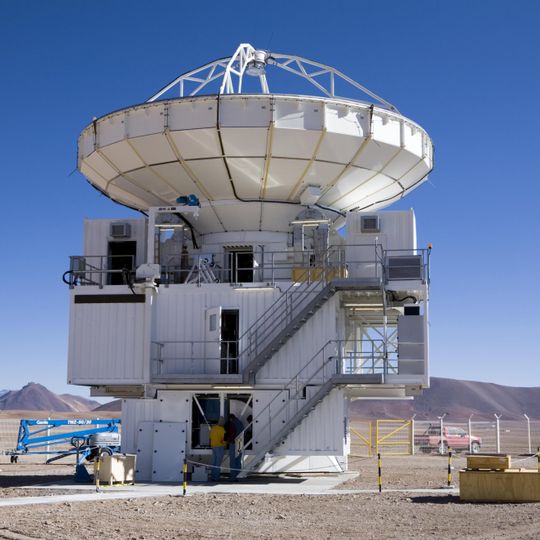
Atacama Pathfinder Experiment, Radio telescope at Llano de Chajnantor Observatory in Atacama Desert, Chile
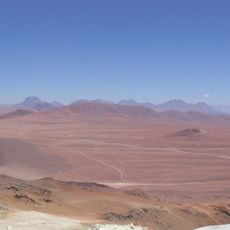
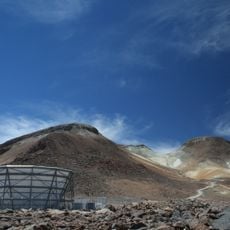
The Atacama Pathfinder Experiment (APEX) is a 12-metre radio telescope whose dish consists of 264 aluminium panels with an average surface accuracy of 17 micrometres. It stands at 5,104 metres on the Chajnantor plateau at Llano de Chajnantor Observatory, 50 km east of San Pedro de Atacama. A modified ALMA prototype antenna, it observes at submillimetre wavelengths between 0.2 and 1.5 mm, and its main instrument, LABOCA, images a field 11 arcminutes wide.
Construction started in 2001 and concluded in 2005 when European research institutes inaugurated the telescope. The facility emerged from international collaboration to study cold molecular clouds and star formation at one of Earth's cleanest observation sites.
APEX's name comes from its role as a pathfinder: it was built as a modified prototype of an ALMA antenna to test the site and find targets ALMA would later study in detail. Its first science results appeared in July 2006, when 26 articles based on early APEX data filled a special issue of Astronomy and Astrophysics.
The extreme elevation and remote location require good physical preparation and clothing adapted to cold and intense UV exposure. Visits are typically only possible with trained staff, and it is wise to check accessibility and opening information in advance.
In May 2012 APEX and the Submillimeter Array in Hawaii detected quasar 3C 279 at 1.3 mm across a 9,386 km baseline, reaching an angular resolution of 28.6 micro-arcseconds. APEX also joined the Event Horizon Telescope campaign that produced the first direct image of a black hole, in M 87.
The community of curious travelers
AroundUs brings together thousands of curated places, local tips, and hidden gems, enriched daily by 92,808 contributors worldwide.