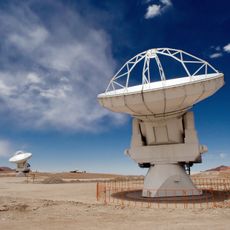
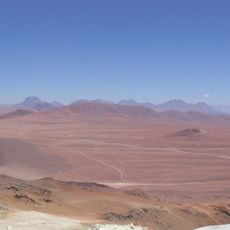
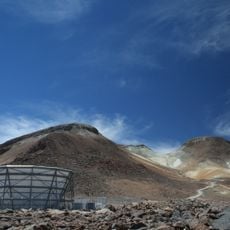
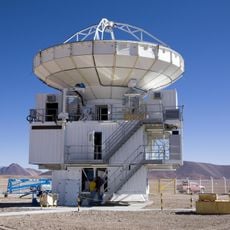
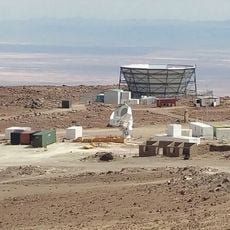
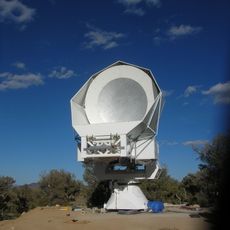
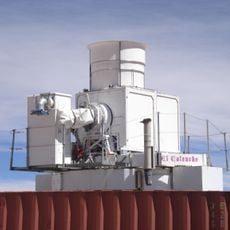
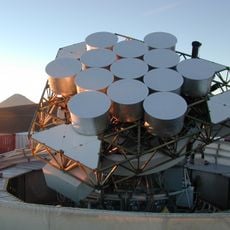
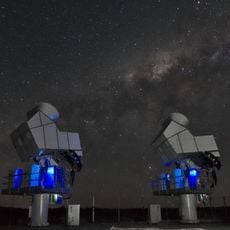
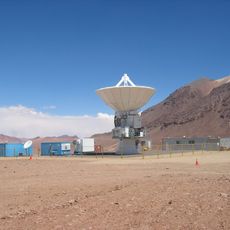
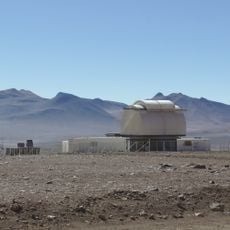
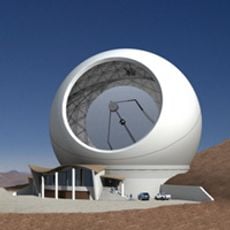
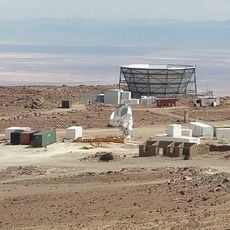
Atacama B-Mode Search, Radio telescope in Atacama Desert, Chile
The Atacama B-Mode Search was a telescope that imaged the sky at 145 GHz, with a camera of 240 polarization-sensitive pixels, each holding two transition-edge-sensor bolometers cooled to 0.3 K. Its optics were two 60 cm mirrors kept at 4 K. It was built in North America inside a standard shipping container and raised out of a roof hatch for observations in the Atacama Desert.
The installation was established in 2012 and collected data through October 2014 on polarization patterns from the early universe. It aimed to investigate cosmic inflation theories and provided important information about the structure of the early cosmos.
Multiple research institutions, including Princeton University, Johns Hopkins University, and Chilean organizations, formed an international coalition to operate this advanced cosmic observatory.
The entire telescope system fits within a standard shipping container, which enabled transport to this remote location in northern Chile's high-altitude desert. The high elevation and dry conditions make this site suitable for observing the cosmic background.
The system uses a rotating sapphire half-wave plate at room temperature spinning at 2.55 Hz to separate atmospheric noise from cosmic signals. This innovative design allows the instrument to detect extremely faint polarization signals from space.
The community of curious travelers
AroundUs brings together thousands of curated places, local tips, and hidden gems, enriched daily by 93,302 contributors worldwide.