Lapa do Santo, Archaeological site and cave in Matozinhos, Brazil
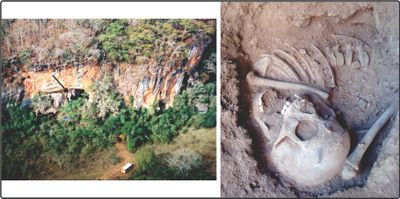
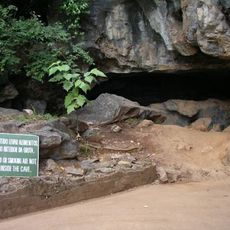
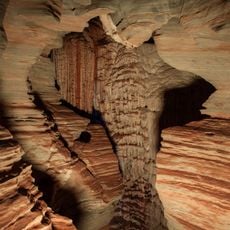
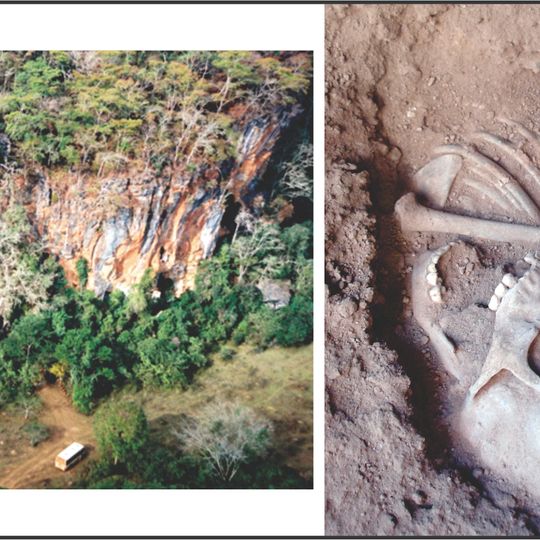
Lapa do Santo is a rockshelter in a 30-metre limestone massif at Matozinhos, Minas Gerais, with a sheltered area of about 1,300 m². Its floor slopes down towards the north and levels off near a natural sinkhole. The southern part, flat and dry in front of the cave entrance, held the excavated burials; the deposit there reaches up to five metres, about half of it a fine grey sediment resembling talc.
Danish naturalist Peter Lund began studying the cave in the 19th century and uncovered human remains alongside extinct megafauna. The site reveals continuous human habitation spanning thousands of years in this region.
The name combines the Portuguese words for rockshelter and saint. Excavations found 26 well-preserved burials in the main area, and by 2018, 39 skeletons aged 8,000 to 11,000 years. André Strauss noted some were burned, others painted red, and some combined a child's skull with an adult's body or one person's teeth with another's jaw.
Lapa do Santo lies in the Carste de Lagoa Santa Environmental Protection Area, a 360 km2 karst zone in Matozinhos. The sheltered area covers about 1,300 m2, with a flat, dry strip in front of the cave entrance and a floor that slopes down toward a sinkhole at the northern end. The Main Excavation Area was backfilled with sediment in 2009 under Brazilian law, so the excavated floor was restored to its original shape.
Lapa do Santo yielded the oldest securely dated rock art in the Americas: an early Holocene low-relief anthropomorphic figure with an erect phallus. The site also holds the New World's oldest known decapitation, dated to roughly 9,000 years ago. Excavations in 2018 uncovered 39 skeletons aged 8,000 to 11,000 years, some painted red or combining a child's skull with an adult's body.
The community of curious travelers
AroundUs brings together thousands of curated places, local tips, and hidden gems, enriched daily by 93,759 contributors worldwide.