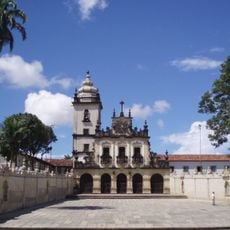
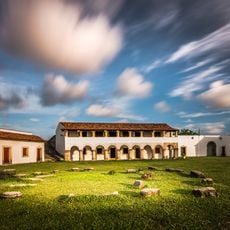
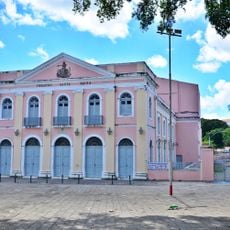
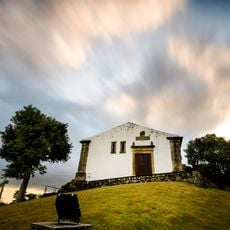
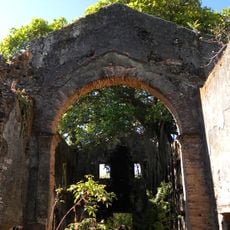
Church of Our Lady of Guia, Portuguese colonial church in Lucena, Brazil.
The Church of Our Lady of Guia is a church building in Lucena featuring thick stone walls and wooden structural elements organized in a rectangular layout following Portuguese colonial design traditions. The building displays the constructive features and proportions typical of sacred structures from this colonial period.
Carmelite friars who arrived in Paraíba in 1591 began the church at the end of the 16th century, and it went through several building phases. In 1763 it was demolished and rebuilt fifteen years later through the efforts of Friar Manuel de Santa Teresa. From 1866 it underwent remodelling and stood abandoned at times; around 1877 church and surroundings became a colony for migrants from the sertão. It was later restored under the Paraíba State Cultural Foundation project.
The name invokes Mary as a protective figure, reflecting the deep religious devotion of the community. Residents continue to gather here for worship and celebrations, keeping alive spiritual practices rooted in the region's earliest colonial foundations.
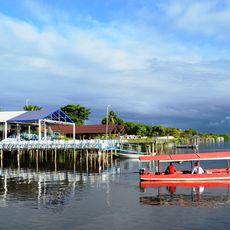
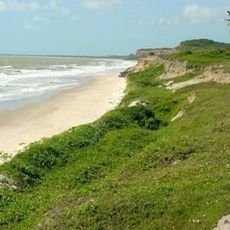
The church stands on a plateau under a kilometre from the Soé river, near the Costinha district. Reach it by boat from Cabedelo or by the PB-008, PB-025 and PB-019 state roads through Lucena. The terrain around the plateau is uneven, so allow time for the approach on foot.
The historian Percival Tirapeli identifies the church as holding the largest altar built in limestone in Brazil. The facade also carries a skull carved in limestone among its motifs, alongside crowns, sceptres and the arms of the Portuguese colonial empire.
The community of curious travelers
AroundUs brings together thousands of curated places, local tips, and hidden gems, enriched daily by 92,820 contributors worldwide.